2014-10-27

Snowdonia Marathon - earning XP

I knew Snowdonia was going to be tough, but I didn't think it'd be that bad.

I trained at running up and down hills, because I live a relatively flat part of the world. The nearest steep hill I've got is a couple of miles long, with a maximum gradient of 20% - whereas the three Snowdonia ascents get up to nearly 30%. So I trained with ankle weights on.

I'd heard that for marathons, it's better to run three days of 10 mile runs than to do marathon length runs as training - so I did that.

I'd been told that the Snowdonia marathon was mainly road, with a little bit of track and path - so I mainly trained for road, with a little off road.

On the day, I slogged up the first ascent and down again without much trouble. The long down hill and flat section was steady, then the second ascent went reasonably well.

Some loon who thinks he can run
More loons
It was about 20 miles that I started to really tire out. My feet ached from pounding down the hills as well as the long distance. I had to stop for a moment and massage my legs and rest my feet - just for a moment. I spent the rest of the flat section shuffling slower and slower.

The last mountain was where I picked up the pace again - going up hill puts less pressure on your feet. I'd trained and trained at the uphill running. From mile 23 or so, I climbed about 200 metres in single run, then as the ground was just levelling out, I had to slow to walk. The road turned into a rocky path, all uneven footing and sharp edges. My knees and all the fine-control muscles hurt like hell, and my feet ached.

When I'd made it to mile 23, I'd been on track for a personal best marathon. If I'd had that bit more stamina to manage the flats and the hard terrain at the top, I'd have managed it.
As it was, I still made a respectable time for my first Snowdonia - just under 5 hours. I'd been hoping for under 5.5 hours. I'd have been happy with under 6 hours.

My brother, the rugby-playing runner, by contrast - he passed me at the top of the last climb, and bounded down the rocky descent.

So - the lessons:

  1. Train the long distances till they're routine.
    I want to run marathons fortnightly, so I'm prepared for those last six miles.
  2. End on bigger hills, including the descents.
    Going downhill when you're tired is hard. I need to condition myself to run down hills after a long tiring run.
  3. More off-road.
    The surprisingly tough surface at the end ofthe run threw me. I do a fair bit of off road running, but I should have done more long distance off-road for this one.
The subtext here, of course, is that I'll be back - Snowdonia is an amazing marathon.

They print your name on your number sheet, so everyone calls it out as you go past - "Come on, Alastair! You can do it, Alastair!" That's still with me - but my knees don't hurt anymore.


2014-09-29

A Fistful of Aces - playing card RPG

Playing cards have been used for RPG randomisation before. I've read none of those other systems - so any toe-treading is entirely coincidental - but the idea seemed sort of cool, so I thought I'd make my own card-based RPG.
After a bit of toying around, it seems that such a system lends itself very well to relatively rules-light but flavourful gaming. Jolly good - I mean: Yee-haw! Saddle up!

A Fistful of Aces

This is a story-telling role-playing game, played with an ordinary deck of playing card. Leave the Jokers in. Shuffle them well.


The Lowdown

Here's how the game is played. There'll be more nitty gritty below - this is just the jist.

One player is the Dealer, who sets the scene. Other players portray characters in the story.
We're telling a story together. The Dealer sets the scene, and the players tell the story of their characters. The Dealer may seem like he's the narrator most of the time, but each player gets to narrate their character's successes and failures.
When the player tells a tale of an outrageous success based on just a little win of the cards, she's raising the stakes - we all now know just how far that player will go, and we can go there too.
Careful how you boast.

The Dealer deals out 7 cards per player, including a hand for himself, which he sets aside until he needs it. The remaining cards are placed on the table face down - this is the draw deck.

When the Dealer describes a task that the players want to resolve - shooting down a bandit, jumping onto a train, bluffing the local deputy, or whatever - the player plays a card from their hand.

If the task is to beat an inanimate object - like jumping onto a train - then the Dealer declares the value of the card that will beat the task.
If the task that the Dealer has described is against another person - a non-player-character like the deputy - then the Dealer usually draws a card from the deck. If the player's card beats the Dealer's, then the player has succeeded. But if the Dealer's card beats the player's, then the Dealer wins, and the task has failed.
On the other hand, if the Dealer's character is a serious adversary - the sherrif, or the bandit chief, or some other key person - then he takes up the hand of cards he dealt himself, and chooses which cards to play.

If a player finds they have a good hand of five cards among their seven - a poker hand - she can play her hand to try to win the scene outright.
The Dealer plays the best hand he's got. The other players may choose to play their hands - for example, if the first player is beaten by the Dealer.
If the player wins, she gets to narrate the outcome of the scene. If the Dealer wins, he tells the tragic tale of the loser.

Each time a player plays a card, they pick up one to replace it. When the Dealer plays a card from his hand, he picks up to replace it.
When poker hands are played, each player and the Dealer picks up to replace the played cards.

Characters

The four suits represent four broad aspects of a person's character: Black suits are physical, Red are mental.

  • Spades represent strength, power, toughness and all aspects of prowess
  • Clubs are speed, maniual dexterity, agility and all aspects of skill
  • Hearts are persuasion, charisma, appeal and all aspects of social
  • Diamonds are cleverness, knowledge, learning and all aspects of smarts

Rank the suits in order of your character's aptitude. You get to have three specialities for your top ranked suit, two for the next, one for the next, and no speciality for the lowest ranked.

Specialities can be anything you like: brawling, shooting, science, doctoring, intimidation.

Tasks

If you play the right suit for the task, you get to add +2 to the face value of the card.
If you play the right colour for the task (but not the right suit) you get to add +1 to the face value.
If a task involves one of your specialites, you get to add +2 to the face value of the card you're playing.
All the picture cards - Jack (J), Queen (Q), King (K) - are worth 10: but in a tie, K beats Q which beats J. Aces are 11.
Jokers are wild - they can be played for the value of any other card.

The targets for an uncontested task - like jumping a gap, or climbing a wall - are ranked Easy to Amazing
  • Easy: 5
  • Average: 7
  • Difficult: 9
  • Very difficult: 10
  • Amazing: 12
Once cards are played, they are left in the discard pile. When the draw deck is finished, the discard pile is shuffled and becomes the draw deck.

Assisting
If a player wants to assist another palyer, they offer their hand for the first player a to draw two cards. If the assisting player has a specialism that is applicable to the task, the first player may draw three cards.
The first player then selects one of the cards to keep (and play if they wish) and returns the other to the assisting player. The assisting player then draws enough cards to make their hand back up to seven cards.

Poker Hands

In order of value, from the least to the best, poker hands are as follows:
  • 1 pair: two cards of the same face value
  • 2 pairs
  • 3 of kind: three cards of the same face value
  • Straight: five cards in sequence order
  • Flush: five cards of the same suit
  • Full house: a pair and three of a kind
  • Four of a kind: four cards of the same face value
  • Straight flush: five cards of the same suit in sequence order
  • Royal flush: 10, J, Q, K, A of the same suit

If two hands are of the same type (two hands of three of kind, for instance), then the higher value cards win. If a task involves one of your specialites, you get to add +2 to the face values of the cards you're playing.

If all the significant cards of that hand are the right suit, then your hand trumps the next better type of hand. If all your significant cards are the right colour, then your hand trumps any hand of the same type.
So for a Social task (Hearts), a flush of Hearts beats four of a kind (which will be a mixed suit hand), and a straight of all red cards beats a flush of black cards.

When you play a poker hand, you must put up a stake of at least 1 chip, which the Dealer matches from the Bank.

Gambling with your Life

Player characters start with 5 chips. Players can give their chips to each other if they're feeling generous.

When you play a poker hand, you must bet at least 1 chip. The Dealer matches your bet from the Bank. You can up your stake by adding another chip, until you run out. You can fold before you run out, but you lose the stake you've bet so far.
Each adversary the Dealer controls will have a limited of a number of chips they can bet before any further increase forces them to fold - to back down and lose their stake.
If the Dealer runs out before you, they must fold (back down) or play their hand. If the Dealer folds, you gain back your stake plus one chip. If the Dealer plays their hand, the winner takes all the pot. You choose whether you want the Dealer to fold or play.

You can also gamble chips to avoid failing a task - you put a chip in the pot before you attempt the task, and if you fail, then instead of your character failing the task, the chip is lost and your character completes the task.

Chips are also lost when failing a task causes injury, such as in a fight.

You gain a chip when you defeat an adversary, and you gain all the chips in the pot when you win at a poker hand. You don't gain chips for defeating extras, only for significant adversaries.

When you've run out of chips, you cannot play any poker hands. Any task failure that would cause you to lose a chip ends with you knocked out, in jail, or dead.
You and the Dealer can thrash out the details - remember we said to be careful how you boast?

High Stakes Games

As you win chips, you can take on tougher challenges, because you can bet higher and force the Dealer to fold more often.

You can also spend chip to gain new specialities. It costs 1 chip for every speciality you already have in that suit - but it always costs at least 1.

Dealer's rules

Who goes first?
Usually, contested tasks are simultaneous. Even in a duel, the quick draw and shot of the duelists is resolved by the opposed plays, not by taking turns.
But if you need to decide who goes first, it's a Skill task. Have the players play a card from their hand, and turn over the top of the draw deck for their opponent (or play from their hand). If a player chooses not to play from their hand for this Skill task, they go last (they might not want to spoil a powerful hand).

More than one adversary
When there is more than one named adversary against the players, then they may assist each other, just like the players.
Pick one adversary to take the lead. For each other adversary assisting her, draw two more cards, and pick one to put in her hand.


Central Casting

Extras in a scene are usually handled without much need for rules. If you need to, pick a suit to rank high, and a speciality to go with it. The extra gets +2 to tasks of that suit, and another +2 to that speciality, just like a player character.
Extras don't have chips to bet. When a player plays a poker hand to defeat multiple extras at once, the number of extras in the scene dictates the number of "virtual chips" the Dealer can stake against the palyer. For these virtual chips, use a distinctly different token. 

Named adversaries are made just like a player character. The Dealer sets their difficulty by giving them a number of chips from 1 to 8 (or even higher for High Stakes Games).

Example extras
  • Brawler: Spades high - fistfighter
  • Saloon drunk: Hearts high - carousing
  • Bartender: Hearts high - rumourmill
  • Deputy: Clubs high - arresting
  • Bandit: Spades high - robbery
  • Cowpoke: Clubs high - ranching
  • And many more...

Example adversaries and named allies
  • Doctor: 
    • Diamonds high - doctoring, medicines, one other book learning; 
    • Hearts - polite society, gossip; 
    • Clubs - pick one
  • Marshall: 
    • Clubs high - shooting, horse skills, tracking;
    • Hearts - streetwise, gossip;
    • Diamonds - law
  • Gang boss:
    • Spades high - brawling, toughness, maiming;
    • Hearts - streetwise, gossip 
    • Clubs - shooting

2014-09-27

Game Settings I Have Pondered

I think about melieu to run games in now and then, and I don't necessarily get to do anything with them - so I thought it might help (me, or anyone peeking at this who wants to run their own) to lay out a few of them on the blog.

A Fascist Potterverse

A mash-up of Harry Potter, Neverwhere, Misfits and others.

Secretly, all manner of supernaturals lurk in our world. Wizards are top of the heap, using their magic to enforce domination and keep the ordinary folk in line - the most benign of the wizarding community believe the mundanes must be magically lobotomised, controlled and kept quiet. The Magocracy is a priviledged elite, using the lesser supernaturals and mundanes as pawns to maintain their luxurious lives.
The player characters are low-lifes of one sort or another - petty criminals who meet through community service, perhaps - who discover they have supernatural abilities. They discover the lies of the Magocracy and decide where they stand.

Cowboys - in space!

Tales From the Star Wars Cantina / Firefly-esque Planet-of-the-week, western-style antics with Galactica-style FTL allowing for a bigger scope than a few planets and moons - all grungy tech and frontier attitude.
A fairly casual game of episodes, with an emerging overall plot drawn from players' goals.

War of Gods

The world shakes under the angry feet of the gods themselves!


These "gods" reflect the beliefs of the people - and reinforce those beliefs with superpower actions. They are in fact powerful extra-planar entities - demons, devils, archons, etc. - and unique monsters.
Their temples function as gateways to the outer plane where the god of the temple resides. Generally, each tribe or clan has its own god, but some allied clans and tribes have co-operating gods.
Tribes and clans have political priesthood and gods (generally settled), or shaman (more often in nomadic people).
Magic is a power of the gods - mortal and player character magic will be very limited.

Demikind races live in walled/fenced or hidden settlements, warring against the dangerous monsters of the wilds. There are few "civilisations" - just cities in key points, supported by agriculture, thriving due to geographic isolation.
A few nomadic peoples outside the civilisations are living in barbaric conditions, constantly struggling against monsters.


As the people of the settings have expanded and populations have grown, their lands have come into contact with each other - and their beliefs have clashed! The gods with brook no rivals! Holy war with the added terror of nuclear-war-level deities.

The player characters will be a disparate band of adventurers / outcasts who see the coming anihilation, and can try to stop it, or aid one side or another.

2014-09-23

Rules and the Game

Why do we use rules to play games? What are rules?

I'm an inquisitive engineer, with a background in sciences, and a love of games. I've been finding that when I talk to people about game rules, there's quite a different reaction even among those who love to play the same games as me. What's that all about?

The Game / Narrative / Simulation theory suggests players can be split into three camps - those who play the game as a challenge, those who play to create stories, and those who play to simulate an alternate reality - and that real gamers can be placed on a three axis graph that reflect their love of each.

[dons pretentious beret and roll-neck]
But like Pirsig in Zen and the Art of Motorcycle Maintenance, I've found there seems to be a split among gamers between what he called Classical thinking (dissect in-game situations to create simulation rules) and Romantic thinking (just do whatever feels right for the enjoyment of the game).

And like Pirsig, I think there's a way to create harmony between these two camps.
[stashes pretentious garb - for now]

I'm going to start with two questions, and see where those lead me: What are rules (in RPGs)? and What are rules for (in RPGs)?

What are rules?

In the context of RPGs, what do we mean by rules? Is everything in the AD&D Players' Handbook (for example) a rule? I think possibly not.

RPG books tend to present a few different types of material, so let's look at each in turn.

Character rules
Character abilities - how strong and smart the character is, skills and so on: these are obviously rules. Without these, the character you play isn't defined.

Mechanics of a game - what dice to roll, numbers to add, targets to beat, etc - especially where these are the mechanics for conflict resolution (can you hit the monster with your sword? can you climb over the wall and escape? can you argue your way past the palace guard?): clearly these are rules.

Species (human, vampire, elf, vulcan, etc) - the playable species (specieses?) of the game also forms part of the rules. Some games may present rules for creating new species, so that playable species are all of a similar power.
Similarly monsters and other adversaries - examples and / or rules for creation form part of the rules.

Are spells, equipment and gadgets rules? Probably, yes - they establish the power of players' characters and their tools. Again, like species, maybe the underlying systems should be put forward along with the spells, equipment etc, to explicitly show the system from which the examples are derived.

Tools, species, and adversaries are benchmarks for the power of the games elements. While most games will give examples, some will also provide rules for creation - what bonuses are appropriate for tools to provide, what are appropriate damages for weapons to deal, how tough adversaries should be, and so on.

Tables of options - like settlement population, random encounters, treasure and the like - are these rules? Maybe not...
Is it a rule of the game that settlements have certain population sizes and demographics, or is this a guide on setting, rather than a game play rule? Would you bother to ask the question about a list of random character or pub names?

Although lots of elements may appear in the rule book to help with play, not all of them are really rules - there's a lot of guidance and flavour in RPG books.

What are rules for?

As well as having my own opinions, I asked around on some RPG forums to get a sense of what other people think. It's always worth it - some people confirmed what I was thinking, but there were some gems of insight I'd never have thought of for myself.

So, in no special order, here's what rules do for us:

Fair play - rules make the game fair.

They create a system for fair interaction, including by randomisation (by Jenga tower, dice, cards or whatever) - rather than the players directly deciding the outcome of their characters' actions (GM included), there is a random element. This avoids bias, or the suspicion of bias.

Fair play also includes fair and equal access to an enjoyable experience. The player's abilities should not hold them back from having fun playing the role they want - the game rules should allow everyone to play equally.


A superspy yesterday
Just as the game rules allow weak students and office workers to play strapping tough warriors and action heroes, I think that the same attitude needs to be applied to social skills. So I may want to play a suave and seductive superspy, but I have the flirting skills of a celebate monk - and the game rules can allow me to do just that. As a player, I should be free to spout cheesy flirting and pick up lines, but my inept skill with them shouldn't override the character's skill.


Gaming the rules - we can play with the mechanics to achive our goals.

The combat rules of the d20 systems have various manoeuvres that can knock down or reposition your opponent, steal or destroy their equipment, and so on. Using these rules imaginatively can be very satisfying.
Rules must serve the style of the game, and enable players (see Fair play, above). Rules should focus attention on the important bits of the game (arguably, d20 games aim to make combat a focus of game play) - they certainly shouldn't get in the way.

Challenges - without rules, what limits you?

If we don't have any rules, can't we just declare the actions of our characters? What stops us being invincible? Can't we claim to have special armour and ignore the attacks of enemies? Can't we call on powers at will and without precedent?

Where do I stand?

Yes, I like rules - but if you come to my game, will you find me invoking the rule book? No, not really.
I prefer to run games by eyeballing the situation - using freeform instincts, within a rules set that I'm largely familiar with.

In my day job, I have a bunch of several-hundred-page safety standards that I have to refer to to test products for safety - but each of these boils down to a set of prescribed tests, built around a small set of safety principles.
Now, I know those principles very well. When I'm testing, I only need to look up the specifics of the test standard when the result is hard to call - most of the time, it's obvious whether the product meets the principles or not.

Of course, knowing the core rule concepts is vital.
Years ago, a gang of us used to do Live Action Role-Playing at the weekends, and we'd sometimes co-opt our non-RPing mates to come and make up the numbers too. One of these non-RPing guys - Jon - clouted a player character - Mike - across the legs with his sponge axe during a fight. Mike asked how much damage the axe dealt - and Jon said "Dunno - ten?"
Now 10 points of damage was a vast amount. Mike's character had 2 hit points on his legs - so Jon's hit had supposedly chopped them off completely. Basically, if the game's Ref had briefed Jon properly, he'd have known not to say "10" - Jon needed to know the ball-park area in which to make an educated guess.

So the rules are important, if only to act as a frame on which to improvise sensibly.
Like jazz [puts on the beret and roll-neck again] - an incompetent random honking on a bunch of trumpets sounds terrible, but a skilled player with an understanding of the rules can break those rules in an entertaining and exciting way.

The rules I've been palying around with inventing recently have been largely about the game setting. You see, I feel like I need to understand what is normal - long before I go deviating from it.
In storytelling, normality must be established / understood before the fantastic events take place - this creates base from which to operate, and avoids players' awkward questions.

I personally really don't like those questions - you know: "Why is XYZ not like ABC, as is normal?"

"Why is there such a long distance between towns? In Medieval Europe, there was generally less than a day's walk between villages - so why is it different here?"

"How can the Dark Lord muster an army of a million, when that'd require a support staff of double that amount? There surely aren't that many people on the continent."

"Why would anyone build a castle here? That makes no sense."

I hate being caught out like that - so I like to explore what is normal first, so I can make sure my games reflect something like reality - or so that when I chose to step away from the normal, I know that I've done so!

Then I can say: "Yes, that is odd, isn't it?"

Playing with rules

Last word from me on this topic - and the pretentiousness really piles up with this bit, I'm afraid.

Listening to Radio 4's The Infinite Monkey Cage, when presenters Brian Cox and Robin Ince were talking with maths author Alex Bellos and number theorist Vicky Neale, the love of discovering new mathematics was brought up - and it rang a big lovely bell with me. Let me paraphrase...

Making up rules is to play with quantifying the world in tables.
I'm finding the patterns, which I then use to provide a simulation.
Rules aren't made, they're waiting to be discovered and expressed.

[adjusts beret, strokes goatee]

2014-09-21

Table NSG1.0 & 1.1 - the Nemesis Speech Generator

Like many GMs, I like to make up tables for silly things. I found one of them today - my Nemesis Speech Generator.

This is for use when the Big Bad Evil Guy is monologuing.

NSG 1.0

NSG1.1

2014-06-14

Gods - what are they for?

In the game-settings we play with - worlds, universes, multiverses - there is almost always some reference to gods, religion, mystic forces and the like: often these are the driving forces behind the story.

Gods and religion serve many roles in games and stories. It's important that in gaming - collaborative story-telling - we all know what we can expect from the gods and their followers.

Although I'm a non-religious person, I'm quite happy to entertain myself and fellow players with religious themes, mystic visions and other tropes - but I think that the delicate topic of religion and gods in fiction (and gaming in particular) could do with some analysis.

Otherwise, how will we all end up on the same hymn sheet?

In-game reality

What is the truth of the gods? Are they proven to be real, or is their presence ambiguous? If Zeus regularly abducts lovers and begets heroes, who would doubt his existence?

Let's split the camps into two: proven and unproven. I'll deal with unproven first, as it covers the more familiar ground (for me, at least).

Unproven

The gods - if there are any - are unproven. Their existence cannot be unquestionably and concretely demonstrated.

This situation is, of course, most like our every day real world. No matter how strong the faith of any individual or group of people, no deities' existence is empirically proven. 

  • Traditions & superstition
  • The intelligensia don't consider the gods to literally be true, but their traditions and superstitions are powerful tools. No-one believes that the priest in the god-mask is actually the god incarnate, but tradition dictates that all treat him as such.
    • Manipulative priesthood: The gods are known to be false, but the priests lie. The population is deceived.
    • Symbolic priesthood: The gods are metaphors for right behaviour. The worship of the gods does not rely on their stories being actually historically true, but more that the parable of their acts teaches the population how to behave.
 
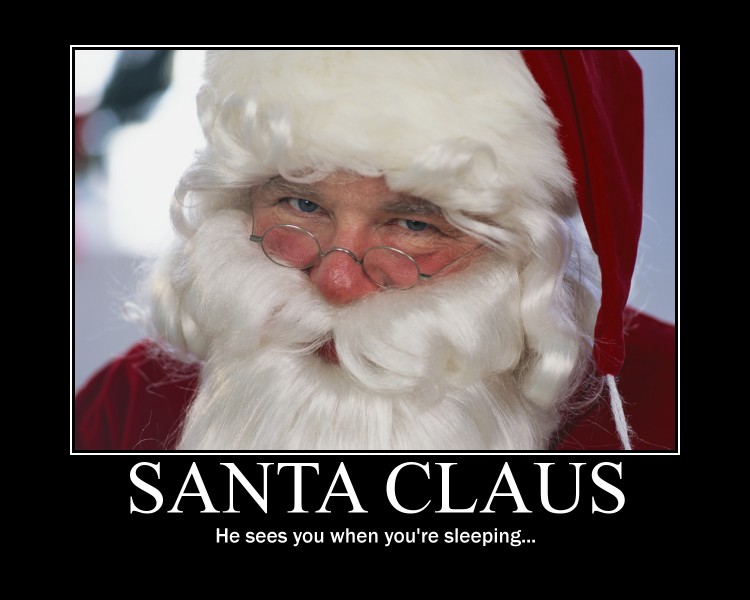
(As an aside, it ocurred to me that - SPOILERS AHEAD, KIDS! - Father Christmas is a prime example of benign manipulation. Most of the population is well aware that they are the ones buying presents for the children, but we all go along with the manipulation that there is a magical present-giving entity, who rewards the good and punishes the bad. Consider a church that works like that... Interesting, yes?)

  • Absent & subtle
  • Belief in the gods is widespread and accepted at all levels. The intelligensia have complex and often philosophical ideas about the gods, while the layfolk have straightforward faith.
    • Faith through teaching:  The priests have faith, and they preach this and enforce the will of their god or gods. No-one can show that the gods are real, but it serves the priesthood to indoctrinate people into belief. This may be benign, as with Santa, or it may be purely to perpetuate the power of the church.
    • Faith through observance: The reality of the gods is socially given, but not readily apparent. No-one questions the gods - their existence is self-evident from casual observation.
Faith through teaching is what is required when people question the power of the church, whereas faith through observance is the state enjoyed when the reported acts of the gods are not in conflict with observable reality - either because we can't observe as closely as required to notice the discrepencies, or because those acts are in accord with reality.

Proven

The gods are a fact of life, with verifiable evidence to back them up.

This situation is not like our real world. The gods are known to act in the mortal realm, to intervene on behalf of pious worshippers. Even the most cynical would respect the invocation of the gods - there will be no atheists here.

  • The "myths" are all true
  • The fantastic stories about the gods' exploits - from their creation of the multiverse, to their appearance, to their powers - are all literally true. Still the gods may have powers and interests beyond mortal ken, but as a minimum, we can trust what their scripture says to be 100% fact.
    • Gods are all-powerful, unlimited beings. Omniscient and omnipotent beings, the gods are literally able to achieve anything they desire.
    • Gods are beyond mortal power, but limited. The gods are constrained by limits of some sort - perhaps according to their station in a heirarchy, or their patron sphere

  • Gods are powerful outsiders 
  • The gods are extra dimensional beings of some sort. They are worshipped, but they may not even claim to be gods - or if they do, it is in order to exploit those who worship them. Scripture about these gods may be an imperfect record of the actual events.
    • Hero-gods and saints. Hercules, the Caesars and so on were elevated to godhood - larger than life heroes. Saints take their place in the afterlife as intercessionary being on mortals' behalf with the ruling deitiy.
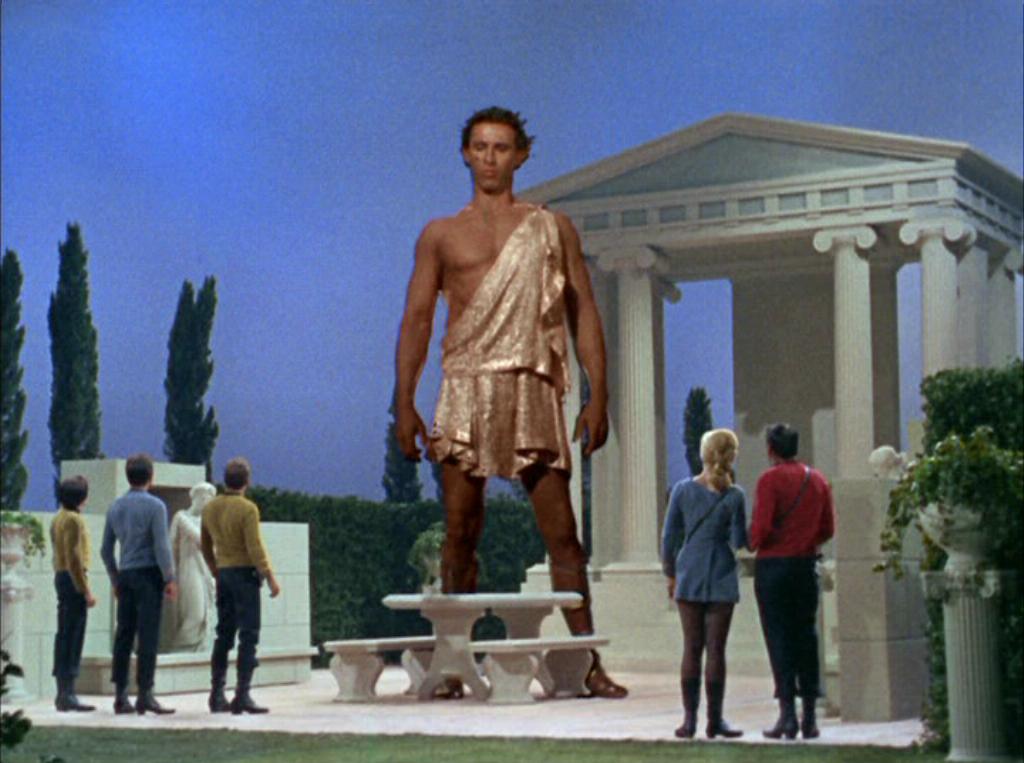
    • Meddlers in mortal affairs. Ultrapowerful being seeking to interfere with the lives and development of lesser entities - Star Trek's Apollo, Q, (and others), or Star Gate's Ra.
    • Alien, unknowable entities. Incomprehensible beings whose motives are unclear. They act without explanation - Lovecraft's Cthulhu et al, 2001's monolith builders.


What is truth?

What constitutes proof of the gods in the game? You need to consider what absolute evidence is available, and what is questionable - so that you can decide how people outside the faithful circles react to that evidence.

Do you have priests who gain their magic from divine energy (and how is that demonstrably different from wizardly magic)?
Would it matter if Apollo turned out to be some errant super-being, rather than a "real" god? What is the difference?
I'll consider these questions along with Function, below.

Function

So - what is the point of gods in your setting? What story purpose do they serve? How important are religion and / or deities to your setting?

I can break this down into three functions:
  • Background flavour
  • Political groups
  • Active characters

Background flavour

The gods and their religions are simply a background flavour - something to increase verisimilitude. Throughout real human history there have been cults and churches, and it would seem unreasonable for these to be absent from a fantasy setting.

These gods and religions are not especially important, except as role-playing and story-telling props.

Political groups

Massive congregations, infalible heirarchies and divine power can make a church an absolute ruler of its culture, even above secular leaders. Historically this has been the case for real world faiths for certain periods.
On the other hand, a religion can rule along side the secular throne. Wise advisers to the emperor hold enormous political influence.
In polytheistic socieities, the various deities' priests might jocky for supremacy with the mortal rulers - who may in turn elevate the status of the deity.

These gods and religions are important because they are the motivators of political groups - orthodox or revolutionary - but it is the people who act, rather than the gods themselves.

Active characters

The gods are present in the real world in some way, like the Greek Olympian gods, living on a holy mountain top, or like the Norse gods, living in some otherworld. In either case, they are real entities who will act on the game setting in some way.

Perhaps the gods manifest themselves through influencings nature - through storms, lightning, earthquakes, sickness and other events. Rather than manifesting in some physical form, the gods manipulate the world to do their will.
This sort of god is subtle and doesn't seem to directly influence the world, moving in mysterious ways. You can use this in games to set up divine coincidences to move the story - random fate becomes divine favour.

Maybe the gods do take on physical form, as perfect immortals, or divine animals - and perhaps these forms influence their bahviours, so that they are as petty and capricious as mortal culture. Just look at the Greek gods - stealing sexy women, starting wars out of jealousy, fighting amongst themselves, cursing mortals on a whim.

Such interfering gods can be the driving force behind adventures.

Divine magic

A common trope in fantasy games is that worship of gods gains the followers magical power.

If priests gain magic from the gods, is this the only form of magic? Are there also wizards? Is there a functional difference between wizardly and priestly magic? Or is the difference only political?

You might have priestly magic concentrate on life and death, fear and morale, and so on - whereas wizardly magic might be concerned with manipulating the elements.

Or if only politics separates divine from arcane, perhaps there would be jealousy between the two styles, so that wizards are outlawed, and the church investigates any magical practice by the layity.

The presence of divine magic in a fantasy game allows for magical differences between followers of different religions - followers of the Death god gain different sapells to the followers of the Creator god, and so on.

False gods

What is the functional difference between an ultrapowerful entity claiming to be a god, and a "true" god?
Leaving aside real-world current religious answers, let's think about why Zeus (who is a god, acording to the Greek mythos) is more qualified as a god than say, Manwe (who is not a god, according to JRR Tolkien's legendarium).
Neither are all-powerful. Neither is the creator of the world. Neither is infallible.

Functionally, then, there is no difference between "true" and "false" gods, except the political implications of the claims.

Enlightenment

There are lots of ways gods can appear in fantasy fiction. Depending on the preferences of your player group, you can use any god or gods you like - but it's usually a good idea to think about whether you'll offend anyone before you use real-world religions, or churches with similar traits to real-world organisations. If in doubt, ask.

Me, I like to have multiple religions in multiple cultures in my game settings, and I tend to have deities fit into the "Powerful outsiders" and "Unproven" categories - I'm interested in the political interaction of faiths.

Whatever sort of deities you want to have in your game, understanding their role and being consistent in their portrayal is key to making the world seem real.

Circuit ultra-running

There's an interesting article on the BBC News site about the circuit ultra-run this weekend in Gloucester.

Circuit ultra-running is daunting - rather than running a long course, it's just laps of a standard 400m track.

The changing scenery and sense of achievement I get from running long distances? Nope, none of that for circuit ultra-runners, just endless laps.
There's much bigger mental challenge in circuits. When I get tired 10 miles from home, I know that the only way to finish is to keep going.
On a circuit, rest is never more than 100m away. The grit to keep going is far more abstract, far more about personal discipline than about necessity.