Showing posts with label Rules. Show all posts

2017-10-02

Keeping It Simple - Training & skills

In my earlier post about setting target numbers in RPGs, I said that the method I'd come up with might break down when skills are assumed to include some specialist training:


Fixed difficulties can make it hard to model tasks that require advanced training.
For example, if someone wants to open a lock, the GM might think "This is just an ordinary door in a house - the lock is nothing special. I'll make it an average task, 'cause the lock is just an average object." However, this would mean that an untrained person with a decent Dexterity could open the lock with a few tries - not very realistic. 
D&D and many other d20 games deal with this by saying that some skills cannot be used untrained - if you've not invested your skill points in the skill, you just can't do it.
Me, I don't like that so much, as it adds another level of look-up: which skills are prohibited to untrained characters? It's not always intuitive.
... and I promised I'd provide my solution. Well, it's a been a little while (ahem), but here it is.

Do we think this task requires special knowledge?

Usually, this is a yes / no question, and the answer is clear. 

For example, climbing is an innate skill of  human (and other humanoids, depending on your game setting) - yes, skill makes us better at it, but anyone with sufficient mobility can climb. 
Similarly jumping, running, and other raw motor skills. 
Also fighting - we can all fight to some extent, even if that just means flailing the limbs wildly and hoping. 

On the other hand, can you try electronic engineering without knowledge? Not so much.

When there is doubt about whether a skill needs knowledge and training, make a decision for the particular skill check, and move on. After the game, think the decision over - was it right? Don't get stuck on little things during the game itself.

Not knowing the topic imposes a penalty

Once we've decided that special knowledge is required for a given skill check, then we think about whether you know that stuff.


That's easy - make a Knowledge check to know the topic. And because we've already set target numbers for skill checks, we only have to decide if the Knowledge is Easy, Average, Hard, Heroic, or Epic.

For complex systems and tasks (like retro-fitting a turbo to an engine, or deciphering a dead language), we can require multiple Knowledge checks, or higher success. 
For example,  "What are all these symbols?" is an Average task, "Knowing these symbols, what happens when they're arranged like this?" is an Average task, or a Hard task if it's your first roll (so you skip a stage of the process); and it's a Heroic task to establish that "I recognise this arrangement of symbols on sight."

Outside knowledge can be influential, too - in a modern game ,there's loads of information available almost all the time. Does the PC have a manual or some sort of instructions for the task, for example? Then we can allow this to take the place of a Knowledge check success, but probably at a slower pace.

But what does success mean? We're buying off penalties here. If you know little about mechanics, it'll be hard to fix an engine, but it's not impossible - a heroically intelligent PC might be able to figure it out with hard work and perseverance. So we're not changing the DC of the task - the task is the task, it will always have the same DC. What's changing is the PC's understanding of the task.

Setting the penalty

How hampered by a lack of Knowledge will you be in this task? Again, because we've already set a bunch of standard adjustment levels using natural language, this should be easy to decide. Is it a Minor, Major, or Extreme problem? You can decide this from your own experience, or use the Difficulty level to give you a clue to what's appropriate - lack of Easy or Average Knowledge will generally be a Minor penalty, Hard would be Major, and Heroic or Epic would be Extreme.

So if the Knowledge check is failed, it may not be the end of your task attempt - you might only be faced with a Minor penalty. Or it could be Extreme. 

For extended complicated systems, you might be able to work out things as you go along examining the problem. That'll let you make new Knowledge checks after starting. So you can start trying to buy down that penalty to something more manageable - all of which will take in-game time.

That's it

Decide: does this skill check require special knowledge?
Set the Knowledge DC, or DCs for complex tasks.
Set the penalty for lack of knowledge.
Decide: do we allow new Knowledge checks as the task progresses.

2016-01-28

Keeping it Simple - Bonuses and Penalties

Specific lists restrict creativity


Lots of games seem to fall into the trap of giving you lists and lists of specific adjustments to apply to die rolls in your game.
I'm calling this a "trap", because if you specify a set of adjustments, then you are strongly suggesting and promoting the idea that only those adjustments are correct.
Yes, you may state that the GM can invent their own adjustments, but unless you put that text alongside every instance of specified adjustment, players will end up treating it like a mandatory list of unassailable law.
 
Games also have a habit of having lots of levels of adjustment, from lots of sources. The d20 OGL games have a myriad of +1s, +2s, -1s, -4s, +5s and so on. There's a lot of maths to juggle, and in the excitement of an action scene, who wants to be fiddling with mental arithmetic?*


OGL d20 games also have rules on which adjustments are allowed to "stack" - that is, what can and can't add together. Usually (but not always), the same type of bonus cannot stack - but there are lots of types of bonus (circumstance bonus, equipment bonus, morale bonus, etc., etc.), and they don't always follow the rule you might expect - so you have to go look them up.
 
D&D Next, or 5th Ed, call it what you like, has a neat way of overcoming this maths issue, with the "Advantage / Disadvantage" rule: when circumstances give you better or worse conditions, roll 2 dice, and take the best (advantage) or worst (disadvantage) result.
Unfortunately, as neat as this rue is, it applies in a list of specified case again, resulting in a perceived lack of freedom to wing it.
 

Broader guidelines promote freedom

Broader guidelines on adjustments allow freedom and creativity. If you give the players and GM a list of a few adjustments that can be made, then they can apply them how they see fit.
If the players are trying to get an advantage, they'll tell the GM how they want to do it, instead of looking up a rule that tells them how they must do it.
Instead of checking through the combat rules to see if there's a bonus for higher ground or charging or whatever, you'll feel free enough to declare that your character's swinging in the rigging and jumping on her enemy like a proper swashbuckling hero!
 

My "fix"

Let's have just three levels of adjustment: Minor, Major and Extreme. This lets us have bonuses or penalties of just three types, positive or negative. Giving them simple descriptive names lets you make value judgements about them, too.
  • Minor = 2, Major = 4, Extreme = 8
Can we stack the adjustments?
Yes - but to avoid run-away adjustments, here's the only bit of complexity I'm going to add: you need 2 of the lower adjustment to add up to make one of the higher adjustment.
That is, 2 Minor = Major, and 2 Major = Extreme.
In this way, adding a Minor adjustment has no effect on a Major adjustment (unless you add 2 Minors, which add together to make a Major).
And to keep our adjustments from getting too high, I'll say that Extreme is as high as they ever go. If you've ever lucky enough to have 2 Extreme bonuses, then the GM should just rule that you succeed, rather than making you roll.
 

Will it work?

For games with a gritty or heroic scale of characters (Conan, Buck Rogers, Star Wars, Pulp Fiction and the like), this sort of thing will work fine. If you need more extreme adjustments (such as in a superhero game, modelling both Superman and Lois Lane), then you'll need to allow them - maybe add an Impossible adjustment level beyond Extreme?
I'll see how we get on with this ruling, and post my findings!
 

* Yes, some people like maths. Not everyone does.


2016-01-09

Keeping It Simple - DCs

Lots of games, especially D&D (all editions - some worst than others), suffer from target numbers or difficulty classes ("DC"s) that are opaque, presented once as a special case, with no explanation as to where the number comes from.

On the other hand, there are plenty of games that give you a set of numbers up front as a basis to let you (the GM or the players) eye-ball the numbers and set your own DCs accordingly - R. Talsorian's Cyberpunk 2020, for one (I think it was the first game I played that used the idea).

How do we set these difficulty-based target numbers?
Decide what difficulty types you want - they should be clear and memorable, and not too many. There should be no doubt which is harder and which is easier.
I'm going with:

  • Easy (little chance of failure), 
  • Average (trained people usually succeed, but may fail), 
  • Hard (trained people need a few attempts to succeed), 
  • Heroic (little chance of success), and ...
  • Epic (even elite trained people usually fail).

Now we need to look at the numbers we should assign to these.
"Easy" should be at least a 50% chance of success even to untrained and untalented characters - so in the d20 system, that's a 10 (you can beat a 10 on an unmodified 1d20 roll 50% of the time).
"Average" should be about a 50% chance for someone with innate talent, or training. In d20 games, a starting character can have a maximum skill bonus of +4, plus their ability score bonus (again, a maximum of +4, but those sort of scores are relatively rare).  So we can set the Average task number at 15, because you need to roll an 11 if you have a bonus of +4, which is what we expect an unexceptional starting character to have.
"Hard" should require talent and skill, and maybe a little more experience. The starting character's maximum ability + skill bonus of +8 can be boosted by Feats like Skill Focus, or by proper tools - so we can set this target number as 20.
However, so far, each of these difficulties can all be beaten by someone with no training, if they're lucky - i.e., they get a high roll. Even an average unskilled person can achieve a hard task sometimes - it'll just take more tries.

"Heroic" and "Epic" tasks are out of the reach of the untalented and untrained.
Let's set "Heroic" at 25 - to beat this, you'll need to roll high, and have a big bonus. That maximum starting character bonus of +8 we looked at a moment ago will need to be boosted with experience or other bonuses to get to the point where Heroic tasks are routine. To have a 50% chance of beating a 25, you'll need a +15 bonus - requiring Feats, experience levels or special tools to reach.
"Epic" needs to be harder, but not out of reach of higher level characters. Let's set it at 30 - that way, Epic tasks won't become routine until you've acquired a +20 bonus.

I've picked increments of 5 for each of the difficulties. Nice and easy to remember, and supported by the game's mechanics: a +5 bonus is normal for a starting character's speciality, and it can be expected to increase by an average of 2 points per level.


  • Easy 10
  • Average 15
  • Hard 20
  • Heroic 25
  • Epic 30


With these numbers set, instead of having to look up the skill, you just have to agree the class of difficulty.

Problems

Of course, it isn't perfect - it needs some tweaks to make it work universally. I'll look at solutions to these in future posts, but first, I'll state what the problems are.

Fixed difficulties can make it hard to model tasks that require advanced training.
For example, if someone wants to open a lock, the GM might think "This is just an ordinary door in a house - the lock is nothing special. I'll make it an average task, 'cause the lock is just an average object." However, this would mean that an untrained person with a decent Dexterity could open the lock with a few tries - not very realistic.
D&D and many other d20 games deal with this by saying that some skills cannot be used untrained - if you've not invested your skill points in the skill, you just can't do it. Me, I don't like that so much, as it adds another level of look-up: which skills are prohibited to untrained characters? It's not always intuitive.

Fixed difficulties don't account for circumstances.
If you're trying to break that lock by torchlight, with a kitchen knife and a bent nail, while the rest of your team are fighting a rear-guard action at your back, it's harder than if your were doing it on your table at home under a bright lamp.
This is simple enough to fix - we can make a system of bonuses and penalties to apply. But again, we need to keep it simple!

2016-01-01

Keep It Simple, Stupid!

I like my games to be simple, so I can concentrate on the play. I don't like having tables and table of things to look up.
I like games that have a neat core mechanic, and stick with it so that everything runs off one easy to learn rule. I don't like special exemptions.
I want to be able to run or play a game with only my notes or the character sheet in front of me, never needing to dig through the rule book.

I've been playing around with my own d20 hack system for a while now. I'd become very familiar with the Open Game Licence d20 systems through playing D&D 3.x, Pathfinder, d20 Modern, and all the rest - so a d20 hack seemed like the way to go. It's been great, very enjoyable ... but I've been weighed down by a lot of legacy issues from the original system.
OGL d20 comes close to having one core mechanic, but then it produces lots of special cases. The character class system, the feats, the skills - there are far too many special abilities, specified DCs, and so on: too much stuff to look up.

So - I've been thinking about how to get rid of look ups. Using d20 as a base to work from (partly because it's where I'm starting from with my own hack, but also because it's OGL and we can all look at it for reference), I'm going to present alternative methods and examine them to see how they stand up.
At the end of this process - or at least after several iterations of the process - I may have a plan of cuts and adjustments to make that'll turn my d20 hack into a system that really stands up by itself. Or I may just have a set of house rules to bolt onto the rules as written. Either way, I'll be happy.


2015-03-19

"Following!" - apprentices and goon squads


Re-watching Game of Thrones the other night, I was struck by how several characters wield power by commanding various others, rather than directly - in particular, one character snaps an order to their guards to seize another name character and cut his throat, just to demonstrate their power.

A goon squad in action

This got me thinking about how to introduce that sort of thing into an RPG - and whether it's a good idea at all.
There's a long history of games, from D&D onwards, adding lots of hirelings and men-at-arms to the player party, but as time has worn on, these features seem to have fallen away. Lately it seems games focus on individual player characters - you get one PC, and maybe an animal companion or hireling.

In my experience as a player and GM, there are issues with player characters having followers - the followers can overshadow the players' characters, they can add to the complexity of scenes (especially combat), they can boost one character's power far beyond the rest of the player-base...

So here's my list of pros and cons:
    PROS:
  • Physically weak but charismatic characters become more viable, even in a violent setting
  • Politically powerful or important characters would tend to be surrounded by guards
  • Apprentices, squires and batmen are trope-tastic
  • More role-playing opportunities
    CONS:
  • Many more characters means more work for the GM
  • More combatants means longer combat
  • Players who don't want henchmen might lose out
With that in mind, I'm going to look at how to harness the pros, while avoiding the cons. Let's see how it might work...

Avoiding GM overload

A follower, yesterday
My first need is to avoid overloading myself!

To that end, henchfolk are an extension of the player's prime character - the player looks after them and directs them, rather then adding to the GM's load.

(I was going to say that "I've not had much experience of this", but actually in the main group I play with, any absent player's character has been run as a sort of collective character by the players and me as Ref.)

Giving the playing of the apprentice or guards to the player of the leader character keeps the GM's load down, but we have to make sure the player doesn't abuse this extra power.
Let's give the GM the right to question any apprentice actions that the player declares - perhaps with some mechanical back up, like a loyalty check.

Avoiding longer combat & extra actions

Goon squads and apprentices defend their master as a default - taking no active action, but granting defensive bonuses.
Directing the henchfolk to do something else requires the master to use an action. The follower(s) do  that action till complete, then return to default. And to avoid shenanigans, these directions can't be contingent - like "Attack those guys there, then those guys over there."

That ought to make sure that we don't have a proliferation of  dice rolls to worry about, and that getting henchfolk to do anything complex or scene-stealing will use up the master character's actions, too.

However,  we've still got the possibility of a squad of guards all needing dice rolls to resolve their actions. That's not what we want!
Some games treat small groups of soldiers as a sort of gestalt larger creature - Star Wars Saga Edition used Squads, for example. By using these sorts of rules we can just roll once for the squad of guards.

Types of followers

I've mentioned "apprentices" and "guards" so far, but we can extend those terms to cover any squire, butler, caddy or similar individual, and any gang, mob, or small force of combatants.

Followers need not be the same character type as the leader they follow -  in the Game of Thrones example that started me out thinking about this, those guards are very definitely differently skilled (tough fighters) to their leader (a scheming court socialite).

So I'd be quite happy for a scholarly wizard character to have a gang of dumb thugs protecting him, or for a barbarian warrior to have a loyal minstrel sidekick. Some combinations can be quite amusing, especially when they stray from what's expected.

Advancing followers

D&D 3rd edition and later editions allow player characters to gather followers - and then advances those followers as a function of the leader character's advancement. As your PC levels up, so do your followers.
So rather than letting any of your fellow PCs who've elected not to have followers catch up with your increased power, that system means that you will always be better than others due to your horde of followers and cohorts.
I reject that - it's exactly what I'm trying to avoid. Under that system, taking followers grants you an immediate advantage over any player who doesn't want to do so, and at very little cost. Once one player takes followers, anyone else who wants to play a loner character is put at a disadvantage - their character concept becomes sub-optimal within the player group. That's no fun.

Improving your followers should require that you spend effort training them, equipping them and so on. In terms of game mechanics, perhaps you should have to give up some of your lead character's experience points to improve followers, and spend your hard-gotten gains on kitting them out with decent weapons.

This method means that your fellow adventurers will advance faster than you if you spend effort keeping your followers trained. You could always neglect their training instead - but it will be part of the game to decide how much investment you want to make in your band of goons.


Conclusions

With a few easy tweaks, we've created some basic rules to gain the pros of using followers, and avoid the cons.

We've given control of the follower to the lead character's player, to avoid overloading the GM.
To keep the use of followers in games balanced, we've limited the additional actions - the leader needs to use some of their turn to command the follower - and we've made the player choose how much investment in the advancement of the followers she wants to make.

In practice, using followers has worked reasonably well with my gaming groups. At least, the cons have all been avoided - to gain all the pros, it may take time for us to get used to having multiple characters to play with.

2014-09-29

A Fistful of Aces - playing card RPG

Playing cards have been used for RPG randomisation before. I've read none of those other systems - so any toe-treading is entirely coincidental - but the idea seemed sort of cool, so I thought I'd make my own card-based RPG.
After a bit of toying around, it seems that such a system lends itself very well to relatively rules-light but flavourful gaming. Jolly good - I mean: Yee-haw! Saddle up!

A Fistful of Aces

This is a story-telling role-playing game, played with an ordinary deck of playing card. Leave the Jokers in. Shuffle them well.


The Lowdown

Here's how the game is played. There'll be more nitty gritty below - this is just the jist.

One player is the Dealer, who sets the scene. Other players portray characters in the story.
We're telling a story together. The Dealer sets the scene, and the players tell the story of their characters. The Dealer may seem like he's the narrator most of the time, but each player gets to narrate their character's successes and failures.
When the player tells a tale of an outrageous success based on just a little win of the cards, she's raising the stakes - we all now know just how far that player will go, and we can go there too.
Careful how you boast.

The Dealer deals out 7 cards per player, including a hand for himself, which he sets aside until he needs it. The remaining cards are placed on the table face down - this is the draw deck.

When the Dealer describes a task that the players want to resolve - shooting down a bandit, jumping onto a train, bluffing the local deputy, or whatever - the player plays a card from their hand.

If the task is to beat an inanimate object - like jumping onto a train - then the Dealer declares the value of the card that will beat the task.
If the task that the Dealer has described is against another person - a non-player-character like the deputy - then the Dealer usually draws a card from the deck. If the player's card beats the Dealer's, then the player has succeeded. But if the Dealer's card beats the player's, then the Dealer wins, and the task has failed.
On the other hand, if the Dealer's character is a serious adversary - the sherrif, or the bandit chief, or some other key person - then he takes up the hand of cards he dealt himself, and chooses which cards to play.

If a player finds they have a good hand of five cards among their seven - a poker hand - she can play her hand to try to win the scene outright.
The Dealer plays the best hand he's got. The other players may choose to play their hands - for example, if the first player is beaten by the Dealer.
If the player wins, she gets to narrate the outcome of the scene. If the Dealer wins, he tells the tragic tale of the loser.

Each time a player plays a card, they pick up one to replace it. When the Dealer plays a card from his hand, he picks up to replace it.
When poker hands are played, each player and the Dealer picks up to replace the played cards.

Characters

The four suits represent four broad aspects of a person's character: Black suits are physical, Red are mental.

  • Spades represent strength, power, toughness and all aspects of prowess
  • Clubs are speed, maniual dexterity, agility and all aspects of skill
  • Hearts are persuasion, charisma, appeal and all aspects of social
  • Diamonds are cleverness, knowledge, learning and all aspects of smarts

Rank the suits in order of your character's aptitude. You get to have three specialities for your top ranked suit, two for the next, one for the next, and no speciality for the lowest ranked.

Specialities can be anything you like: brawling, shooting, science, doctoring, intimidation.

Tasks

If you play the right suit for the task, you get to add +2 to the face value of the card.
If you play the right colour for the task (but not the right suit) you get to add +1 to the face value.
If a task involves one of your specialites, you get to add +2 to the face value of the card you're playing.
All the picture cards - Jack (J), Queen (Q), King (K) - are worth 10: but in a tie, K beats Q which beats J. Aces are 11.
Jokers are wild - they can be played for the value of any other card.

The targets for an uncontested task - like jumping a gap, or climbing a wall - are ranked Easy to Amazing
  • Easy: 5
  • Average: 7
  • Difficult: 9
  • Very difficult: 10
  • Amazing: 12
Once cards are played, they are left in the discard pile. When the draw deck is finished, the discard pile is shuffled and becomes the draw deck.

Assisting
If a player wants to assist another palyer, they offer their hand for the first player a to draw two cards. If the assisting player has a specialism that is applicable to the task, the first player may draw three cards.
The first player then selects one of the cards to keep (and play if they wish) and returns the other to the assisting player. The assisting player then draws enough cards to make their hand back up to seven cards.

Poker Hands

In order of value, from the least to the best, poker hands are as follows:
  • 1 pair: two cards of the same face value
  • 2 pairs
  • 3 of kind: three cards of the same face value
  • Straight: five cards in sequence order
  • Flush: five cards of the same suit
  • Full house: a pair and three of a kind
  • Four of a kind: four cards of the same face value
  • Straight flush: five cards of the same suit in sequence order
  • Royal flush: 10, J, Q, K, A of the same suit

If two hands are of the same type (two hands of three of kind, for instance), then the higher value cards win. If a task involves one of your specialites, you get to add +2 to the face values of the cards you're playing.

If all the significant cards of that hand are the right suit, then your hand trumps the next better type of hand. If all your significant cards are the right colour, then your hand trumps any hand of the same type.
So for a Social task (Hearts), a flush of Hearts beats four of a kind (which will be a mixed suit hand), and a straight of all red cards beats a flush of black cards.

When you play a poker hand, you must put up a stake of at least 1 chip, which the Dealer matches from the Bank.

Gambling with your Life

Player characters start with 5 chips. Players can give their chips to each other if they're feeling generous.

When you play a poker hand, you must bet at least 1 chip. The Dealer matches your bet from the Bank. You can up your stake by adding another chip, until you run out. You can fold before you run out, but you lose the stake you've bet so far.
Each adversary the Dealer controls will have a limited of a number of chips they can bet before any further increase forces them to fold - to back down and lose their stake.
If the Dealer runs out before you, they must fold (back down) or play their hand. If the Dealer folds, you gain back your stake plus one chip. If the Dealer plays their hand, the winner takes all the pot. You choose whether you want the Dealer to fold or play.

You can also gamble chips to avoid failing a task - you put a chip in the pot before you attempt the task, and if you fail, then instead of your character failing the task, the chip is lost and your character completes the task.

Chips are also lost when failing a task causes injury, such as in a fight.

You gain a chip when you defeat an adversary, and you gain all the chips in the pot when you win at a poker hand. You don't gain chips for defeating extras, only for significant adversaries.

When you've run out of chips, you cannot play any poker hands. Any task failure that would cause you to lose a chip ends with you knocked out, in jail, or dead.
You and the Dealer can thrash out the details - remember we said to be careful how you boast?

High Stakes Games

As you win chips, you can take on tougher challenges, because you can bet higher and force the Dealer to fold more often.

You can also spend chip to gain new specialities. It costs 1 chip for every speciality you already have in that suit - but it always costs at least 1.

Dealer's rules

Who goes first?
Usually, contested tasks are simultaneous. Even in a duel, the quick draw and shot of the duelists is resolved by the opposed plays, not by taking turns.
But if you need to decide who goes first, it's a Skill task. Have the players play a card from their hand, and turn over the top of the draw deck for their opponent (or play from their hand). If a player chooses not to play from their hand for this Skill task, they go last (they might not want to spoil a powerful hand).

More than one adversary
When there is more than one named adversary against the players, then they may assist each other, just like the players.
Pick one adversary to take the lead. For each other adversary assisting her, draw two more cards, and pick one to put in her hand.


Central Casting

Extras in a scene are usually handled without much need for rules. If you need to, pick a suit to rank high, and a speciality to go with it. The extra gets +2 to tasks of that suit, and another +2 to that speciality, just like a player character.
Extras don't have chips to bet. When a player plays a poker hand to defeat multiple extras at once, the number of extras in the scene dictates the number of "virtual chips" the Dealer can stake against the palyer. For these virtual chips, use a distinctly different token. 

Named adversaries are made just like a player character. The Dealer sets their difficulty by giving them a number of chips from 1 to 8 (or even higher for High Stakes Games).

Example extras
  • Brawler: Spades high - fistfighter
  • Saloon drunk: Hearts high - carousing
  • Bartender: Hearts high - rumourmill
  • Deputy: Clubs high - arresting
  • Bandit: Spades high - robbery
  • Cowpoke: Clubs high - ranching
  • And many more...

Example adversaries and named allies
  • Doctor: 
    • Diamonds high - doctoring, medicines, one other book learning; 
    • Hearts - polite society, gossip; 
    • Clubs - pick one
  • Marshall: 
    • Clubs high - shooting, horse skills, tracking;
    • Hearts - streetwise, gossip;
    • Diamonds - law
  • Gang boss:
    • Spades high - brawling, toughness, maiming;
    • Hearts - streetwise, gossip 
    • Clubs - shooting

2014-09-23

Rules and the Game

Why do we use rules to play games? What are rules?

I'm an inquisitive engineer, with a background in sciences, and a love of games. I've been finding that when I talk to people about game rules, there's quite a different reaction even among those who love to play the same games as me. What's that all about?

The Game / Narrative / Simulation theory suggests players can be split into three camps - those who play the game as a challenge, those who play to create stories, and those who play to simulate an alternate reality - and that real gamers can be placed on a three axis graph that reflect their love of each.

[dons pretentious beret and roll-neck]
But like Pirsig in Zen and the Art of Motorcycle Maintenance, I've found there seems to be a split among gamers between what he called Classical thinking (dissect in-game situations to create simulation rules) and Romantic thinking (just do whatever feels right for the enjoyment of the game).

And like Pirsig, I think there's a way to create harmony between these two camps.
[stashes pretentious garb - for now]

I'm going to start with two questions, and see where those lead me: What are rules (in RPGs)? and What are rules for (in RPGs)?

What are rules?

In the context of RPGs, what do we mean by rules? Is everything in the AD&D Players' Handbook (for example) a rule? I think possibly not.

RPG books tend to present a few different types of material, so let's look at each in turn.

Character rules
Character abilities - how strong and smart the character is, skills and so on: these are obviously rules. Without these, the character you play isn't defined.

Mechanics of a game - what dice to roll, numbers to add, targets to beat, etc - especially where these are the mechanics for conflict resolution (can you hit the monster with your sword? can you climb over the wall and escape? can you argue your way past the palace guard?): clearly these are rules.

Species (human, vampire, elf, vulcan, etc) - the playable species (specieses?) of the game also forms part of the rules. Some games may present rules for creating new species, so that playable species are all of a similar power.
Similarly monsters and other adversaries - examples and / or rules for creation form part of the rules.

Are spells, equipment and gadgets rules? Probably, yes - they establish the power of players' characters and their tools. Again, like species, maybe the underlying systems should be put forward along with the spells, equipment etc, to explicitly show the system from which the examples are derived.

Tools, species, and adversaries are benchmarks for the power of the games elements. While most games will give examples, some will also provide rules for creation - what bonuses are appropriate for tools to provide, what are appropriate damages for weapons to deal, how tough adversaries should be, and so on.

Tables of options - like settlement population, random encounters, treasure and the like - are these rules? Maybe not...
Is it a rule of the game that settlements have certain population sizes and demographics, or is this a guide on setting, rather than a game play rule? Would you bother to ask the question about a list of random character or pub names?

Although lots of elements may appear in the rule book to help with play, not all of them are really rules - there's a lot of guidance and flavour in RPG books.

What are rules for?

As well as having my own opinions, I asked around on some RPG forums to get a sense of what other people think. It's always worth it - some people confirmed what I was thinking, but there were some gems of insight I'd never have thought of for myself.

So, in no special order, here's what rules do for us:

Fair play - rules make the game fair.

They create a system for fair interaction, including by randomisation (by Jenga tower, dice, cards or whatever) - rather than the players directly deciding the outcome of their characters' actions (GM included), there is a random element. This avoids bias, or the suspicion of bias.

Fair play also includes fair and equal access to an enjoyable experience. The player's abilities should not hold them back from having fun playing the role they want - the game rules should allow everyone to play equally.


A superspy yesterday
Just as the game rules allow weak students and office workers to play strapping tough warriors and action heroes, I think that the same attitude needs to be applied to social skills. So I may want to play a suave and seductive superspy, but I have the flirting skills of a celebate monk - and the game rules can allow me to do just that. As a player, I should be free to spout cheesy flirting and pick up lines, but my inept skill with them shouldn't override the character's skill.


Gaming the rules - we can play with the mechanics to achive our goals.

The combat rules of the d20 systems have various manoeuvres that can knock down or reposition your opponent, steal or destroy their equipment, and so on. Using these rules imaginatively can be very satisfying.
Rules must serve the style of the game, and enable players (see Fair play, above). Rules should focus attention on the important bits of the game (arguably, d20 games aim to make combat a focus of game play) - they certainly shouldn't get in the way.

Challenges - without rules, what limits you?

If we don't have any rules, can't we just declare the actions of our characters? What stops us being invincible? Can't we claim to have special armour and ignore the attacks of enemies? Can't we call on powers at will and without precedent?

Where do I stand?

Yes, I like rules - but if you come to my game, will you find me invoking the rule book? No, not really.
I prefer to run games by eyeballing the situation - using freeform instincts, within a rules set that I'm largely familiar with.

In my day job, I have a bunch of several-hundred-page safety standards that I have to refer to to test products for safety - but each of these boils down to a set of prescribed tests, built around a small set of safety principles.
Now, I know those principles very well. When I'm testing, I only need to look up the specifics of the test standard when the result is hard to call - most of the time, it's obvious whether the product meets the principles or not.

Of course, knowing the core rule concepts is vital.
Years ago, a gang of us used to do Live Action Role-Playing at the weekends, and we'd sometimes co-opt our non-RPing mates to come and make up the numbers too. One of these non-RPing guys - Jon - clouted a player character - Mike - across the legs with his sponge axe during a fight. Mike asked how much damage the axe dealt - and Jon said "Dunno - ten?"
Now 10 points of damage was a vast amount. Mike's character had 2 hit points on his legs - so Jon's hit had supposedly chopped them off completely. Basically, if the game's Ref had briefed Jon properly, he'd have known not to say "10" - Jon needed to know the ball-park area in which to make an educated guess.

So the rules are important, if only to act as a frame on which to improvise sensibly.
Like jazz [puts on the beret and roll-neck again] - an incompetent random honking on a bunch of trumpets sounds terrible, but a skilled player with an understanding of the rules can break those rules in an entertaining and exciting way.

The rules I've been palying around with inventing recently have been largely about the game setting. You see, I feel like I need to understand what is normal - long before I go deviating from it.
In storytelling, normality must be established / understood before the fantastic events take place - this creates base from which to operate, and avoids players' awkward questions.

I personally really don't like those questions - you know: "Why is XYZ not like ABC, as is normal?"

"Why is there such a long distance between towns? In Medieval Europe, there was generally less than a day's walk between villages - so why is it different here?"

"How can the Dark Lord muster an army of a million, when that'd require a support staff of double that amount? There surely aren't that many people on the continent."

"Why would anyone build a castle here? That makes no sense."

I hate being caught out like that - so I like to explore what is normal first, so I can make sure my games reflect something like reality - or so that when I chose to step away from the normal, I know that I've done so!

Then I can say: "Yes, that is odd, isn't it?"

Playing with rules

Last word from me on this topic - and the pretentiousness really piles up with this bit, I'm afraid.

Listening to Radio 4's The Infinite Monkey Cage, when presenters Brian Cox and Robin Ince were talking with maths author Alex Bellos and number theorist Vicky Neale, the love of discovering new mathematics was brought up - and it rang a big lovely bell with me. Let me paraphrase...

Making up rules is to play with quantifying the world in tables.
I'm finding the patterns, which I then use to provide a simulation.
Rules aren't made, they're waiting to be discovered and expressed.

[adjusts beret, strokes goatee]

2014-09-21

Table NSG1.0 & 1.1 - the Nemesis Speech Generator

Like many GMs, I like to make up tables for silly things. I found one of them today - my Nemesis Speech Generator.

This is for use when the Big Bad Evil Guy is monologuing.

NSG 1.0

NSG1.1

2014-04-05

d02: Unlimited Power

Here's a fast and slightly silly role-playing game system I cobbled together this afternoon, for use in beer and pizza gaming sessions - or maybe even more serious, but less simulationist gaming than my usual d20 stuff.

It's based loosely on d02: Know No Limit, and its derived game REAL Ultimate Power d02.

I may expand on it sometime...


d02: Unlimited Power


  • Bad guys have captured the Queen! Are you badass enough to defeat them and rescue Her Majesty?
  • A zombie wizard has turned your brother into a monster! Are you brainy enough to save him and stop the wizard?
  • Evil terrorists have kidnapped your family and are trying to make you kill the President! You get the picture.

These are just three amazing examples of the amazing episodes of d02: Unlimited Power that you can play. There are no limits - only your imagination! Anything can happen.

An episode of d02: Unlimited Power is played out by a group of one or more players, and a Games Master (GM).
During each episode, your character (we'll just call the character "you", most of the time) will take on bad guys and their mook hench-folk to win.

Character creation

What sort of hero do you want to play? Make up your character's focus, select skills, and play!

Your character's focus can be anything - from debating to wrestling, from kung-fu to wizardry. This will be the focus of your winning.

Skills

There are 5 skills, which range from 1 to 10.

  • Brains (Bra)
  • Chasing (Cha)
  • Hotness (Hot)
  • Winning (Win)
  • Luck (Luk)

When you create a character, you have 20 points to spread around these skills.
A skill of zero means you can't use the skill at all. Zero brains means you can't have ideas. Zero chasing means you can't move. Zero Hotness means nobody fancies you in the slightest. Zero Winning means you lose every contest. Zero luck means bad things will always happen to you.

Winning focus
You must state what sort of winning your character is best at - for example: shooting, fighting, gadgets, magic. This is your Winning focus.

Winning tools
A Winning tool is some sort of thing that you use to be better at winning. It must be something to do with your Winning focus - so if you have a Winning focus of Magic, it might be "Spells", or if you have a Winning focus of "kung-fu" it might be "Kung-fu weapons".
For every point of Awesomeness you have, when you use your Winning tools to win at your Winning focus, you add that number of successes to your Winning roll.
When your Awesomeness is more than 1, your benefit for using Winning tools increases. This may be because you're better at using it, or because you get to use more Winning tools at once - you decide.


Awesomeness

As well as skills, you have Awesomeness. Your Awesomeness starts at 1, and may be increased as you get better.
You add your Awesomeness to all rolls. No matter how many penalties you get, you will always have at least as many dice as your Awesomeness.

Equipment

You start out with your Winning tool (unless the episode is all about getting it for the first time - your origin story!). You may have your Winning tool taken away if you are captured - be careful! But don't worry, getting it back will be awesome.
Other equipment you have is determined by your skills. When you want something, tell the GM you have it. The GM will either agree, or ask you to make a skill check to have brought it along.
You should also keep track of things you pick up during an episode.

Using skills

Describe your action. The GM will give you a bonus for how interesting, cool and amazing your action is - and a penalty for any dull actions. Remember, no matter how many penalties you get, you will always have at least as many dice as your Awesomeness.
Roll as many dice as you have skill points, plus your Awesomeness, plus any bonus or penalty your GM gave you. This fistful of dice is called a "dice pool". Sometimes you add dice to it, sometimes you take dice away.
For every die that comes up high (that is, more than half the biggest number on that die), you score one success.
Sometimes you only need one success - like when you want to break a door down.
Sometimes you'll need more than one - like when you want to defuse a bomb, and there are booby traps on it: you'll need one success per booby trap, and one for the bomb fuse itself.

Luck
The Luck skill is a bit different.
You use Luck in two ways: to avoid bad things (explosions, poisons, stay conscious, resist spells, and so on); and to add to other rolls.
When your GM asks you to "Test your Luck", you roll your current Luck skill. Each success you get reduces the bad thing that you're trying to avoid.
When you use Luck to add to other rolls, you reduce your Luck skill by one, and get one extra die for that skill roll only.


Winning

Each time you get into a fight, argument, dance-off or rap-battle, or any other kind of contest, you need to win. No matter what kind of battle your trying to win, we call it a contest.

Roll your winning skill, just like described in Using skill above. Remember, describing cool moves will get you bonuses, being dull will get you penalties.

Winning against mooks
When your in a contest with mooks (that is, anyone who doesn't have proper skills), you defeat as many mooks as you have successes. You can decide whether they are killed, unconscious, running away, or whatever you like.
If you get less successes than the number of mooks fighting you, that means that while you were taking out their mates, one of them got a hit in! Your Winning skill is damaged by one - you lose one die from that dice pool.

Winning against Bad guys
When in a contest with a Bad guy (that is, anyone who has proper skills, like you), you make your Winning rolls against each other - whoever got the most successes wins that round.
you check who has the highest Winning skill. If yours is equal or higher, then each success you get counts as damage to the Bad guy's Winning skill. If theirs is higher, then you only damage their Winning skill by 1 point, no matter how many successes you got.

Running out of Win
When you have no more points left in Winning, you must Test your Luck.
If you succeed, you can carry on fighting, using your Awesomeness, or you can use this chance to escape.
If you fail, then you have lost the contest! You are knocked out, captured, or paralysed - or whatever else is right for the scene.


Using your Winning focus
If the contest is the kind of thing you've written down as your Winning focus, then you use the whole dice pool. If it's anything else, you use one less die.
Example: Brad Sex's Winning focus is Wrestling. A Bad guy is shooting at him. Brad has to use his Winning skill at -1 if he tries to shoot back, so Brad decides it'd be better to climb up on the ropes and double-drop kick the Bad guy instead - he gets all his Winning skill dice (and probably a bonus for being cool).

Winning together
You can help your allies out by acting together. One of you gets to be the main contestant, and the others make Winning skill checks. The main contestant gets to add one die for each success that the other get.

Recovering

All skills recover one point per your level of Awesomeness, each scene.
So after a big fight, it might be a good idea to have a scene or two of planning and training, or something, to get everyone back up to strength.
You can also use the Brains skill to do first aid, and revive a knocked out ally.

Chasing

When a Chase happens, the GM decides how many successes you need to catch up. The GM may give you bonuses or penalties depending on what kind of transport you want to use: a push bike is not as fast a rocket plane.
Every success you get that is more than the Bad guy you're chasing means you are gaining on him. Each success above yours that the bad guy gets means that he is getting away.


Getting better

Improving skills

Your skills increase as you defeat bad guys and mooks. Defeating bad guys give you Improvement Points (IP), which you use to get better - but it gets harder to improve skills as you get better.
To improve a skill by one point, it costs the same IP as the current skill. To improve it by more than one, add up all the steps.
Example: Brad Sex has 4 points in Hotness. If he wants to improve his Hotness, he has to spend 4 IP - this will get him to 5 Hotness. If he wants to improve it to 6 Hotness, it'll cost him 4 + 5: 9 IP.

Improving Awesomeness

Like Skills, it gets harder to improve Awesomeness as you get more awesome. To improve Awesomeness by one point, it cost 10 times your current Awesomeness level.


Bad guy gallery


Bad guy Skills & Awesomeness
Bad guys have skills and awesomeness just like the players' characters.
The skills given here are typical - as GM, you can change them.
Set the Bad guy's Awesomeness to whatever level seems challenging to the players for the episode you're planning.

Winning tools and bad guys
A Bad guy's winning tool should nearly always be an actual thing, so that the players can take it away - or try.

Zombie wizard
Bra 7; Cha 1; Hot 0; Win (magic) 7; Luck 5
Awesomeness ??
Winning tool - Skull staff

Terrorist boss
Bra 4; Cha 4; Hot 4; Win (bombs) 6; Luck 2
Awesomeness ??
Winning tool - Detonator

Mega monster
Bra 2; Cha 6; Hot 0; Win (biting) 10; Luck 2
Awesomeness ?? (at least 5)
Winning tool - Hugeness

Alien queen
Bra 3; Cha 6; Hot 0; Win (fighting) 8; Luck 3
Awesomeness ??
Winning tool - Laser claws 

2013-07-23

Exercise, heat and hydration

Running during the current heatwave is hard work.

In normal conditions, I carry a backpack of isotonic drink to keep myself hydrated for longer runs, but for a short few kilometers, I tend to wait till I get home.
However, in this heat, I need to carry water on even the short runs.

Without good hydration, lactic acid builds up, sapping strength and stamina. Extreme cases will do serious damage.

Drowning in rules
Most role-playing games don't deal with this particularly - they may have some rules on general fatigue, or on heat damage from high temperatures, but there tends to be less about water consumption.
3rd Edition D&D, which is based on the d20 rules, which I'm using for my own game, does have a rule for how much water one needs each day - a gallon, apparently - double or treble that for "very hot climates". (It's in the Environments section of the DMG - under starvation and thirst.)
This sort of quantity seems to me to be so excessive as to be useless. Also, there's no accounting in that rule for exertion or lack of it.

So, I thought I'd see if I could find a simple mechanism to reflect dehydration in RPGs, including under hot conditions, and when exerting oneself.
(I'm not looking to make real world recommendations regarding survival rations here - just to get some verisimilitude for rulings regarding water intake in RPGs.)

When I run for 3 hours, I'll drink about two litres of isotonic. I will tend to need to top up my water intake after I've run. This seems to be in line with recommendations - although I've just planned this based on how I feel about my own thirst while I run.
In hot weather, I'll drink more - but only by about a third or so. Of course, this is British hot that I'm talking about: just 30 Celsius or so in the shade.

Dehydration damage
What I don't know in detail - and what I'm not keen to find out first hand - is the point at which I start to get injured or ill from lack of water.
Thankfully, the internet provides answers. We start to get ill when we exceed 2% body water loss. At 5% - 10%, headaches and other symptoms set in, including seizures, and even death.
In game terms, let's say that at 2% dehydration, there's a risk of symptoms - penalties to act, and so on. You're not at your best, but you can still manage to get things done.
At 5% or more, the penalties get worse, and real damage starts to set in.

It appears that body water is estimated at about 60% of the mass of a person. There's bound to be some leeway in that, depending on physique, but we can stick with that figure for now. 2% of that 60% gives us about 1% of mass. I'm rounding off, of course.

Litres per kilo
To translate that into litres per kilo, a 100kg person starts to experience dehydration symptoms once they've lost about a litre of water. This seems to be in the right order of magnitude: it's said that an average person needs to top up a loss through sweat, urine and breath of about 1.2 litres per day.
We get a bit of water from normal food intake, so if we use 1 litre to replace 1.2 litres, it seems close enough for our purpose. Let's stick with 1% of mass as our benchmark for dehydration symptoms - with severe symptoms appearing at 5%

Remember my drinking 2 litres for 3 hours of exertion? That's double my daily need, in an eighth of a day. It seems like exertion increases your dehydration sixteen times. But let's also assume that you spend only 10 hours per day active, with the other 14 hours split into relaxing and resting / sleeping - and then compress all our water loss into that 10 hour slot.
(D&D assumes an 8 hour day in terms of travel, so we seem to be in the right region. I know that's fairly artificial, but the time you spend working is going to be the major contribution to your daily dehydration, while the resting time is less important.)

That means that my 3 hour run is about a third of the day - and I've got a thirst for double my whole day water intake. That means I'm drinking six times more for that three hour exercise than I would normally.
Maybe I'm drinking more than I strictly need because I have water on tap - so let's drop that down to a multiplier of five. Very conservative - but we're looking for minimum intakes to avoid serious ill health.

So for any portion of the day spent exerting yourself, you need five times the amount of water you would normally.

That means that for every hour spent in strenuous exertion (forced march, mass combat, frantic digging, hard rowing, and so on - generally if you're expending about double the usual effort to achieve your task), you need to drink an extra half pint per 100lbs, or 500ml per 100kg.

Heat and thirst
I also found I was drinking about a third more water when the temperature was 10 degrees more than normal. (That's Celsius, of course, I'm a scientist at heart.)
Compare that with the D&D rule that you need double for "very hot climates". The weather section of the rules gives temperature categories of "cold" (0 - 40 degrees), "moderate" (40 to 60 degrees), "warm" (60 to 85 degrees), and "hot" (85 to 110 degrees), with scope for cold snaps and heat waves (subtracting or adding 10 degrees each). Of course, this being a darn tootin' Yankee creation, these temperatures are in archaic Fahrenheit - so my 10 degree jump seems to take us pretty much from one temperature category to the next.
What this seems to tell us is that you need to add one third to your water intake for any given time period for each 10 C or 20F above normal temperate weather conditions - for each weather category, in D&D terms.
But the maths for adding thirds of 100ths is going to make hard work - let's simplify, and make it one half.

Attempting a rule
Let me try to put all this into a rule:
Humanoids need to drink 1/100 of their body weight in water or water-based liquids each day, or risk dehydration. For this calculation, 1lb = 1 pt.
Every hour of strenuous exertion adds one half that amount to the total needed that day, as a top up drink. Strenuous exertion includes mass combat, frantic digging, hard rowing, and so on - generally if you're expending about double the usual effort to achieve your task, then the effort is said to be strenuous.
For each weather category hotter than "moderate", the amount of water required is increased by 1/2. That is: In warm weather, you need 1.5 times the amount of water; in hot weather, you need 2 times the amount; and in weather exceeding 110 F, you need 2.5 times the amount.
Make this increase after adding any extra amount for strenuous exertion.
Round all these numbers up to the next half pint.
 Each hour of strenuous exertion prompts you to either drink the required top up amount, or make a save, as below.
Each day, or as prompted above, if you've drunk a whole 1/100 less than your required water, you must make a Fortitude save, DC 15 (+1 for each time you've had to make this save since you were last fully hydrated). Failure indicates that your are fatigued.
If you've drunk 3/100s less than your required water, you must make a new Fortitude save, DC 20 (+1 for each time you've had to make a dehydration save since you were last fully hydrated). Failure indicates that you are exhausted.
Once exhausted through lack of water, every hour you must either drink the required amount, or make a new Fortitude save, DC 20 (+1 for each time you've had to make a dehydration save since you were last fully hydrated). Failure means that you take 1d4 lethal damage.

Not really very simple, though is it? Maybe we should just use D&D's rules after all...

But let's compare what I've got with the 1 gallon rules from D&D:
Consider a 200lb fighter. He needs to drink 2 pints per day to keep hydrated. In a typical adventuring day, though, he has a few encounters (lasting a few minutes in total), runs about a bit, and so on - amounting to maybe one hour of strenuous effort. So he needs an extra 1 pint for that hour.
We're still nowhere near to the D&D gallon - less than half. It'd take another hour of activity, plus some hot weather to get there...

But maybe we need to imagine that a normal state for a hero is that she's putting in some strenuous activity each day - that seems right, doesn't it? She's not very heroic if she's just lounging about all the time, is she?
Resting, or light duties would be the exception, not the norm for a heroic character.

So, let's try another approach, aiming for the lower intake values, but keeping the relative simplicity of D&D rules:
Medium characters need at least half a gallon of water-based liquid per day, assuming they are actively adventuring. When resting, undertaking light professional tasks, sedately travelling (such as aboard ship as passengers, or at a regular pace on mounts), and so on, this requirement is halved. (Small creatures need half as much in all cases.)
For each weather category hotter than "moderate", the amount of water required is increased by 1/2. That is: In warm conditions, you need 1.5 times the amount of water; in hot conditions, you need 2 times the amount; and in conditions exceeding 110F, you need 2.5 times the amount. For each 20 degrees above 130F, the requirement increases by another half.
A character can go without water for 1 day plus a number of hours equal to his Constitution score. For each pint that a character drinks during that time, add another 6 hours. In hot weather, halve these times.
After this time, the character must make a Constitution check each hour (DC 10, +1 for each previous check) or take 1d6 points of nonlethal damage. Characters that take an amount of nonlethal damage equal to their total hit points begin to take lethal damage instead.
Characters who have taken nonlethal damage from lack of water are fatigued. Nonlethal damage from thirst or starvation cannot be recovered until the character gets water, as needed - not even magic that restores hit points heals this damage.
That'll do - the crazily excessive gallons are gone, hot weather is accounted for, and strenuous activity is built into the base line requirement, with provision for lazy layabouts.

2013-07-06

Morals, ethics and character development

Right from its start, Dungeons and Dragons introduced the concept of Alignment - a bench mark of your character's moral and ethical outlook. By assigning an alignment to your character, you were making a statement about the sort of person that character was, morally and ethically - rather than simply having your character take whatever action seemed optimal.
Arguably, without this innovation, D&D would just have been an adventure game, with no in-built role-playing requirement.
(Would our hobby have developed differently without this role-playing rule? We'll never know.)

Alignment is described in Pathfinder and 3rd Edition D&D as a "creature's general moral and personal attitudes". Other games have similar concepts: World of Darkness has Virtues and Vices, for example.
I'm going to use the term alignment to refer to all such moral and personality traits within RPGs. I won't get bogged down in discussing the meaning of alignment systems of different games - you can use the links to look at the examples above.
However, in this article, I'll concentrate on the D&D alignment system, as it's the one system that comes in for the most criticism.

What alignments do for us, is they provide us with a short-hand term to describe the usual behaviour of our characters and creatures in the game. D&D goes on to describe alignment as "a tool for developing your character's identity." If your character is Good, that means something about the way she acts in response to critical situations. D&D says that "Good characters make personal sacrifices to help others." So you've got a handle on at least one part of her behaviour just from that single word.
That seems worthwhile - after all, if we have nothing to set our characters' personality apart from our own, then we could just be playing an adventure game, and not playing a role at all.

Objections
Search through almost any role-playing game forum, and you'll quickly find that many people don't like the use of alignments in their games. I asked around on some forums again, to find out what the common objections were.

Nearly a quarter of the negative remarks were to do with the bad role-playing that alignment can produce: dumb and goofy role-playing by some players has been excused by reference to the character's alignment. "I'm supposed to be totally random, innit? Chaotic Neutral For the Win!"
I'm not sure that this is really the fault of alignment systems. Bad role-players will use any excuse.
Interestingly, as we'll see from the positive comments below, the role that alignments play in fostering role-playing was raised as a positive point as well.

Over a quarter of the responders said that they didn't like the poor definitions of the alignments. "Good" and "Evil" are hard to define when confronted with complex examples - is it evil to kill hostage-takers, putting the hostages at risk? - is it evil to kill the non-combatant members of a tribe of orcs?
This is levelled squarely at D&D's alignments, and in particular, many of the comments mentioned that the definitions had changed markedly over the editions of the game.
To me, that isn't a helpful thing to raise: each edition of a game supersedes the previous one - you shouldn't try to mix rules or alignment definitions.

On the topic of slaughtering helpless orc children - the idea of species that are "always chaotic evil" took a fair bit of flack. The generally allowed exception was angels and demons and other inherently magical creatures - it was agreed that these sort of otherworldly creatures can embody an alignment.

About a fifth of the negative comments were that alignment is restrictive. Interestingly, D&D and its derivatives specifically say that alignment "is not a straitjacket for restricting your character". So how is alignment restrictive? From reading between the lines of these responses, it seems that the restrictive comment includes worries about the fixedness of alignment, rather than the narrowness of the alignment. (We'll see that this is supported by some of the positive comments, below.)
I'll add comments about "lack of nuance" to this section, as well - taking the total share of negative comments up to nearly half. This addresses the narrowness of alignment, and the perceived inability of alignment systems to reflect characters who display complex moral and ethical behaviour.

Support
On the other hand, there were some very positive responses about alignment systems in my survey.

The most common positive response (at 50% of the positive comments) was that alignments promote at least basic role-play. That ties in with what I've said above - alignments build in role-playing, by making you think about how the alignment affects your character's behaviour.

Roughly equal shares of the positive comment pool were given to a few innovations in alignment systems from various games. I found that people liked alignment systems that allow change, that base alignment on reputation, and that reward the playing of the alignment.

Lastly, a few respondents said that they liked alignments because they promote team play. If all of your adventuring group share a moral outlook, then the group is able to pull together. Players are less likely to screw over their fellow players' characters if they are working towards a common goal.

Embrace change
So we can see that players don't liked fixed alignments, finding them restrictive, and some have said they like alignment systems which allow change.
This makes for good drama and verisimilitude. People rarely have fixed moral attitudes throughout their lives. Some of the most interesting characters in fiction have changing ethics through their stories.
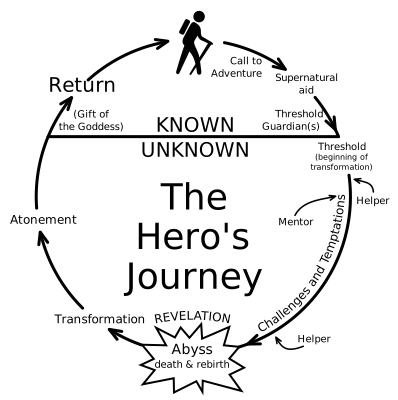
In the hero's journey, characters often reject the heroic quest to try to carry on with their comfortable existence - behaving in a Neutral manner: avoiding hardship and risk, perhaps while advocating that someone else should take on the burden. Later, however - because they are heroes, of course - they accept the quest, and become Good - actively pursuing good despite the risks and hardships.

George Lucas wrote Star Wars with the Hero's Journey in mind, and so provides us with some clear examples. Here we go:
At first Luke Skywalker refuses Ben Kenobi's quest (to go with him Alderaan and learn the ways of the Force), only later going when his adoptive family are killed. Even then, he doesn't appear to be particularly motivated - until he's exposed to what the Empire are doing, and meet people he cares about who are fighting against it. 
So in alignment terms, we could say that Luke goes from the human default of True Neutral, towards Good, through a series of attitude changes.
Changing personalities in RPGs therefore should not merely be catered for, they should be encouraged. Exploring how adventuring and heroism changes your character's attitude, or the villain's personality, is an exciting and interesting thing to do. Static, unchanging characters are dull.

Making alignment dynamic

Over the years, I often tried to think of ways to make alignment dynamic and flexible - to let characters move between alignments, and give players consequences to their role-playing of their alignments.
Even before I started working on this post, I was trying out some ideas.

What the research I did for this post has taught me is what people want from alignment, and what they want to avoid.
I've pinned down the goals to the following:
Alignment should be rewarding, changeable and nuanced, and promote role-playing.
Misalignment
http://www.giantitp.com/forums/showthread.php?t=37591
I toyed with the idea that as your drift from your moral compass points,  you become more susceptible to magical coercion, possession and so on, and less able to produce magical effects that rely on dedication to an alignment.
Mechanically, this would be through gaining misalignment points - inspired by the Dark Side points system of the various Star Wars RPGs.
Several things made me give up on this idea - it would be hard to implement, for a start, but mostly because it punishes characters for role-playing.
So, I discarded it.

Reputed alignment
After discarding misalignment  as a bad idea, I thought about rewarding alignments - granting special abilities or bonuses based on alignment. This idea was prompted by a relatively new player who said that he didn't see the point of alignment, as it didn't gain you anything, except maybe some experience points rewards.
At first, I thought these benefits would just be connected to your normal alignment - but it gradually dawned on me that your reputed moral and ethical outlook would have at least as much effect on the world than your true morals and ethics.
This then led me to think about having two alignment systems, running in parallel - letting you play characters who were hiding their true nature, or acting against their true type.
There are so many examples of this in media - Bruce Wayne isn't the self-centred playboy he pretends to be,

In summary, what I came up with is this: 

Alignments
Your moral and ethical outlook makes a difference to your understanding of others.

It is easier to understand creatures and people who are similarly aligned to you.
You gain a +1 alignment bonus to Sense motive checks against targets with any shared alignment axis.
 It is hard to understand people and creatures that are utterly opposed to your way of thinking.
You take a -1 alignment penalty to Sense motive checks against targets with an alignment on the opposed alignment axis.
 The GM applies these bonuses secretly, without revealing the alignments of NPCs. 

Reputation 
Heroes become more well-known as they achieve memorable actions - this is reflected by an increasing reputation bonus.

Your reputation bonus is equal to 1/2 your level (rounding down, to a minimum of 0).

Additional reputation bonus rewards may be granted by the GM. Characters doing conspicuous deeds may gain increased reputation. Generally, such reputation bonuses should be no more than +1 / level.
The reputation bonus sets the level of fame for your character. If NPCs have heard of you, then you gain modifiers to certain charisma-based checks, depending on your alignment. A successful check means that your reputation modifier is applied to certain social skill checks.
To determine whether any particular NPC has heard of a character with a reputation score, make a reputation check, DC15.

A reputation check is 1d20 + reputation score + NPC's INT modifier


The GM may substitute a Knowledge skill bonus for the Int modifier if he decides the character’s past activities apply to a particular field. For example, if the character were a cleric, Knowledge (religion) might be appropriate.
Reputation acts as a penalty to Disguise checks.
Applying reputation
Your reputation modifier is applied differently depending on your alignment.

All alignments gain their reputation score as a reputation bonus to Diplomacy checks with targets having the exact same alignment. Reputation bonuses stack.

Good alignments grant a reputation bonus to Diplomacy.
Evil alignments grant a reputation bonus to Intimidate.
Chaotic alignments grant a reputation bonus to Intimidate.
Lawful alignments grant a reputation bonus to Bluff.
These rules fulfill my aims of making alignment attractive, flexible, and nuanced.

2013-05-17

Taming the Chaos: probability and the heroes

Some time ago, I was discussing critical hits and misses in RPGs with a friend. We talked about how criticals, badly handled, can ruin a game.
He set me on the trail to writing this post - but being the kind of sciencey person I am, I couldn't just spew back out all he'd said. I had to go look for the facts and logic myself - which in turn led me to find other opinions...

To start with, in a survey that I ran on some RPG forums, I found that responders said they liked character skill or player choice to be the most significant part in success or failure, not the dice roll.

On the other hand, in another survey, responders said that they like the extra randomness of critical hits and misses.

So here I'll look at what we can do to marry these two apparently conflicting preferences.

Critically Random

Critical hits and misses are a staple of a great many RPGs. You rolled the biggest number on the die, so you get more than mere success - and the inverse for critical failures.

Players love criticals, because they reward those big rolls, and punish the low rolls - but are they opening up a wealth of excessively random results, where the die result overrides the skill of the character?

Yes, I believe I can show that to be the case.

Critical misses: the more you try the worse you fail
With critical failure rules, whenever you roll the dice to determine your character's success at a task, you run the risk of a critical failure.
The more often you roll, the more likely you are to screw up in this way. This punishes the player characters more than the non-player characters, because the PCs are the focus of the game. You're making all the rolls.
Further, lots of game systems have ways for powerful characters to take more actions during their turn. The more actions you can take, the more you can achieve, meaning that you are generally more effective.
Similarly, some games use dice pools, whereby you roll more dice of the same type to represent your increasing power, and count the number of dice that beat a given target number. It's common in those games to have a critical failure happen when the number of your dice that come up with the minimum result (usually 1) exceed the number that succeed. But it is also common in such games for the success number to be moveable - a routine task might need you to roll a 5, but a difficult task might need a 6, for example.

But both these systems also give you more chances to critically fail, because you're rolling the dice - and taking that risk - more often.
It shouldn't be a consequence of increased power to run a greater risk of catastrophic failure than some unskilled dweeb, should it?

Critical hits: GM loses control
Critical hits give some special result as a reward for a good roll on the dice. Where this can be problematic is that the game's progress can be altered in the extreme by a single random outcome.

For example: In 3rd edition D&D, using only the Players Handbook (let alone the plethora of Splatbooks that add so many options that the creators can't keep track of them), it is possible to create a 1st level (that is, a fresh start up) half-orc barbarian character who can deal 66 damage on a successful critical hit. (Our Strength 20 half-orc is using a Greataxe, is in a berserk frenzy [barbarian Rage], and has rolled maximum damage on a critical hit.)
To put that in context, a routine hit from the same character (no critical, no Rage, rolling average damage) would deal 13 damage. Hell, a maximum damage roll without the critical is 22.

Why's that important? Well, a normal bad guy for this 1st level barbarian is likely to have 10 hit points or so. So the barbarian can kill one of these routinely - whether they get a critical or not. Clearly this is the barbarian's job.
But the heroes aren't supposed to just beat down every encounter they meet. Sometimes - usually for the sake of plot - they need to meet something so overpowering that they ought to run. The Dungeonmasters' Guide even tells us to do this. So an overpowering challenge (challenge rating 6, to use the jargon) that the players are supposed to flee from is likely to have 50 to 80 hit points - a young white dragon, for example, has 76.

With one very lucky hit, the 1st level barbarian can reduce this supposedly overpowering monster to a mere 10 hit points - low enough for the rest of the player party to finish it off with little risk.

Similarly, RoleMaster and its derivatives, (including Middle Earth Role-Paying (MERP) and SpaceMaster, and all), had long tables of critical hit results. Often these were amusing ("arrow pierces both ears; hearing impaired" followed by some extreme damage multiplier for skewering the target's skull) - but ultimately they created the same problem: through random chance, dangerous foes could be destroyed with a single attack.

Conversely, this can easily go the other way: an encounter that was intended to be routine, or even a pushover can explode in the players' faces. That lowly hobgoblin that the mid-level party have cornered stands a non-zero chance of killing one of the player characters in a single hit.

At this point, whether it's the players who are winning big or loosing out, our GM has lost control of the game.

The overpowering encounter has been defeated, or the hero on whom the story-line has been pinned is dead. The game is most likely to grind to a halt while the GM tries to think of a new story line - or they'll be tempted to alter the supposedly overpowering encounter to add another monster to take the dead one's place, or somehow claim that the dead PC lives.

Very unsatisfactory.

What Do We Do About It?

If randomisation can ruin the game, what do we tend to do about it? Anecdotally, it seems, we cheat.

Fudging the rolls
When random rolls go against the story, the GM is tempted to cheat. This special cheating is called "fudging", and most games even explicitly advise the GM to do it.
To me, this ruins the fun. If I know that the GM is fudging to keep PCs alive, to push the story forward, then all sense of risk is lost. I feel like Superman before anyone figured out Kryptonite was bad for my health. As a player, I've quit out of few games over the years where cheating in my favour has kept me alive - and I know other players who feel the same way.

I've also found that GM fudging regarding dice rolls is a significant issue with the wider gamer world. In my survey, I found that about a third of responders volunteered that they considered GM rolls to be subject to doubt, and that they resented or otherwise felt negatively about that. The other two thirds gave no opinion - which considering it wasn't a question I'd asked in the survey, we can't really take as a positive result for GM trust.

Doing away with fudge
If fudging the rolls is a source of dissatisfaction, how can we do away with it?

Rolling in the open:
The GM can of course, roll all the dice in front of the players. That works fine if our game is under control - but if randomisation can have a negative impact on the game, then rolling in the open doesn't solve this. It can even lead GMs to extreme methods, like practising sleight of hand or loaded dice - and no-one in their right mind wants that.

But if we've got our randomisation in a place where all parties are satisfied with its results, then rolling in the open can be engaging and exciting. Players pay more attention when the GM rolls the dice in front of them.
If you adopt this method, you may need to get your players on board with the principle of dramatic irony - the players may end up knowing (or suspecting) things their characters don't know. If the players can see that you've rolled a tiny number on the dice, but announced a massive number as the result, they know the big bonuses you're adding to that roll, and may treat their antagonist with more fear than he would normally command.
Me, I like to cultivate dramatic irony in my games: giving out scenes where the villains discuss their plans, or shadowy figures stalk the player characters. As long as everyone is on board with the separation of player and character knowledge, it can be good fun to play along with the ignorance.

Players roll all the dice:
D&D's Unearthed Arcana supplement for 3rd edition included this variant rule: Let the players roll everything for themselves.

If the GM's dice rolls are suspect, then stop rolling. Instead of the monsters having a dice roll to attack the heroes, the heroes get a defence roll to avoid the monsters' attacks. Rather than the vile vizier trying to lie to the heroes, the heroes try to sense his motives.
Instead of the GM rolling for the NPCs, you assume that the NPCs' actions are always the average of what they might achieve, and let the players do the randomisation.

The great advantage of this is that the players become proactive, leading the action, even when they're defending against a horde of attackers.

Of course, this involves tweaking the rules of the game. It may take some work on the GM's part - but most RPGs give you some idea of what the average results of typical rolls are going to be. You'll just need to work out the rules of thumb for your NPCs and monsters, and apply them.

Again, this method only really works if the randomisation element in your game is sound.

Taming the Chaos

What can we do to keep the game manageable (assuming we're not going to cheat)?

Change the dice: 
If we change from a d20 to a d12, the chances of getting the maximum or minimum result increase - and vice versa. So to decrease randomness, it might appear that we should increase the number of sides on our dice.

But we can't simply swap dice types around without rescaling the modifiers. A +2 to a roll is a big deal when you're rolling a d10, but relatively insignificant when you're rolling a d100.
If we take the d20 as a base, and change it to a d100 instead, we'll need to multiply all the modifiers in the game by 5.

As long as we make sure that the point at which criticals happens stays as the maximum and minimum results of our die type, we should find that they happen far less often (one 5th of the time).

But is that really solving the issue? A less common chance is still going to happen now and then - and perhaps the increased rarity will work against us, as we become even less inclined to plan for those outside chances.

Do away with criticals?
My first instinct is to certainly get rid of critical failures, they're annoying at best and often counter-productive at worst - but critical success is a reward that players seem to resent losing.
I ran a quick poll of RPG forums again, and found that three times as many people liked critical success rewards than disliked them, and over half of people disliked critical failures.
I also found that a significant number of responders volunteered that they didn't like critical success in skills - combat seemed to be acceptable, but the outlandish outcomes of critical skill success seemed to be a randomisation too far.

While getting all this data in, there were some critical failure rules that were brought up that seems to be well-liked, and certainly appeared interesting.

So if critical hits in combat are well liked, how can we keep them? We need to retain the excitement of reward for a good roll, while ensuring they don't ruin the GM's plans (by killing the heroes, or by the heroes killing supposedly overpowering encounters).

Critical advantage
In the game I run, I make critical success in combat give advantage, instead of massive damage.
When a critical result comes up on the dice, the player (or me, as the GM) can opt for some extra effect. in my rules, I split those extra effects into Attack, Maim, or Move.
The Attack option means that the creature can get a free attack (either a simple attack, or a combat trick, like tripping the defender, or disarming them). The attack must make a new check to make this attack. There are a limited number of attacks in a round, so the player has to judge whether this is worth it.
The Maim option lets the player choose to inflict some injury on top of the damage they are deal, so that the defender starts to bleed each round, or has reduced movement, or some similar effect. The defender gets a check to resist this effect.
The Move option lets the attacker re-position themselves in the fight as a free move.

In play, these options have kept the reward of critical hits, which players like, but have largely retained control of the game. With a single additional hit, a hero is unlikely to kill an overpowering menace - and vice versa.
Also, the variety of options gives players choice

Optional failure
While we're praising options for players, I should mention one of the better critical miss rules that was brought up while I was researching this post.
In a few games, a bad roll on the dice allows the player to take the option of re-rolling - but if that second roll is a failure, something catastrophic happens.

For example: In at least one of the systems, that catastrophic thing is damage to your weapon - the game is a post-apocalypse setting, where materials to repair swords are scarce. Let's look at that in action...

Altair tries to hit the lowly goblin with his staff, and his player rolls a 1. The player can opt to re-roll, but risks breaking or damaging his staff  if he misses with the second roll. The player thinks the goblin is not worth the risk, and decided to simply miss. No critical.
Later, Altair is faced with a foul giant. The stakes are far higher, and every hit counts. Altair's player chooses to re-roll his potential critical miss, as he judges it better to try again and risk breaking the staff.

Conclusion: Chaos Tamed?

The randomness of critical hits and misses can be fun, and need not wreck the precarious balance of the GM's plans.
Options and choice for the players are good - giving bonus choices to increase drama is better than merely adding damage, or a secondary table of random effects. When players can choose how their awesome or terrible dice rolling effects the game, there's more meaningful fun to be had.