Showing posts with label Magic. Show all posts

2014-06-14

Gods - what are they for?

In the game-settings we play with - worlds, universes, multiverses - there is almost always some reference to gods, religion, mystic forces and the like: often these are the driving forces behind the story.

Gods and religion serve many roles in games and stories. It's important that in gaming - collaborative story-telling - we all know what we can expect from the gods and their followers.

Although I'm a non-religious person, I'm quite happy to entertain myself and fellow players with religious themes, mystic visions and other tropes - but I think that the delicate topic of religion and gods in fiction (and gaming in particular) could do with some analysis.

Otherwise, how will we all end up on the same hymn sheet?

In-game reality

What is the truth of the gods? Are they proven to be real, or is their presence ambiguous? If Zeus regularly abducts lovers and begets heroes, who would doubt his existence?

Let's split the camps into two: proven and unproven. I'll deal with unproven first, as it covers the more familiar ground (for me, at least).

Unproven

The gods - if there are any - are unproven. Their existence cannot be unquestionably and concretely demonstrated.

This situation is, of course, most like our every day real world. No matter how strong the faith of any individual or group of people, no deities' existence is empirically proven. 

  • Traditions & superstition
  • The intelligensia don't consider the gods to literally be true, but their traditions and superstitions are powerful tools. No-one believes that the priest in the god-mask is actually the god incarnate, but tradition dictates that all treat him as such.
    • Manipulative priesthood: The gods are known to be false, but the priests lie. The population is deceived.
    • Symbolic priesthood: The gods are metaphors for right behaviour. The worship of the gods does not rely on their stories being actually historically true, but more that the parable of their acts teaches the population how to behave.
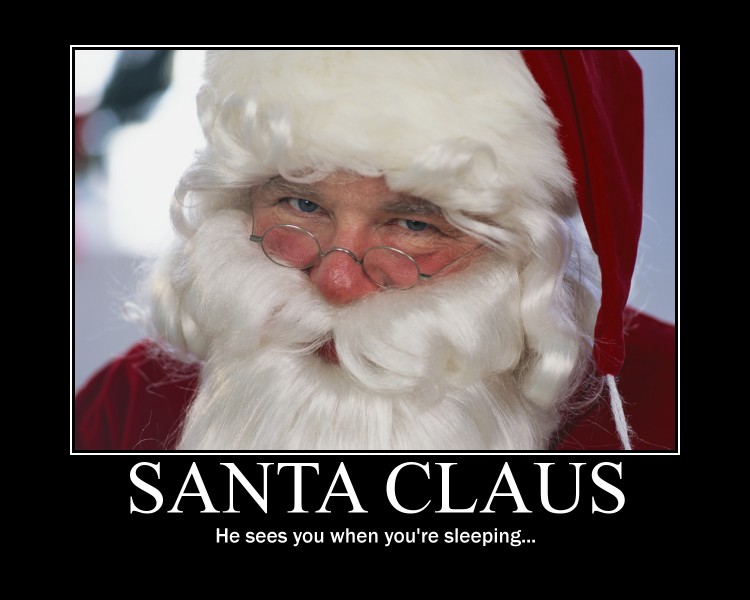
 
(As an aside, it ocurred to me that - SPOILERS AHEAD, KIDS! - Father Christmas is a prime example of benign manipulation. Most of the population is well aware that they are the ones buying presents for the children, but we all go along with the manipulation that there is a magical present-giving entity, who rewards the good and punishes the bad. Consider a church that works like that... Interesting, yes?)

  • Absent & subtle
  • Belief in the gods is widespread and accepted at all levels. The intelligensia have complex and often philosophical ideas about the gods, while the layfolk have straightforward faith.
    • Faith through teaching:  The priests have faith, and they preach this and enforce the will of their god or gods. No-one can show that the gods are real, but it serves the priesthood to indoctrinate people into belief. This may be benign, as with Santa, or it may be purely to perpetuate the power of the church.
    • Faith through observance: The reality of the gods is socially given, but not readily apparent. No-one questions the gods - their existence is self-evident from casual observation.
Faith through teaching is what is required when people question the power of the church, whereas faith through observance is the state enjoyed when the reported acts of the gods are not in conflict with observable reality - either because we can't observe as closely as required to notice the discrepencies, or because those acts are in accord with reality.

Proven

The gods are a fact of life, with verifiable evidence to back them up.

This situation is not like our real world. The gods are known to act in the mortal realm, to intervene on behalf of pious worshippers. Even the most cynical would respect the invocation of the gods - there will be no atheists here.

  • The "myths" are all true
  • The fantastic stories about the gods' exploits - from their creation of the multiverse, to their appearance, to their powers - are all literally true. Still the gods may have powers and interests beyond mortal ken, but as a minimum, we can trust what their scripture says to be 100% fact.
    • Gods are all-powerful, unlimited beings. Omniscient and omnipotent beings, the gods are literally able to achieve anything they desire.
    • Gods are beyond mortal power, but limited. The gods are constrained by limits of some sort - perhaps according to their station in a heirarchy, or their patron sphere

  • Gods are powerful outsiders 
  • The gods are extra dimensional beings of some sort. They are worshipped, but they may not even claim to be gods - or if they do, it is in order to exploit those who worship them. Scripture about these gods may be an imperfect record of the actual events.
    • Hero-gods and saints. Hercules, the Caesars and so on were elevated to godhood - larger than life heroes. Saints take their place in the afterlife as intercessionary being on mortals' behalf with the ruling deitiy.
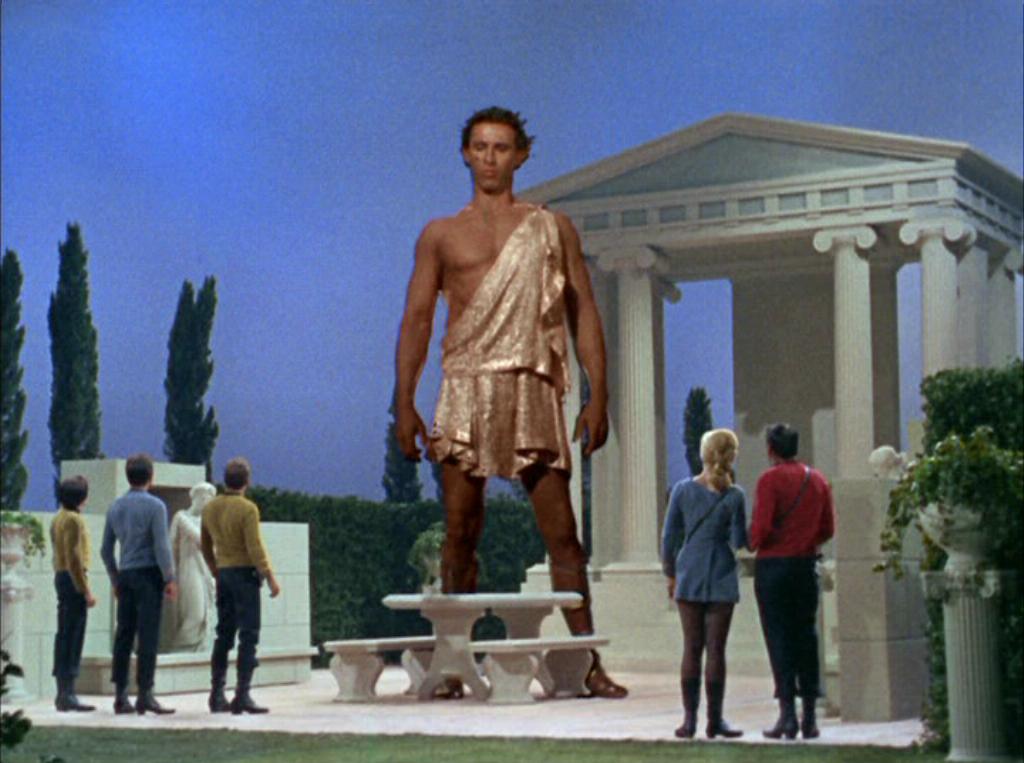
    • Meddlers in mortal affairs. Ultrapowerful being seeking to interfere with the lives and development of lesser entities - Star Trek's Apollo, Q, (and others), or Star Gate's Ra.
    • Alien, unknowable entities. Incomprehensible beings whose motives are unclear. They act without explanation - Lovecraft's Cthulhu et al, 2001's monolith builders.


What is truth?

What constitutes proof of the gods in the game? You need to consider what absolute evidence is available, and what is questionable - so that you can decide how people outside the faithful circles react to that evidence.

Do you have priests who gain their magic from divine energy (and how is that demonstrably different from wizardly magic)?
Would it matter if Apollo turned out to be some errant super-being, rather than a "real" god? What is the difference?
I'll consider these questions along with Function, below.

Function

So - what is the point of gods in your setting? What story purpose do they serve? How important are religion and / or deities to your setting?

I can break this down into three functions:
  • Background flavour
  • Political groups
  • Active characters

Background flavour

The gods and their religions are simply a background flavour - something to increase verisimilitude. Throughout real human history there have been cults and churches, and it would seem unreasonable for these to be absent from a fantasy setting.

These gods and religions are not especially important, except as role-playing and story-telling props.

Political groups

Massive congregations, infalible heirarchies and divine power can make a church an absolute ruler of its culture, even above secular leaders. Historically this has been the case for real world faiths for certain periods.
On the other hand, a religion can rule along side the secular throne. Wise advisers to the emperor hold enormous political influence.
In polytheistic socieities, the various deities' priests might jocky for supremacy with the mortal rulers - who may in turn elevate the status of the deity.

These gods and religions are important because they are the motivators of political groups - orthodox or revolutionary - but it is the people who act, rather than the gods themselves.

Active characters

The gods are present in the real world in some way, like the Greek Olympian gods, living on a holy mountain top, or like the Norse gods, living in some otherworld. In either case, they are real entities who will act on the game setting in some way.

Perhaps the gods manifest themselves through influencings nature - through storms, lightning, earthquakes, sickness and other events. Rather than manifesting in some physical form, the gods manipulate the world to do their will.
This sort of god is subtle and doesn't seem to directly influence the world, moving in mysterious ways. You can use this in games to set up divine coincidences to move the story - random fate becomes divine favour.

Maybe the gods do take on physical form, as perfect immortals, or divine animals - and perhaps these forms influence their bahviours, so that they are as petty and capricious as mortal culture. Just look at the Greek gods - stealing sexy women, starting wars out of jealousy, fighting amongst themselves, cursing mortals on a whim.

Such interfering gods can be the driving force behind adventures.

Divine magic

A common trope in fantasy games is that worship of gods gains the followers magical power.

If priests gain magic from the gods, is this the only form of magic? Are there also wizards? Is there a functional difference between wizardly and priestly magic? Or is the difference only political?

You might have priestly magic concentrate on life and death, fear and morale, and so on - whereas wizardly magic might be concerned with manipulating the elements.

Or if only politics separates divine from arcane, perhaps there would be jealousy between the two styles, so that wizards are outlawed, and the church investigates any magical practice by the layity.

The presence of divine magic in a fantasy game allows for magical differences between followers of different religions - followers of the Death god gain different sapells to the followers of the Creator god, and so on.

False gods

What is the functional difference between an ultrapowerful entity claiming to be a god, and a "true" god?
Leaving aside real-world current religious answers, let's think about why Zeus (who is a god, acording to the Greek mythos) is more qualified as a god than say, Manwe (who is not a god, according to JRR Tolkien's legendarium).
Neither are all-powerful. Neither is the creator of the world. Neither is infallible.

Functionally, then, there is no difference between "true" and "false" gods, except the political implications of the claims.

Enlightenment

There are lots of ways gods can appear in fantasy fiction. Depending on the preferences of your player group, you can use any god or gods you like - but it's usually a good idea to think about whether you'll offend anyone before you use real-world religions, or churches with similar traits to real-world organisations. If in doubt, ask.

Me, I like to have multiple religions in multiple cultures in my game settings, and I tend to have deities fit into the "Powerful outsiders" and "Unproven" categories - I'm interested in the political interaction of faiths.

Whatever sort of deities you want to have in your game, understanding their role and being consistent in their portrayal is key to making the world seem real.

2013-03-02

Magic items: role and drama - Part 2

Continuing from part 1, I'm going to look at what we can do to make magic items more awesome and interesting.
But first, I need to talk about consumables and artefacts - because magic items aren't always infinite, permanent things, and that is a significant difference.

Consumables versus artefacts
Consumable magic items of one sort or another are a near-ubiquitous trope in fantasy fiction: various powders, foodstuffs, liquors and salves that are used up each time they are applied, and grant special effect to the consumer - they allow the hero or villain a one-time chance to magically cheat.
In part 1, I mentioned d'Artagnan's cure-all salve, but let's also consider literally consumable magic items - fantastic foods like Lord of the Rings' lembas elvish way bread, and Thomas Covenant's aliantha treasure-berries; or potions like Getafix's strength potion, and Oberon's love potion.

(Incidentally, after some digging around, it appears that the now common idea of one-shot magical scrolls first appears with Vancian magic (from Jack Vance's Dying Earth, later stolen paid loving tribute in D&D). Magical writing prior to that appears to be thought of as permanent - which makes sense, really, given that this is what writing is for: permanence.)

Anyway, back to the topic: the drama of consumable magic items is that they run out. The hero cannot always be saved - and in some instances, reaching the precious item becomes a point of tension itself. Remember Popeye straining to get to his last can of spinach?

Items that are used up are in effect sacrificed. The magic is called up by the destruction of the precious thing (even if it is only precious because of the magic it will invoke - let's not get bogged down in circular argument, though). Token objects have been found at temples sites by archaeologists - sacrificial items to invoke magic. So we have a long tradition of one-shot magic, where the magical item is exhausted in the act.

Compared with items that never run out, this is a significant difference of drama and narrative in itself. If Excalibur only worked once, the whole story would be radically different.

So let's draw a line between one-shot and permanent magic items.

What to do about it?
In part 1, I hope I made it fairly clear that I think magic items should not be the common tools that they have become in our hobby - and in this part, I hope also that I've shown there is a distinction between two broad types of magic items: the one-shot consumable, and the persistently magical artefact.

Here, then, is my core aim: 
Magic items should START awesome, and STAY RARE.

By which I mean that the tool box of mundanely magic items should all but go - no more stacks of trinkets providing small bonuses here and there - leaving only the powerful and exciting magic items. So the first time a permanent magic items shows up in the game, it should be an awesome item. There should be no lesser items in the game.
These powerful items should remain rare, so that the discovery of each one is a memorable event.

The tool box need not completely vanish of course - that's why I pre-ambled for so long about consumable items. Consumable items can replace the myriad mundanely magical trinkets (look: alliteration - literary!) - potions, oils, paper bombs and other one-shot items can make up an adventurer's utility belt.

But permanent magic items should never be reduced to tools.

How we can actually enforce such a concept on our games will depend on the rules we're working in, of course. We can use increased thresholds for crafting magic items, changed probabilities on  random treasure tables, and the like.
I have in mind (for example) the idea that the special materials in the d20 OGL rules should become cheaper - these are materials that grant special properties to things made from them, but are not inherently magical. The special properties are impressive (adamantine cuts through most objects, for example), but are not magical.
However, as the rules currently stand, these special materials are so expensive that it is cheaper to make an item magical than it is to make it out of one of the special materials.

As for permanent magic items, some maths modelling is probably needed to work out an optimal way to encourage awesome item creation (again, depending on the game system you use)  - but the GM can simply veto dull items (the kind that grant +2 to this, +1 to that) when creating treasure, replacing such things with single-use of limited charged items.

What is awesome?
Your mileage may vary, so to speak, but generally a clear and overt spell effect is awesome, whereas a numerical bonus is a little dull. A flaming sword, arrow-repelling armour, a ring of water walking, or an invisibility cloak - these clearly awesome.

This is not to say that improving abilities can't be awesome. In old editions of D&D there were magical items that literally doubled your character's weapon damage, for example. A massive bonus like this is certainly in the realms of awesomeness. What we should be avoiding is a +2 or +4 here and there, and favouring a +8 or +10 instead.

In short, awesome magic items allow the user to do something they could not normally do - not by improving their abilities, but by giving them new ones.

What is rare?
I'm thinking that any character should only have one or two permanent magic items, plus a plethora of one-shot tools, at the peak of their career.
These permanent items should be signature items that are as famous as the hero or villain wielding them. The tool belt of one-shot items can be pretty cool in their own right, but they shouldn't be things that the character relies on and uses in all encounters.

What does this do to the game?
Permanent magic items become more impressive - both from their rarity, and their (hopefully) inherent awesomeness. Characters may become associated with their awesome artefact - such as Thor's hammer, or Arthur's sword.
Limited magic items become a resource to be managed. Those potions and scrolls won't last forever.

Ultimately, I think adventuring will be more dramatic - without the mundane magical shopping trip, the golf-bag of enchanted swords, the bag of holding with half the Gamesmasters' Guide treasure list stashed away in it.
Heroes will have to rely on their own skills and abilities more, with only one or two signature magical items.
Villains will wield significant artefacts that can be the target of the heroes' plan (steal the Evil High Priest's Staff of Horrors, and he's nothing but a mortal man).

How to mechanically achieve this balance of magic items will depend on the game you're playing - I still have plenty of work to do to make magic item tables for my own game. When I'm done, I may post another article showing the workings - but don't hold your breath....

There's no reason why we can't just wing it - it's a lot less work! But ultimately, to show fairness in action, it helps to enshrine those principles in the rules.
Of course, like many things in RPGs, it is often far easier to think of a general principle and aim, and use GM judgement to apply that principle, than it is to make rules to reflect it.

2013-01-30

Magic Items: role and drama - Part 1

Players love their magic items. I've been converting the magical equipment and weapons that a D&D party gained over the course of their career, into similar items for the game I'll be running - and it got me thinking about the topic in general terms.
This is a big topic! I started writing what I thought would be a short post about magic items and my concerns with the darned things - and found that I need to do this in two parts.
In this part, I'll ask what are "magic items", what role do they serve, and why do most fantasy games seem to fail at delivering the exciting and amazing magical things that fable and literature abound with?
In part two, I'll  stop complaining and talk about what might be done to solve the issue.

What are magic items?
Magic items are just that: items of some sort that have some magical property. The One Ring from Lord of the Rings, the Sivalinga in Indiana Jones and the Temple of Doom, the flying carpet in Arabian Nights - as well as lesser tools, such as the magical trickery of skiving lunch boxes in Harry Potter, or d'Artagnan's healing salve in The Three Musketeers - are all magic items.
In literature and myth, magical equipment, weapons, armour and jewellery are special things, maybe even central to the plot.
In RPGs, magic items tend to be routine - and that is what has been bugging me.

What's wrong with the way that RPGs deal with magic items?
For a start, the name isn't great."Magic items" is a deliberately bland term - making dull broth out of awesome sauce.
By being generic, they become a standard issue bit of equipment, losing that magical quality like a folding shovel: "You don't have a Bag of Holding? You call yourself an adventurer!"

Why is this a problem? A proliferation of magic items in your game makes it hard to use a magic item as a McGuffin - players are not interested unless the item is very powerful, and then unless you explain the dread significance of the One Ring, tend to be only covetously interested.
(Even knowing the "drawbacks" of the One Ring, many players would tend to think that being the Dark Lord of Middle Earth would be awesome, thank you very much. Clearly, that's not the drama that the Professor intended when he wrote Lord of the Rings.)

Also, we tend to end up with uninterested players if there are too many magic items in a game. I recall a joke in one player group about high level characters having golf caddies to carry their magic swords around for them. "Another magic sword? Yawn.... Put it with the others."

History of RPG items
It's worth looking at how the gaming industry has developed this modern relationship with magic items in the RPGs.
In early RPGs, magic items tended to be relatively rare - or at least the intent of the game-writers was that they should be relatively rare. Let's look at the chances of finding magic items in an early edition of D&D, and in a later edition.

In the Basic D&D, the chance of finding any magic item at all in a treasure horde is about 27.5% (there are ten treasure types, each with a variable percentage chance of having one or more magic items).
These chances remain fixed throughout the game, at all levels of play - however, at low level, the monsters you face tend to be the ones without magic items, whereas at high level the tend to be ones with more.

In 3.5 Edition D&D, the chance of a treasure containing magical items increases with level:

  • Low level: 5% to 50%
  • Mid level: 50% to 90%
  • High level: 75% (varies)

Strangely enough, the chance of a magic item being present in a treasure at high levels actually drops to around 75% or so (with some aberrations in the treasure table - 19th level, for example), but the power of those items is generally increased.

It's not a big increase to be honest - can it be responsible for the plethora of magic items in modern RPGs?
I doubt it.

Shopping is not heroic
Aside from the slightly increased frequency of finding magic items as part of a treasure, there is another significant change that has appeared since the early RPGs: the magic item market.
In the first D&D rules sets, magic items were listed in the Dungeon Masters Guide - that is, away from the players. There were no prices listed for magic items, either - the rules merely hinted that some non-player character might be found through advertising, and persuaded to buy unwanted magic items. Costs could be derived from the section about creating magic items - and even the least potion would be an investment of thousands of gold pieces.
Jump forward to the 21st Century, and in D&D 3.5 we've got magic items starting with values of 25 gold pieces, and a listed price for each, together with rules for how many magic items (based on cost) one is supposed to have at any given stage in one career.

So our heroes go shopping for magic items. There are so many trivial little magic trinkets to choose from too - stacking up all those tiny little bonuses to optimise your "hero"...

Now, I'm having great fun with Bethesda's Skyrim still - I tend to play games like this over and over - but I find that as much as I enjoy the adventure game, I get so annoyed with the damn shopping. I have trading fatigue. A hero's life shouldn't be bogged down with running around between traders haggling, or making potions to make her better at haggling. This is all stuff that won't make it into the epic tale of the Dragonborn when the bards tell it, right?
It's because there are so many tiny little footling bonuses that you desperately want to stack together - "Must buy more magic thingies!"

Did Frodo and Co go shopping in Rivendell? Did Conan spend all his money on necklaces of natural armour and belts of giant strength?
No, they went boozing and blew their loot on whores, and sang songs with the elves and ate big feasts.
(You can figure out which did which.)

Next: I solve everything
We know what's wrong (or what I think is wrong) - too many trinkets, not enough excitement, and far too much shopping - so what am I going to do about it?
See the next part, coming soon!