Showing posts with label Running. Show all posts

2017-04-12

A Coventry Way Challenge

A Coventry Way is a full circumnavigation of the city of Coventry in Warwickshire. It was started in the 70s, and thrashed out over decades of path finding (they literally thrashed it out in some places) by some local runners who were training for mountain marathons by running in the country- side around the city. Here's a link to the association's homepage history:

The Challenge then is to do the whole route in one go. Some walk, some run, some form relay teams. All start when they feel like it on the day - so there's a stretched out circle of tired folk round Coventry from before dawn to after dusk.

Getting ready

In my head, whenever I have an event run to do I always set out my excuses first - it's not part of any planned psychology, it just tends to happen. I think I'm a positive pessimist: by planning for the worst, I'm well prepared - but often pleasantly surprised.
Maps - upside down, too
So this event's excuses are: I had a chest infection that developed into a minor bout of pneumonia over the New Year and into February, so my training has been shortened; I've never run this distance before; it's a self-navigated course, so I might get lost along the way; it's going to be the hottest day of the year so far at a maximum of about 20°C in the shade.
With all those problems to overcome, I decided that I would be pleased if I just finished the course!
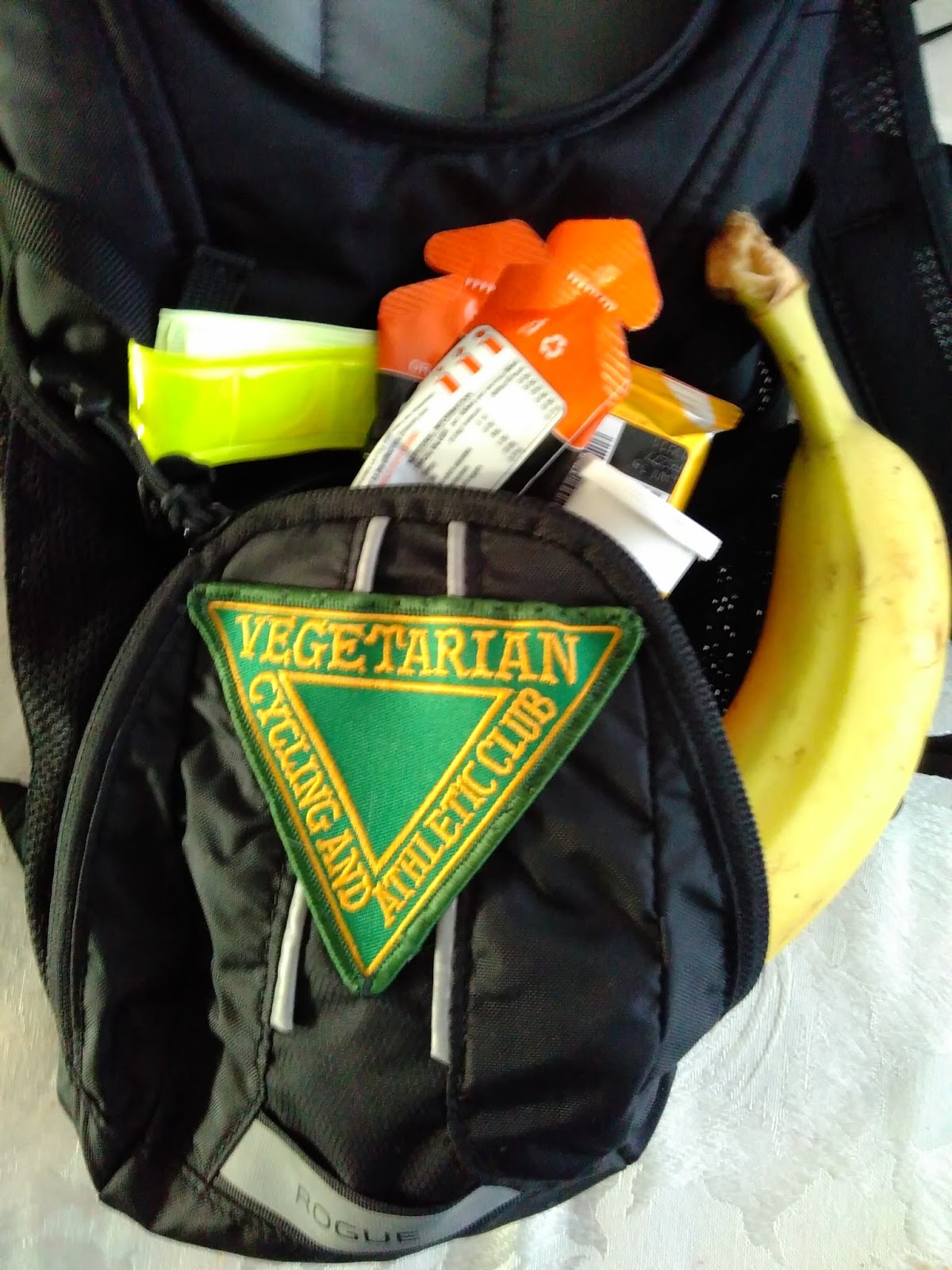
Standard rations
Naturally, some part of me also optimistically predicted a finishing time based on my closest similar distances - I tend to complete the 33 miles of the Marlborough Downs Challenge in 6.5 hours - so I guessed between 8 and 9 hours would be pretty good going.
There are checkpoints along the way, with food provided, but I have learned that you can't rely on the world to provide veggie friendly options - I carried my own. It barely fit in my pack! I also took extra isotonic tablets to let me replenish my drink, as I reckoned I'd need to refill my two litres Camelbak once or twice along the way.


Setting out

This year over 200 took part. It was a breezy, very sunny day, and warming up even at 8 am when I arrived. The car park at the Queens Head in Meriden (west of Coventry, just off the A45) was filling up with cars, and people in hiking and / or running gear. I gave in my number, got my start time logged, started my tracking app, and set out.
Straight away, I felt my calves tighten up - I get this sometimes when I'm not properly hydrated. I slowed my pace and drank, and shook it off. The opening section was up hill, in rolling middle-England country side - with an unfortunate stink of cattle (one of the local farms near Meriden is rather intensive in its housing of the cows). Breathing through the nose, I found myself falling in with an ultra-runner called Glyn - he was a Grand Union Canal veteran. We chatted for a long stretch up til check point 1, where I met up with a work colleague Jon and his kids who cheered me on before going off to rugby practice. It's good to get support! This event doesn't draw crowds, so peer support from chatting with fellow runners along the way is key. Lots of gelatin-based snacks, sadly - it's amazing how many running events want to hand out jelly babies and Haribo! - but some Jaffa Cakes were on offer.

Horses - I didn't steal any
Between CP1 and check point 2, we had a diversion because of a golf tournament as we headed out of Kenilworth. Glyn lingered longer than I wanted to at CP2, so I made off on my own.
Through Bubbenhall and on to Ryton-on-Dunsmore, where we ran through some narrow paths among industrial sheds - a bit grim after the open country - and then crossing under the Eastern side of the A45, to head north. I spotted some leisurely horses paddocked by the path - I doubt they'd have made better progress than us runners! As I came up on CP3 I was really grateful for a rest. I'd only done 19 miles by that point!


Halfway and harder going

Motte or Bailey?
From Wolston, I headed off through open fields toward the Fosse Way, over the Avon and along a straight and deeply hoof-pitted bridleway (the mud was like concrete with the dry weather), up to Brinklow. There are the remains of a motte-and-bailey castle at Brinklow - thankfully we didn't have to climb it! Out of Brinklow, at CP4, I refilled my Camelbak - over half way.


The route joins the Oxford Canal path for a few miles, and passes under the M6 (concrete and noisy traffic) and the Nettle Hill Bridge (iron aquaduct, much quieter).

M6 - going under it
Coming off the towpath, headed toward Ansty - and then across what I have come to think of as the Plains of Gorgoroth! Like something out of Mordor - a ploughed field of crumbled earth so dry, it was like staggering across rocks. I swear I could hear Sam Gamgee trying to encourage me onwards.


Once again the course came back to the Oxford Canal, before turning north to Barnacle and into Bedworth.
Urban(e) art
Here, I got lost. Making it to CP5 in a pleasant housing estate, I paused, chatted with other walkers and runners, had a Jaffa cake or two, water, etc. - and then set off in completely the wrong direction. If it hadn't been for a helpful driver at a set of lights about a kilometre away sending me back the way I'd come, I'd have been properly lost!
Back to CP4, and off in the right direction, then. This urban section was the trickiest - the signs were harder to spot, and fellow challengers were harder to see among the usual normal townsfolk. I tagged along for a bit with a challenger who knew his way, going at a brisk walk rather than a jog, and I was grateful not only for the guidance, but for the rest. To be honest, I'd been walking longer sections between jogging by this point - about 30 miles.


M6 again - over it this time
Back over the M6, and down into Corley Moor. I'd been warned this would be a quagmire, but it was hardly even muddy that day! On to Corley Moor village - the Red Lion looking very inviting in the sunshine - but onwards to CP7. I should have refilled my Camelbak again - I ran out of water as I went through Birchley Hays Wood, as I discovered trying to wash down an energy gel to pep me up for the last stretch - but a fellow challenger let me have some of his. Very thankful! The course runs mainly downhill from there, gently enough to ease the legs - and I finally came in sight of the Queens Head again 8 hours and 53 minutes after I'd set off.

Food was being served - mainly carnivorous at a glance, but to be honest, I didn't feel hungry so much as thirsty and tired. I collected my certificate, changed into soft shoes and headed home for a decent thirst quencher.
Reward (unofficial)
Reward (official)


Observations

There were lots and lots of kissing gates along the way, which broke one's stride (I tended to walk up to and away from them, rather than run). The course was generally well signed, as the Coventry Way logos were well-placed at turns and gates and so on. The few places that caused confusion were when we passed through built-up areas (just a couple in the whole 40 miles), where it was easier to miss what signs there were.

This is a challenge I will definitely do again! I hope to make better time in future (less wrong turns!) - but the biggest challenge for me is just finishing!

RESULTS

2015-05-03

Marlborough, Physio and Stretching

I've been laid low with sciatica. Some months ago I decided I was going to have to bail out of the Marlborough Downs 33 mile challenge.
Very disappointing, especially as I'd persuaded / challenged my brother to run it this year. We're looking to raise money for the Kenya Community Education Project - a small non-profit school funding project that my brother's been involved with.

I'd seen the doctor about my sciatica, and been told to rest and take ibuprofen. The NHS website has a few stretches to combat sciatica, which I was trying to remember to do regularly. Nothing was getting better - in fact, with work requiring me to drive assorted hire cars with badly adjusted seats on long hauls, and my lab stool being badly set for typing up reports, I was getting worse.

One day I was in such agony that I just made a private appointment for a physiotherpay session, then went home, calling in sick for the rest of the day.
That was my best move of this saga!

Physio at Daventry's  Heartlands Physiotherapy (not a sponsored plug, just a genuinely grateful nod) discovered a bunch of things wrong with me that were causing the sciatica - but which all boil down to one overall issue: I'm not supple, and running was tightening everything up.

When I first satarted running, I used to stretch a bit afterwards. I seem to have stopped bothering at some point. Part of the reason I was doing it was to strengthen my knees - but the knee troubles of my novice days seemed to have disappeared, so I suppose that's why I stopped.

I've never been able to touch my toes with my knees straight - but I'd been gradually getting worse. Toughening up my legs with long distances was also shortening my muscles and ligaments. I was less and less flexible.
When the sciatica hit, I could hardly even touch my knees! (Exaggeration, but not much.) And putting on socks was a real struggle.
I'm not actually this skinny


So I was prescribed a bunch of stretches - hamstring, piriformis, side core, knee - and some strengthening exercises - squats. Twice a day. The pain started to go away. I need less ibuprofen.
I have a couple of pages of diagrams like this

After a couple of appointments to check progress, I got back to running short distances, and have built up the miles gently. I've got back into a routine, but added to it, too - now I'm running shorter distances at the weekend, but more often. Instead of running 30km in one go, I'm doing two lots of 15km - one in the morning, and one in the evening, and then again the next day.

So now, after 3 months, I'm ready for the biggest run of the year.

Click here to sponsor me (or my brother - the choice of charity was his).

I'll never neglect my stretching again!

2015-04-27

Buying Shoes

Shoes are hard to buy for long distance running, because you don't really know what they'll be like until you've run a serious few in them - and then it's too late to take them back.

Here, then, are some problems I've found over the last 4 years:

  • Stripes - dynamic stylish stripes on shoes can cut into the instep. Maybe they're added for arch support? But for me, they are usually a sign of bleeding soles to come.
  • Width fitting - I've got skinny ankles but wide toes, and my spread starts back at the arch. If I don't get medium width or wider shoes, I get compression across the bones of the middle of my foot.
  • Differences in sizing - a 9 is not a 9 from all the shoe makers. At least this one is easy to spot in the shoe shop, or before I go running, but sometimes I've been caught out by shoes that are only slightly too small, and thinking I'll get away with it. Black toenails from repetitive briuising are the result - not good.

Moat of these issues take about 6km (3-4 miles) to manifest. The shoes by then are muddy and the soles are clearly scuffed. It's cost me an average of about £100 each year in hardly used shoes - I wear out shoes every 500 miles or so.

This outburst today was brought to you by the shoe sale at our local sports store, from which two pairs of low priced lemons have recently made their way, via a 6 mile detour round my running routes, into the charity shops.

So for the 33 mile ultramarathon next month, I'll be running in my old, nearly worn out shoes - cause I'm not risking wrong shoes on the race day!

2015-02-11

Sciatic nerve pinch!

It feels like I've somehow pinched my sciatic nerve - the leg nerve that runs from the back of the pelvis to the calf. It's a sharp pain in the back of my right hip, that gets worst when I raise my right leg, especially if I keep the leg straight.

No, it's not some Vulcan incapacitating technique, it's an injury.
Apparently this is common in runners, though I've only just experienced it after years of happy running.
Weight lifters also get it, so maybe the leg lunges with weights I was trying out to strengthen my knees started it off.
Lower back mobility is another issue - and I've always had difficulty touching my toes with straight legs, ever since I was a kid.

There are a bunch of exercises to strengthen the core muscles, which should prevent it from re-occurring, and there are a load of stretches to ease it off in the mean time.

But the horrifying crux of the matter is - I should stop running till the pain goes, then build back up gently.

Yuk! Horrible idea!

I've got three and a half months till the Marlborough 33 miler - so I've got to rest if I'm going to get better.

In the meantime, I'll be back at the boxing and static bike - and I'm looking to get a rowing machine maybe - to keep the cardio up and help with the core flexing and strength.

2014-10-27

Snowdonia Marathon - earning XP

I knew Snowdonia was going to be tough, but I didn't think it'd be that bad.

I trained at running up and down hills, because I live a relatively flat part of the world. The nearest steep hill I've got is a couple of miles long, with a maximum gradient of 20% - whereas the three Snowdonia ascents get up to nearly 30%. So I trained with ankle weights on.

I'd heard that for marathons, it's better to run three days of 10 mile runs than to do marathon length runs as training - so I did that.

I'd been told that the Snowdonia marathon was mainly road, with a little bit of track and path - so I mainly trained for road, with a little off road.

On the day, I slogged up the first ascent and down again without much trouble. The long down hill and flat section was steady, then the second ascent went reasonably well.

Some loon who thinks he can run
More loons
It was about 20 miles that I started to really tire out. My feet ached from pounding down the hills as well as the long distance. I had to stop for a moment and massage my legs and rest my feet - just for a moment. I spent the rest of the flat section shuffling slower and slower.

The last mountain was where I picked up the pace again - going up hill puts less pressure on your feet. I'd trained and trained at the uphill running. From mile 23 or so, I climbed about 200 metres in single run, then as the ground was just levelling out, I had to slow to walk. The road turned into a rocky path, all uneven footing and sharp edges. My knees and all the fine-control muscles hurt like hell, and my feet ached.

When I'd made it to mile 23, I'd been on track for a personal best marathon. If I'd had that bit more stamina to manage the flats and the hard terrain at the top, I'd have managed it.
As it was, I still made a respectable time for my first Snowdonia - just under 5 hours. I'd been hoping for under 5.5 hours. I'd have been happy with under 6 hours.

My brother, the rugby-playing runner, by contrast - he passed me at the top of the last climb, and bounded down the rocky descent.

So - the lessons:

  1. Train the long distances till they're routine.
    I want to run marathons fortnightly, so I'm prepared for those last six miles.
  2. End on bigger hills, including the descents.
    Going downhill when you're tired is hard. I need to condition myself to run down hills after a long tiring run.
  3. More off-road.
    The surprisingly tough surface at the end ofthe run threw me. I do a fair bit of off road running, but I should have done more long distance off-road for this one.
The subtext here, of course, is that I'll be back - Snowdonia is an amazing marathon.

They print your name on your number sheet, so everyone calls it out as you go past - "Come on, Alastair! You can do it, Alastair!" That's still with me - but my knees don't hurt anymore.


2014-06-14

Circuit ultra-running

There's an interesting article on the BBC News site about the circuit ultra-run this weekend in Gloucester.

Circuit ultra-running is daunting - rather than running a long course, it's just laps of a standard 400m track.

The changing scenery and sense of achievement I get from running long distances? Nope, none of that for circuit ultra-runners, just endless laps.
There's much bigger mental challenge in circuits. When I get tired 10 miles from home, I know that the only way to finish is to keep going.
On a circuit, rest is never more than 100m away. The grit to keep going is far more abstract, far more about personal discipline than about necessity.

2014-05-31

Wildlife woes

When I go running, I particularly like to run in the countryside, either on country lanes, or footpaths and bridleways.
I get to see the picturesque landscape, the rabbits, butterflies, sometimes a fox. I hear the birds singing, and sheep in the fields.
Preston Capes
Badby Woods

All very pleasant.

But there are some creatures out there that seem to have other ideas...


Near where I work, some of the local farmers keep bees. Almost any footpath I care to run along has a nearby beehive, with the resultant traffic of bees to and from the hive and plants around about it.

So I've been stung three times now by bees.

Each time it has been on the top of my head, when a bee has been caught in my hair. I have fine fluffy hair, easy for an insect to get tangled in. The second time it happened, I cut my hair really short to try to stop it happening again - it didn't help.
When I get stung on the head, there's nowhere for the venom to go (scalps are thin), so the swelling looks worse. I end up looking sort of like this:

 Or like this:


Now, I wear a bandana when I run, to keep the bees from getting trapped.

As well as bees, I've been stung a few times by a wasp. Just the one, over and over again, on my top lip. That was nasty, but not nearly as bad as the bee stings.


Moving on to vertebrates - but not exactly a wild animal: farm dogs.

There's a good 10 mile route through the countryside around my home, but it goes through a farm. This is a public road, which passes through a farm - its building are on either side of the road.
The farm appears to be run by a trio of dogs: I've never seen any people there. The first time I ran through there was with some mates - the dogs looked at us, but paid little attention.
Just before I ran through on my own, some weeks later, I met some cyclist going the other way, who warned me "There are some excited dogs up ahead."


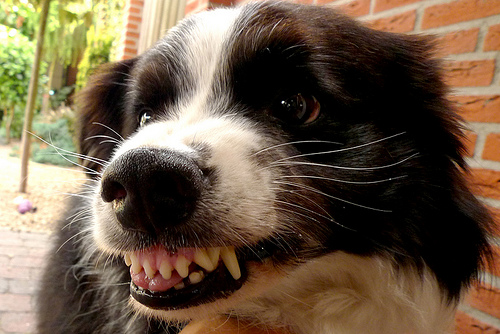
For "excited", read "angry". These three farm dogs were pissed off with their territory being invaded once by whizzing sweaty men, and weren't going to let another sweaty man jog through. They herded me along - and the border collie bit me on the ankle.
(I'm told this is normal - if over-enthusiastic - herding behaviour for sheep dogs: to nip sheep on the ankles.)
Suffice to say, my personal best kilometer pace was set after passing through that farm.

Since then, I've learned that apparently dogs wag their tails differently when they're stressed and when they're happy - to the left when stressed, and to the right when happy.
Dogs know this, and they react with dominant / aggressive behaviour to dogs who appear stressed.
I theorise that being left-handed, when I instinctively wave left-handed to greet dogs - and being naturally nervous of them since I was bitten quite badly on the face by a dog as a child - I am encouraging dogs to be aggressive to me.

These days, I wave right-handed.
I also don't run through that farm.


On to avians - while running round a pond, I saw a lovely sight: some goslings being led along by their parents on the path ahead.
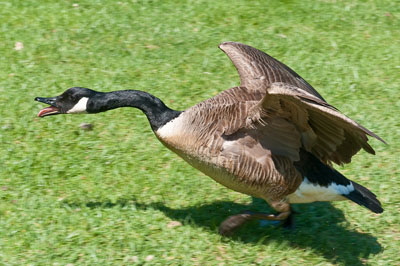
Of course, although I tried to give them plenty of room and go around, the parents had decided I was going to eat their offspring, and gave chase. Geese are quite big and scary when they're angry.


Worse than an angry goose waddling after me, was the buzzard attack this week.
Running along a normal stretch of road through a woodland, there was whoosh of something passing fast just above my head - a buzzard. As I ran on, I watched it fly over the road and into the trees on the other side, assuming I'd just been on its flight path by coincidence.
A few seconds later - BAM! I felt like someone had smacked me round the top of the head - a good cuffing blow that knocked my head forward and made me stagger. As I looked up and around to what had hit me, I saw my bandana flying to the ground on the verge in front of me, and the damn buzzard swooping up into the branches over my head.
A buzzard yesterday
It perched there, and keened at me: "Peeaw! Peeaw!" - I grabbed my hat and ran on, covering my head with my arms and muttering "All right, I'm going, I'm going!"
When I got back to work, one of my colleagues told me I was bleeding. Not too badly, on examination - as though I'd been badly scratched by a cat. The cuts didn't hurt so much as the impact. Still, I washed the cuts with alcohol from the solvents cupboard, to avoid bird flu or whatever nasties were on the hawk's talons.

As the attack had happened during my lunch break, I had to fill in the accident book and report it to the health and safety manager. "Wear a hat," he suggested.

I suspect the buzzard is nesting, or otherwise considers that patch of woods to its territory, and really just wanted me gone.
Suffice to say, that route is struck off my list of runs, too.

Incidently, when I was looking online for a picture of a British buzzard, it appears that my attack isn't especially uncommon:
Notice the first picture, top left...

Running is a great way to get out and about and see the countryside and wildlife. I just worry that the wildlife doesn't want to see me.
It'll be badger attacks, next...


2014-04-16

We run

A suppodedly inspirational facebook post about how a "fatty" runner is inspirational has been rebuffed by the runner in question.

It makes good reading - both of the posts. Here they are with some commentary.

When I see another runner, all I think is "Go on!" - maybe a little "Can I catch them up?"

Both these posts talk about the journey - like self improvement is the only possible motivation to run.

Me, I run because it's fun - but when I think back, I remember it didn't start as fun. It started as self-improvement, to work on my asthma, and shift some weight.

It's taken me three years to get to be a mediocre runner - the London Marathon elite come in with times faster than my half-marathon times - but I was even worse when I started. I was half walking, half running for the whole 2.5 miles of the flat track near where I work.

You have to start to get better, and then you have to stick at it.

UPDATE: The Self-consciousness Barrier

Talking about this post with some friendly people, I was reminded of the need to overcome self-consciousness.

No-one looks their best when they run: your clothes are sweaty, your face is red, bits of you wobble, you're probably pulling a strained face.
Some people find being in public view hard enough without all that.

The thing is, no-one is really going to be paying much attention to a runner who jogs or lumbers or glides past. Even if you're in some way especially remarkable, you'll only be noticed for a second.

Runners are just part of the landscape. No-one expects you to stick around - you are moving past by default.

And anyway, the more you run, the more natural you'll look - less sweat, less red in the face, less wobbly.

2014-03-24

Ankle weights

There aren't many big hills round here in the Midlands - at least, there are few long steep hills, like I'll have to cope with in Wales in May - so I do repetitions of the tallest steep hill round here, and makes sure I include a few steep gradients in my runs in general.

But I've been looking at those Welsh hills, and realising that no matter how many reps I do, I just don't have access to the gradients that Wales has.

So I've been running with ankle weights on. The ones I've been using at just under half a kilo each and have been getting lighter as they leak the iron sand that gives them their weight - they're old, see.


Now I've decided that the combination of those weights being light, and shedding their load gradually, means that I should use some new, heavier ones - and today was my first run with the new 2 kilo weights.

Bloody hell, that was hard going!

For the first time in ages, I came home exhausted - both out of breath and with tired legs. It was just a 7 km run, over the local big hill and back. Usually, that gets me a little out of breath, but it hardly fatigues me.

But when I started out, that hill used to be the most daunting thing on my routine. It's taken a lot of running to make it a relatively casual event.
By adding an extra kilo to each leg, and dragging that up and down and up and down that hill, I'm forcing myself to recondition my legs.

In time, it'll be easy.

2014-01-04

Cardio for endurance

If I run slowly and steadily, I can keep going for a long time. I don't break any records, but I get there.

On the other hand, if I don't also train to run short fast distances, my ability to run half-decent times over distance is gone.
I can plod it out, but it's little more than a half-hearted jog - no sense of achievement, no sense of effort. I feel like I might as well be walking.

After all the distance running I've done, my legs are fairly well toughened up to the point where they'll stand up to any distance - only starting to hurt when the sheer repetitive plodding of the distance have inflamed the joints. I only seem to need sporadic long distance runs - say once a week - to maintain this ability.

Over the holidays, I took a break. My cardio fitness has dropped off in that short time, and I'm finding myself slow and my chest tight. It's not good for me to run with a tight chest - if I force the air in and out of my lungs, I run the risk of popping one. (Everyone runs that risk, but asthma makes it worse.)

Also, the bane of lactic acid is inversely connected to the efficiency of your oxygen intake and circulation. If you can't get the oxygen into your muscles quickly, anaerobic action takes over and makes lactic acid. (As I've commented before, fuel is important too.) A good circulation also helps to take away the waste lactic acid.

So, my new regime for the time being - plenty of high intensity training, to get my heart and lungs back into shape.

The HIT that I've prescribed myself is 3 sets of 20 second blasts, either on the static bike, or boxing. I warm up with a minute of easy activity - slowly pedalling the bike, or slow punches on the heavy bag - then 20 seconds of the fastest action I can manage. On the bike, I stand up for that fast action, too (strengthening my knees in the process). Then a slow couple of minutes, before another 20 second bust, and again for the 3rd burst.
The whole HIT process takes just about ten minutes, and one hardly breaks a sweat in the cold.

2013-11-30

Over the hills and far away

My brother has challenged me to join him in running the Sarn Helen Hill Race (a 16.5 miler) in May, and the Snowdonia Marathon in October.

These are both fairly long runs, mainly off road, in hilly country (thankfully, the Snowdonia marathon doesn't actually ascend Snowdon itself). They're both in Wales - so those hills are going to be properly steep.

16.5 miles is what I call a "kilometrathon" - it works out at just over 26km. It's one of my favourite distances: long enough to be tasking, but short enough to stay fun all the way.
The marathon is a distance I've never actually raced, except to carry on for longer afterwards. I've run it solo a couple of times. I find marathons to be very tiring by the end, but again, they're the sort of epic distance I enjoy.

Anyway - all this is just to say: I'm getting back out there on the hill training again. Welsh hills are likely to be harder than the Marlborough Downs, so I need to put in more regular effort.
I also know that I need to strengthen my knees for the long distances - so I'll be doing some balancing and light weight work, too.

2013-11-17

Why We Run

Why do you run? What keeps you from stopping? What makes you want to stop, stay in or slack off?

Exercise
XKCD

I run because I have asthma - if I don't exercise regularly, my asthma symptoms get worse. (I can also use drugs to control my asthma, which I do, but the exercise staves off the symptoms so that I take less medicine.)

I run to keep generally fit. My immune system seems to be vastly improved compared to before I ran: I have only had one cold that kept me off work in the last three years. I've lost weight, and fit into my old clothes again.

I run to be prepared. The Scouting motto is "Be prepared" - which while I was enjoying all the other fun of being a Scout, I took to heart. I have a commemorative 50p coin with that motto on it, which I always keep: 50p won't buy much these days, but it'll get me a phone call. And if I know I can always get up and run a few dozen miles if I have to, then I'm prepared for most emergencies - along with all the other first aid training and wood craft I picked up when I was Scouting.

I run to clear my head. Running uses very little brain power, but it bombards you with sensations - the feeling of your breath, legs, feet; the sight and sound of the world moving past. It's rather like meditating: you put your brain in neutral. I find I think of all sots of unconnected things while I'm running - they just float up to the surface while I'm busy pushing the road past.

I run because running makes us human. I run to pay tribute to my ancestors (no, don't roll your eyes at that - it'll make sense in a minute), whose hunting kills from their running hunts allowed a respite from the drudgery of survival, so that they could think and innovate - and ultimately invent agriculture, which in turn allowed me to choose to vegetarian. Having that choice is a privilege - so I run to salute their efforts to allow me to make that choice, however roundabout it was.

It's hard to find the motivation to run for many people. I keep running because of all those reasons.

Sometimes I don't want to run. I miss a day now and then. Usually it's because other demands got in the way - I was dealing with a client at the time I'd usually go running, or I was travelling - but sometimes it's because I'd rather have a glass of wine and watch Big Bang Theory or QI, or write notes for more gaming material.

But my first reason always brings me back: I run because running makes me better.

I know that's a reason most people don't have, so, I'd like to throw it open to you lot who read these ramblings:

  • Why do you / did you want to run?
  • What makes you want to stop, stay in, or slack off?
Answers in the comments, please!

2013-10-20

Running solo

Recently, I've been running in a small group - some friends wanted to come out training, so we teamed up to run together.
Running with relative novices, I found out some things I'd forgotten about my progress over the last few years, which was helpful. I also started to realise that I need to run on my own - at least some of the time.

In a group, the pace, distance and scheduling of the run are all dictated by the group. When runners have different abilities, some will be slowed down while other will - hopefully - improve with the encouragement of the group.
There are advantages to the group - increased motivation being the most obvious, and a regular schedule being another.

But I spent a couple of years running solo, practically every day, at my own pace. I never have to consider anyone else when I'm out on my own. I just run where I like, for as long as I like, as fast or slow as I like.

Today, the rest of the group decide to run at time that wasn't convenient for me. So off I went by myself - and it was great! I ran an old route I'd not used for months. It was really tiring, because I've been running shorter distances in general, and at a slower pace.

What am I taking away from today's run? I need to get back into big long runs again, and I need to regularly run on my own, at my own pace, with my own thoughts.
I'm not about to drop out of the group effort, but those weekend session need to include time for me to head for the hills and see the world.

That is why I run, after all.


2013-08-11

Novice running

Just recently, I've run a few sessions with mates who are keen to start running for fitness - and despite their being keen, it seems I'd overestimated their abilities.

I'm trying to go easy with them, and remember what it was like when I started running, but it seems like the three years of nearly daily running I've done have made me into some sort of superhero in comparison with someone who doesn't run at all... and that's clearly not right.

So I thought I'd better think back harder to my first few runs, and what it was like for me then, and how long it took for me to get to the fitness I'm at now - and look at recommendations for novice runners.

What I quickly saw in writing this post was how far I've come, and how crap I was to start with. I hope I can also take away lesson about training novices constructively, too.

Starting out
It was the week of my 40th birthday when I went out running for the first time since school. My basic fitness was the residue left behind from having cycled to work each day about a dozen years prior to that (about 10 miles each week day), and that immediately prior to my running, I'd been walking daily, for half an hour, each lunch time at work.
I was trying to build up my ankle strength after spraining it badly at a party, and trying to build up my stamina - better stamina puts less stress on my lungs, and stress on my lungs is what triggers my asthma.

So I wasn't in good shape, but I had an underlying ability to run when I started out.

Nevertheless, my first attempt to run the same distances as my daily walk was dreadful. I managed it in 25 minutes - just a few minutes less than I would if I were walking briskly. I couldn't run the whole distance in one go. I didn't run it at all the following day, but I did go out and walked it again.

For the first few weeks, I didn't manage to run the whole 30 minutes. I was walking for sections each time - but those sections were gradually getting shorter, and my speed was increasing.

I was running 3 or 4 or 5 miles nearly every day, and getting quite confident and comfortable with it within about six months.

Longer distances
What I really wanted to do though, was run for a long distance. I started to increase my weekend runs with a friend who ran for very long distances (this is the guy whose fault it was I started running at all, really - his first ever marathon was day 1 of a multiday ultramarathon in the Sahara).

With some encouragement, and plenty of short daily runs by myself, I ran till I got happy with 10 km. I increased my weekend distances gradually. Then one day I found I'd done 10 miles (16 km), and I still felt relatively fresh - so I decided to try for a half marathon distances: 13.1 miles (21 km).

This was about a year after I'd started running, though. I've heard of people starting out with a basic level of fitness and training to run a marathon in six weeks - but I certainly didn't even try to do that.

Since then, I've trained to run longer and longer, and I've got a couple of marathons and one ultramarathon under my belt - but my idea of a fun distance is really the half marathon, or on a really good day, the 30 km.

Starting from scratch
For novices, Runners' World magazine recommend that you start with a 2 mile goal - aiming to be running for 30 minutes non-stop at a slow relaxed pace.

It also plans this goal to be the end of 8 weeks of training.

So, while I pulled my mate along straight out the gate of his house for three minutes of running, up a hill, at what I thought was a relaxed pace, Runners' World suggests we should have started out with 1 minute running, then 2 minutes walking, repeated for the whole session.
This probably accounts for why, after about 2 km - 10 minutes of a good long distance pace (for an established runner), he flaked out and had to slow to a walk.
He managed  a few more bouts of running - a minute or two for the rest of the 30 minutes - but we walked for most of the rest of the distance.
When I compare that with what the experts say is good for a novice - and how I was when I started - I'm impressed he managed as well as he did.

Essentially, the training plan for novices should be based on starting walking twice as much as you run, every other day - with a walk of the same length on the other days - and building up gradually to run / walk in even amounts, finally culminating in running continuously for a whole 30 minutes.

Which is rather like what I did, without knowing it was right - it was just what I found comfortable.

Better training
So good news for my novice running mates - I know what we should be doing now! Keep it up for a month, and we should be running most of the sessions, with just a couple of 1 minute walks.

Keep it up for 2 months, and I should find these youngsters outpacing me, and pulling me along. Everyone wins.

2013-07-23

Exercise, heat and hydration

Running during the current heatwave is hard work.

In normal conditions, I carry a backpack of isotonic drink to keep myself hydrated for longer runs, but for a short few kilometers, I tend to wait till I get home.
However, in this heat, I need to carry water on even the short runs.

Without good hydration, lactic acid builds up, sapping strength and stamina. Extreme cases will do serious damage.

Drowning in rules
Most role-playing games don't deal with this particularly - they may have some rules on general fatigue, or on heat damage from high temperatures, but there tends to be less about water consumption.
3rd Edition D&D, which is based on the d20 rules, which I'm using for my own game, does have a rule for how much water one needs each day - a gallon, apparently - double or treble that for "very hot climates". (It's in the Environments section of the DMG - under starvation and thirst.)
This sort of quantity seems to me to be so excessive as to be useless. Also, there's no accounting in that rule for exertion or lack of it.

So, I thought I'd see if I could find a simple mechanism to reflect dehydration in RPGs, including under hot conditions, and when exerting oneself.
(I'm not looking to make real world recommendations regarding survival rations here - just to get some verisimilitude for rulings regarding water intake in RPGs.)

When I run for 3 hours, I'll drink about two litres of isotonic. I will tend to need to top up my water intake after I've run. This seems to be in line with recommendations - although I've just planned this based on how I feel about my own thirst while I run.
In hot weather, I'll drink more - but only by about a third or so. Of course, this is British hot that I'm talking about: just 30 Celsius or so in the shade.

Dehydration damage
What I don't know in detail - and what I'm not keen to find out first hand - is the point at which I start to get injured or ill from lack of water.
Thankfully, the internet provides answers. We start to get ill when we exceed 2% body water loss. At 5% - 10%, headaches and other symptoms set in, including seizures, and even death.
In game terms, let's say that at 2% dehydration, there's a risk of symptoms - penalties to act, and so on. You're not at your best, but you can still manage to get things done.
At 5% or more, the penalties get worse, and real damage starts to set in.

It appears that body water is estimated at about 60% of the mass of a person. There's bound to be some leeway in that, depending on physique, but we can stick with that figure for now. 2% of that 60% gives us about 1% of mass. I'm rounding off, of course.

Litres per kilo
To translate that into litres per kilo, a 100kg person starts to experience dehydration symptoms once they've lost about a litre of water. This seems to be in the right order of magnitude: it's said that an average person needs to top up a loss through sweat, urine and breath of about 1.2 litres per day.
We get a bit of water from normal food intake, so if we use 1 litre to replace 1.2 litres, it seems close enough for our purpose. Let's stick with 1% of mass as our benchmark for dehydration symptoms - with severe symptoms appearing at 5%

Remember my drinking 2 litres for 3 hours of exertion? That's double my daily need, in an eighth of a day. It seems like exertion increases your dehydration sixteen times. But let's also assume that you spend only 10 hours per day active, with the other 14 hours split into relaxing and resting / sleeping - and then compress all our water loss into that 10 hour slot.
(D&D assumes an 8 hour day in terms of travel, so we seem to be in the right region. I know that's fairly artificial, but the time you spend working is going to be the major contribution to your daily dehydration, while the resting time is less important.)

That means that my 3 hour run is about a third of the day - and I've got a thirst for double my whole day water intake. That means I'm drinking six times more for that three hour exercise than I would normally.
Maybe I'm drinking more than I strictly need because I have water on tap - so let's drop that down to a multiplier of five. Very conservative - but we're looking for minimum intakes to avoid serious ill health.

So for any portion of the day spent exerting yourself, you need five times the amount of water you would normally.

That means that for every hour spent in strenuous exertion (forced march, mass combat, frantic digging, hard rowing, and so on - generally if you're expending about double the usual effort to achieve your task), you need to drink an extra half pint per 100lbs, or 500ml per 100kg.

Heat and thirst
I also found I was drinking about a third more water when the temperature was 10 degrees more than normal. (That's Celsius, of course, I'm a scientist at heart.)
Compare that with the D&D rule that you need double for "very hot climates". The weather section of the rules gives temperature categories of "cold" (0 - 40 degrees), "moderate" (40 to 60 degrees), "warm" (60 to 85 degrees), and "hot" (85 to 110 degrees), with scope for cold snaps and heat waves (subtracting or adding 10 degrees each). Of course, this being a darn tootin' Yankee creation, these temperatures are in archaic Fahrenheit - so my 10 degree jump seems to take us pretty much from one temperature category to the next.
What this seems to tell us is that you need to add one third to your water intake for any given time period for each 10 C or 20F above normal temperate weather conditions - for each weather category, in D&D terms.
But the maths for adding thirds of 100ths is going to make hard work - let's simplify, and make it one half.

Attempting a rule
Let me try to put all this into a rule:
Humanoids need to drink 1/100 of their body weight in water or water-based liquids each day, or risk dehydration. For this calculation, 1lb = 1 pt.
Every hour of strenuous exertion adds one half that amount to the total needed that day, as a top up drink. Strenuous exertion includes mass combat, frantic digging, hard rowing, and so on - generally if you're expending about double the usual effort to achieve your task, then the effort is said to be strenuous.
For each weather category hotter than "moderate", the amount of water required is increased by 1/2. That is: In warm weather, you need 1.5 times the amount of water; in hot weather, you need 2 times the amount; and in weather exceeding 110 F, you need 2.5 times the amount.
Make this increase after adding any extra amount for strenuous exertion.
Round all these numbers up to the next half pint.
 Each hour of strenuous exertion prompts you to either drink the required top up amount, or make a save, as below.
Each day, or as prompted above, if you've drunk a whole 1/100 less than your required water, you must make a Fortitude save, DC 15 (+1 for each time you've had to make this save since you were last fully hydrated). Failure indicates that your are fatigued.
If you've drunk 3/100s less than your required water, you must make a new Fortitude save, DC 20 (+1 for each time you've had to make a dehydration save since you were last fully hydrated). Failure indicates that you are exhausted.
Once exhausted through lack of water, every hour you must either drink the required amount, or make a new Fortitude save, DC 20 (+1 for each time you've had to make a dehydration save since you were last fully hydrated). Failure means that you take 1d4 lethal damage.

Not really very simple, though is it? Maybe we should just use D&D's rules after all...

But let's compare what I've got with the 1 gallon rules from D&D:
Consider a 200lb fighter. He needs to drink 2 pints per day to keep hydrated. In a typical adventuring day, though, he has a few encounters (lasting a few minutes in total), runs about a bit, and so on - amounting to maybe one hour of strenuous effort. So he needs an extra 1 pint for that hour.
We're still nowhere near to the D&D gallon - less than half. It'd take another hour of activity, plus some hot weather to get there...

But maybe we need to imagine that a normal state for a hero is that she's putting in some strenuous activity each day - that seems right, doesn't it? She's not very heroic if she's just lounging about all the time, is she?
Resting, or light duties would be the exception, not the norm for a heroic character.

So, let's try another approach, aiming for the lower intake values, but keeping the relative simplicity of D&D rules:
Medium characters need at least half a gallon of water-based liquid per day, assuming they are actively adventuring. When resting, undertaking light professional tasks, sedately travelling (such as aboard ship as passengers, or at a regular pace on mounts), and so on, this requirement is halved. (Small creatures need half as much in all cases.)
For each weather category hotter than "moderate", the amount of water required is increased by 1/2. That is: In warm conditions, you need 1.5 times the amount of water; in hot conditions, you need 2 times the amount; and in conditions exceeding 110F, you need 2.5 times the amount. For each 20 degrees above 130F, the requirement increases by another half.
A character can go without water for 1 day plus a number of hours equal to his Constitution score. For each pint that a character drinks during that time, add another 6 hours. In hot weather, halve these times.
After this time, the character must make a Constitution check each hour (DC 10, +1 for each previous check) or take 1d6 points of nonlethal damage. Characters that take an amount of nonlethal damage equal to their total hit points begin to take lethal damage instead.
Characters who have taken nonlethal damage from lack of water are fatigued. Nonlethal damage from thirst or starvation cannot be recovered until the character gets water, as needed - not even magic that restores hit points heals this damage.
That'll do - the crazily excessive gallons are gone, hot weather is accounted for, and strenuous activity is built into the base line requirement, with provision for lazy layabouts.

2013-06-30

Running again: the recovery

The 33 miler in May was very hard work - but I was out running again for short distances just a week later.
I straight away put in some short runs in the Lake District and Highlands (where I was on business), and returned to my usual lunch time course, and later in June added some longer (just 10km or so) runs around the countryside near my parents' place in Northern France.

During the 33 miler, I'd injured my left knee - the ligaments for flexing my knee and to a lesser extent, the ankle, were strained and sore. At times in the 33 miler, in the last few miles, I was limping along in pain - but intermittently I was able to run on it.
After the run, walking was mildly painful. Driving home was horrible - every gear change was painful as I worked the clutch. But after just one day, the pain was low enough to carry on normally, and - as I said - I started running again the following week.

What's caught up with me now however, is that the knee hasn't fully recovered. Those longer runs have fired it off again - it seems that the 5 to 6 km routes were not enough to strain the ligaments, but the increased distances were.

So, I have more short distances planned, and more strengthening exercises for the knee. Something like this happened with my right knee about 18 months ago, and that recovered fine after a few months of relative rest and shorter routes.

What counts most is that I keep exercising somehow.

2013-05-13

Marlborough Challenge - done!

After 33 miles of wide open views, chalk hill figures, ancient burial mounds, stone circles and neolithic tracks, sun, wind and rain, elation and pain - I'm done!

33rd mile


I came in 107th, out of 150-odd finishers. About 40 people either dropped out along the way, or didn't show up on the day. I managed to get round in 6 hours 27 minutes, which is about what I expected, if not a bit faster.

Big thanks go out to Pete and Jo for coming down to Avebury and the finish line, and to Helen, for putting up with my training and boring blurbs about hill reps and pace records for the last few months, and then being good enough to hug me (despite my being all stinky and sweaty) at various check points on the way round.
But untold thanks must go to Stewart, who came along to give me the support of someone who knew the route, had run it before, and could ferry Helen between check points. Without Stewart, it would have been a far lonelier run.
I also have to say how amazing the other runner on this event were - everyone (at least, everyone I met) was cheerful and friendly, far more interested in having a good day than beating anyone.

My muscles seems fine today: tired, but not aching. More uncomfortable is my left knee, which really started to whinge and complain at about 28 miles. The pain seems centred on the tendons along the side of the knee, that move the foot and lower leg, and it comes on with the last few degrees of movement between bending and straightening my knee. On the other hand, I can already walk down stairs like a normal person, so it's not all that bad.
I had a similar injury on my first long run, last year - on my right knee. It just needed rest and shorter distances - and now, I think it's stronger.
I dare say I'll be recovered enough for work on Wednesday.

You can, of course, still visit my Just Giving page to donate - it stays open till the 12th August. Thanks to everyone who's donated so far. It really helped inspire me to keep going, knowing that people have put their hands in pockets to donate on my behalf.

And now? A few short runs this week, and settle into a 10 mile max routine again... until the next event that takes my fancy.
Someone told me there's a run from Avebury to Stonehenge on the May Day Bank Holiday...


2013-05-01

Dancing lessons from God

"Peculiar travel suggestions are dancing lessons from God"
Bokonon, from Cat's Cradle

Last Friday, I was running my usual lunch time route round the airfield perimeter where the glider club meets, and I was stopped by a chap in a Landrover. "You can't run here", he said. "There is no right of way here." Or at least, that was the jist of what he said.

After I'd run back to the public road and gone back to work, I looked up the local Ordnance Survey maps to check that he was correct. Yes, he was, it turn out. There is no public right of way on that path. I'd been running there for three years, but apparently I'd never had the right.

So, I had to find another route with defined rights of way.

As it happened (as it was meant to happen), I found better, hillier route, through woods and fields.

The views of Warwickshire are lovely. Round the airfield, being a wide open flat landscape, all I would ever see was the sky. That's interesting enough - cloudscape and sunlight and the shadows of rain - but I spent much of my time looking out for gliders rather than enjoying the scenery. (Gliders will kill you if they hit you, and they're very quiet and hard to steer out the way of a suddenly emerging runner...)

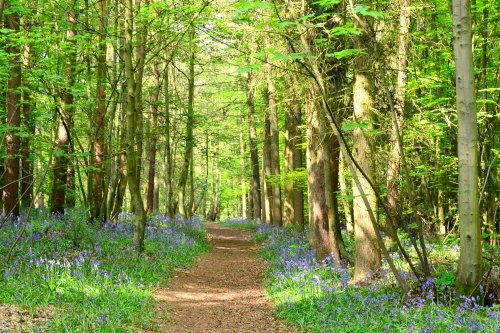
But now I'm rewarded with high places and wide views of rolling hills and fields and woods. We're having a late spring after that cold spell, and all the plants are hurrying to catch up - the trees are still partly bare, but the grass flowers are out and the bluebells are tentatively carpeting the woods. It's only going to get more lovely.

Of course, all this running and enjoyment of the great outdoors is only possible because of my great medication. Remember to sponsor me if you haven't so far!

2013-04-21

My Own Private Marathon

It's less than a month till my big run. I'm still short of my sponsorship target - every pound counts, so please follow this link and donate anything you can afford.

As part of my prep for the Marlborough Downs Challenge 33, I'm running a marathon today.

That's 7 miles less than the 33 miles of the Marlborough race, of course, but it'll be a good bench mark.

So I'm off down the A5 to Towcester, then back home by the back roads through Blakesley, Maidford and Preston Capes - and finally, over the dreaded Newnham Hill at about mile 24.

It's a lovely sunny day today. Sunblock, asthma medication, sports drinks, sunglasses and phone all ready. Best be off then!

I fully expect to be told I'm going the wrong way, and a long way from London.

2013-04-01

Recovery Days

I decided not to go running today.

Yesterday, I ran 32 km, and it's tried me out. All the fine muscles and tendons round both knees and ankles are aching still. It hurts a bit to climb the stairs.

It's been a long time since I ached the day after a run. Yesterday wasn't an especially long run - I've gone farther, and recovered faster - but I think that it was the pace I kept up through the run that's left me aching.

We've just entered April - my big event target is the 33 mile race in May, a little over a month away. Now is not the time to be wussing out of training.
I'm pretty sure tomorrow I'll be fine - but despite my fatigue, I don't want to loose today.

So - onto the static bike for some high intensity cycling, and a bout of boxing training with my heavy punch bag.
My knees and ankles are aching, so I pick the bike as it doesn't impact those joints. Also, boxing doesn't impact the legs, except in asking for agility.

Both these exercises are good for general fitness and cardio - and those are things I need to keep up with too. It's all very well pushing my distance endurance limits, but without a strong heart to back it up, it won't do me much good.

http://www.justgiving.com/Marlborough-33-2013