Showing posts with label Gaming. Show all posts

2017-10-02

Keeping It Simple - Training & skills

In my earlier post about setting target numbers in RPGs, I said that the method I'd come up with might break down when skills are assumed to include some specialist training:


Fixed difficulties can make it hard to model tasks that require advanced training.
For example, if someone wants to open a lock, the GM might think "This is just an ordinary door in a house - the lock is nothing special. I'll make it an average task, 'cause the lock is just an average object." However, this would mean that an untrained person with a decent Dexterity could open the lock with a few tries - not very realistic. 
D&D and many other d20 games deal with this by saying that some skills cannot be used untrained - if you've not invested your skill points in the skill, you just can't do it.
Me, I don't like that so much, as it adds another level of look-up: which skills are prohibited to untrained characters? It's not always intuitive.
... and I promised I'd provide my solution. Well, it's a been a little while (ahem), but here it is.

Do we think this task requires special knowledge?

Usually, this is a yes / no question, and the answer is clear. 

For example, climbing is an innate skill of  human (and other humanoids, depending on your game setting) - yes, skill makes us better at it, but anyone with sufficient mobility can climb. 
Similarly jumping, running, and other raw motor skills. 
Also fighting - we can all fight to some extent, even if that just means flailing the limbs wildly and hoping. 

On the other hand, can you try electronic engineering without knowledge? Not so much.

When there is doubt about whether a skill needs knowledge and training, make a decision for the particular skill check, and move on. After the game, think the decision over - was it right? Don't get stuck on little things during the game itself.

Not knowing the topic imposes a penalty

Once we've decided that special knowledge is required for a given skill check, then we think about whether you know that stuff.


That's easy - make a Knowledge check to know the topic. And because we've already set target numbers for skill checks, we only have to decide if the Knowledge is Easy, Average, Hard, Heroic, or Epic.

For complex systems and tasks (like retro-fitting a turbo to an engine, or deciphering a dead language), we can require multiple Knowledge checks, or higher success. 
For example,  "What are all these symbols?" is an Average task, "Knowing these symbols, what happens when they're arranged like this?" is an Average task, or a Hard task if it's your first roll (so you skip a stage of the process); and it's a Heroic task to establish that "I recognise this arrangement of symbols on sight."

Outside knowledge can be influential, too - in a modern game ,there's loads of information available almost all the time. Does the PC have a manual or some sort of instructions for the task, for example? Then we can allow this to take the place of a Knowledge check success, but probably at a slower pace.

But what does success mean? We're buying off penalties here. If you know little about mechanics, it'll be hard to fix an engine, but it's not impossible - a heroically intelligent PC might be able to figure it out with hard work and perseverance. So we're not changing the DC of the task - the task is the task, it will always have the same DC. What's changing is the PC's understanding of the task.

Setting the penalty

How hampered by a lack of Knowledge will you be in this task? Again, because we've already set a bunch of standard adjustment levels using natural language, this should be easy to decide. Is it a Minor, Major, or Extreme problem? You can decide this from your own experience, or use the Difficulty level to give you a clue to what's appropriate - lack of Easy or Average Knowledge will generally be a Minor penalty, Hard would be Major, and Heroic or Epic would be Extreme.

So if the Knowledge check is failed, it may not be the end of your task attempt - you might only be faced with a Minor penalty. Or it could be Extreme. 

For extended complicated systems, you might be able to work out things as you go along examining the problem. That'll let you make new Knowledge checks after starting. So you can start trying to buy down that penalty to something more manageable - all of which will take in-game time.

That's it

Decide: does this skill check require special knowledge?
Set the Knowledge DC, or DCs for complex tasks.
Set the penalty for lack of knowledge.
Decide: do we allow new Knowledge checks as the task progresses.

2017-10-01

Fantastic Toponymy: Inventing Place Names

When we invent a place for a game, we need to name it. We can just mash together some syllables until they sound cool, or we can try to make a name that seems to have history, that sound natural and hints at the culture of the place by using real elements from real cultures. Or if we're really adventurous, we can invent sounds that have invented meaning, and use those to build our place names - like Tolkien famously did.

"Toponymy" is the naming of places, from the Greek "topos" place and "onoma", name. The places all around the Old World have names that have developed over centuries or millennia- names usually derived from a simple description of the place.

The New World, by contrast, is named far more recently, with names that are usually simple, current language terms that are easily understood, or native names perhaps spelled poorly by the settlers. Both follow similar conventions once you look into the language.

Reflecting culture

Where is this place you're naming? What are the people there like? Are this a place of familiar, homely folk, or do you want to invoke a feeling of "otherness" about your invented place?

The names of the British Isles are familiar sounding to we English speakers (even those outside the UK). They can seem homely, even rustic and Olde Worlde (especially to those outside the UK!).

Similarly, the names of other nations' places, made up as they are by different language elements, can seem foreign, but familiar - "Porto Nova" reflects that it's inhabitants speak some Mediterranean, Romance language, so we have a handle on the sort of culture we might find there, just from the name.

A place called "Klak'amtuu" or "Shissiissii" tells us that this is a culture we are not familiar with.

Be careful not to just borrow real world names directly for your fantasy locations, though. Those have cultural baggage that you probably don't want in your game.
Of course, if you deliberately want to bring in the implications of a real-world name to your game, that's up to you - just be sure you're aware of them!
Calling your pseudo-Britain "Albion" (as in the popular CRPG Fable) is fine if you include all the people of Great Britain - the Cornish, English, Scottish and Welsh), but not so good if you just treat them all as English. We have whole political parties here in the UK dedicated to independence for those nations.

Settlements and other places 

Since you're reading this in English, I'll start by looking at English place names.

Nottingham is a worn-down version of "Snotta-ingas-ham", meaning the settlement ("-ham") of the people ("-ingas") of Snotta (a Danish chieftan). That "-ingham" ending is all over England.
Canterbury is from "Cantware-burgh", meaning the Kentish ("Cantware-") Stronghold ("-burgh"). Again, that "-bury" ending, and the related "-burg", "-borough", and "-burgh" ending are all over the British Isles.

So armed with this knowledge, your invented place could be called Notesbury ("Snotta's Stronghold"), or Cantingham ("Settlement of the people of Kent") - some other combination from the name elements appropriate to the culture.

There are plenty of resources for such elements of British place names on the web, so I won't just reproduce a list here.

Similarly, you can find that sort of list for other cultures: Here's a list for Japanese place names, and a short list for Maghreb toponyms.

From these examples, you can see that place names tend to be derived from a few common parts:
  • geographical feature (river, hill, valley, forest, etc)
  • type of settlement (farm, fort, village, town, etc)
  • direction or position (north, south, upper, middle, etc)
  • person of note (founder or clan leader, saint, etc)
  • description (dark, cold, red, windy, etc)
It can be helpful to make up a plain English name with such elements, and then translate it into whatever language is appropriate - for example: Hill Fort Town might be "Lawtonbury" in pseudo-Britian, or "Okajo Machi" in pseudo-Japan.

Country and regional names 

Nations and regions are often named for who lives (or lived) there (usually this is the name given to the place by its inhabitants), or a descriptor of the region (usually this is a name given by outsiders to the region).

Thus we get Scotland, the land of the Scots; France, named for the Franks; and Afghanistan the place of ("-istan") the Afghans, and so on.
While on the other hand we get Cameroon, the land of shrimp (Portuguese "Camaroes", via French "Cameroun"), from the abundance of shrimp found by European explorers in the Wouri River; and Wales, named by the Saxons for the foreigners ("Welisc") who lived there.

This can be useful - dual names for a place can help show historical enmity between the natives and the outsiders who imposed the other name.

Here's a list of country names and etymologies - and a list of regional names for places within countries that aren't on the former list.

You can see from those lists that national names - in the Old World - tend to be derived from a few common elements:
  • people's or tribal name (Franks, Angles, Danes, Sicels, etc)
  • description of people (foreigners, bearded ones, etc)
  • geographical description (green, forest, mountainous, etc)
  • place indicator (place, land, home, etc)
So again using your language of choice to reflect the culture you want to imply, you can name your region in a similar manner to settlements and places, but using these elements.

Geographical feature names

The great geographic features of the land were often named long long ago, in languages far removed from everyday. The new folk invading or colonising a place would just use the local name, not knowing or soon forgetting what it meant.
The River Avon in England means the "River River" - "avon" is derived from an ancient British word for river.

Alternately, the name may be clear and descriptive in the current common language - the Misty Mountains in Tolkien's Middle Earth, for example.

Features like mountains, rivers, lakes, marshes, and headlands will usually include some element that means just that - "mountain", "river", "lake", etc. Together with that element, there will usually be another part that simply describes the feature - "misty", "dark", "wide", or similar - or perhaps the name of a person or tribe.

Once again, we end up with the same sort of naming method, choosing from a this set of word elements.

Alien and bizarre places

To suggest a strange an exotic place, you can use language elements the players will not be familiar with, or invented languages like Klingon, or Quenya - or even your own invented gibberish sounds.

So in Middle Earth, we have Imladris, meaning "Cloven Valley" for Rivendell, and and Hithaeglir meaning literally "Towers of Mist" for Misty Mountains.

One could with relative ease invent a range of place name word element and use them consistently for a new culture. This could work particularly well in contrast with a region of familiar sounding names - for example, Crick Hollow, Buckland, Chetwood, and Weathertop giving way to Khazad-dum, Lothlorien, Gondor and Cirith Gorgul as we progress further away from the homely Shire with Frodo and Company.

Similarly, this technique works even with names that while relatively familiar, don't have that homely feeling created by names like your local region's names - so English name elements giving way to Germanic and Scandinavian names, or Latin names will create an atmosphere that evokes those lands, and all the assumptions that go with them.

Conclusion

Because place names can be evocative, and can be laden with culture, we should be careful not to just use them at random. Names and style choices in game settings will create an atmosphere. With only a little research and work, you can bring life into a place just by speaking its name.

2016-01-28

Keeping it Simple - Bonuses and Penalties

Specific lists restrict creativity


Lots of games seem to fall into the trap of giving you lists and lists of specific adjustments to apply to die rolls in your game.
I'm calling this a "trap", because if you specify a set of adjustments, then you are strongly suggesting and promoting the idea that only those adjustments are correct.
Yes, you may state that the GM can invent their own adjustments, but unless you put that text alongside every instance of specified adjustment, players will end up treating it like a mandatory list of unassailable law.
 
Games also have a habit of having lots of levels of adjustment, from lots of sources. The d20 OGL games have a myriad of +1s, +2s, -1s, -4s, +5s and so on. There's a lot of maths to juggle, and in the excitement of an action scene, who wants to be fiddling with mental arithmetic?*


OGL d20 games also have rules on which adjustments are allowed to "stack" - that is, what can and can't add together. Usually (but not always), the same type of bonus cannot stack - but there are lots of types of bonus (circumstance bonus, equipment bonus, morale bonus, etc., etc.), and they don't always follow the rule you might expect - so you have to go look them up.
 
D&D Next, or 5th Ed, call it what you like, has a neat way of overcoming this maths issue, with the "Advantage / Disadvantage" rule: when circumstances give you better or worse conditions, roll 2 dice, and take the best (advantage) or worst (disadvantage) result.
Unfortunately, as neat as this rue is, it applies in a list of specified case again, resulting in a perceived lack of freedom to wing it.
 

Broader guidelines promote freedom

Broader guidelines on adjustments allow freedom and creativity. If you give the players and GM a list of a few adjustments that can be made, then they can apply them how they see fit.
If the players are trying to get an advantage, they'll tell the GM how they want to do it, instead of looking up a rule that tells them how they must do it.
Instead of checking through the combat rules to see if there's a bonus for higher ground or charging or whatever, you'll feel free enough to declare that your character's swinging in the rigging and jumping on her enemy like a proper swashbuckling hero!
 

My "fix"

Let's have just three levels of adjustment: Minor, Major and Extreme. This lets us have bonuses or penalties of just three types, positive or negative. Giving them simple descriptive names lets you make value judgements about them, too.
  • Minor = 2, Major = 4, Extreme = 8
Can we stack the adjustments?
Yes - but to avoid run-away adjustments, here's the only bit of complexity I'm going to add: you need 2 of the lower adjustment to add up to make one of the higher adjustment.
That is, 2 Minor = Major, and 2 Major = Extreme.
In this way, adding a Minor adjustment has no effect on a Major adjustment (unless you add 2 Minors, which add together to make a Major).
And to keep our adjustments from getting too high, I'll say that Extreme is as high as they ever go. If you've ever lucky enough to have 2 Extreme bonuses, then the GM should just rule that you succeed, rather than making you roll.
 

Will it work?

For games with a gritty or heroic scale of characters (Conan, Buck Rogers, Star Wars, Pulp Fiction and the like), this sort of thing will work fine. If you need more extreme adjustments (such as in a superhero game, modelling both Superman and Lois Lane), then you'll need to allow them - maybe add an Impossible adjustment level beyond Extreme?
I'll see how we get on with this ruling, and post my findings!
 

* Yes, some people like maths. Not everyone does.


2016-01-09

Keeping It Simple - DCs

Lots of games, especially D&D (all editions - some worst than others), suffer from target numbers or difficulty classes ("DC"s) that are opaque, presented once as a special case, with no explanation as to where the number comes from.

On the other hand, there are plenty of games that give you a set of numbers up front as a basis to let you (the GM or the players) eye-ball the numbers and set your own DCs accordingly - R. Talsorian's Cyberpunk 2020, for one (I think it was the first game I played that used the idea).

How do we set these difficulty-based target numbers?
Decide what difficulty types you want - they should be clear and memorable, and not too many. There should be no doubt which is harder and which is easier.
I'm going with:

  • Easy (little chance of failure), 
  • Average (trained people usually succeed, but may fail), 
  • Hard (trained people need a few attempts to succeed), 
  • Heroic (little chance of success), and ...
  • Epic (even elite trained people usually fail).

Now we need to look at the numbers we should assign to these.
"Easy" should be at least a 50% chance of success even to untrained and untalented characters - so in the d20 system, that's a 10 (you can beat a 10 on an unmodified 1d20 roll 50% of the time).
"Average" should be about a 50% chance for someone with innate talent, or training. In d20 games, a starting character can have a maximum skill bonus of +4, plus their ability score bonus (again, a maximum of +4, but those sort of scores are relatively rare).  So we can set the Average task number at 15, because you need to roll an 11 if you have a bonus of +4, which is what we expect an unexceptional starting character to have.
"Hard" should require talent and skill, and maybe a little more experience. The starting character's maximum ability + skill bonus of +8 can be boosted by Feats like Skill Focus, or by proper tools - so we can set this target number as 20.
However, so far, each of these difficulties can all be beaten by someone with no training, if they're lucky - i.e., they get a high roll. Even an average unskilled person can achieve a hard task sometimes - it'll just take more tries.

"Heroic" and "Epic" tasks are out of the reach of the untalented and untrained.
Let's set "Heroic" at 25 - to beat this, you'll need to roll high, and have a big bonus. That maximum starting character bonus of +8 we looked at a moment ago will need to be boosted with experience or other bonuses to get to the point where Heroic tasks are routine. To have a 50% chance of beating a 25, you'll need a +15 bonus - requiring Feats, experience levels or special tools to reach.
"Epic" needs to be harder, but not out of reach of higher level characters. Let's set it at 30 - that way, Epic tasks won't become routine until you've acquired a +20 bonus.

I've picked increments of 5 for each of the difficulties. Nice and easy to remember, and supported by the game's mechanics: a +5 bonus is normal for a starting character's speciality, and it can be expected to increase by an average of 2 points per level.


  • Easy 10
  • Average 15
  • Hard 20
  • Heroic 25
  • Epic 30


With these numbers set, instead of having to look up the skill, you just have to agree the class of difficulty.

Problems

Of course, it isn't perfect - it needs some tweaks to make it work universally. I'll look at solutions to these in future posts, but first, I'll state what the problems are.

Fixed difficulties can make it hard to model tasks that require advanced training.
For example, if someone wants to open a lock, the GM might think "This is just an ordinary door in a house - the lock is nothing special. I'll make it an average task, 'cause the lock is just an average object." However, this would mean that an untrained person with a decent Dexterity could open the lock with a few tries - not very realistic.
D&D and many other d20 games deal with this by saying that some skills cannot be used untrained - if you've not invested your skill points in the skill, you just can't do it. Me, I don't like that so much, as it adds another level of look-up: which skills are prohibited to untrained characters? It's not always intuitive.

Fixed difficulties don't account for circumstances.
If you're trying to break that lock by torchlight, with a kitchen knife and a bent nail, while the rest of your team are fighting a rear-guard action at your back, it's harder than if your were doing it on your table at home under a bright lamp.
This is simple enough to fix - we can make a system of bonuses and penalties to apply. But again, we need to keep it simple!

2016-01-01

Keep It Simple, Stupid!

I like my games to be simple, so I can concentrate on the play. I don't like having tables and table of things to look up.
I like games that have a neat core mechanic, and stick with it so that everything runs off one easy to learn rule. I don't like special exemptions.
I want to be able to run or play a game with only my notes or the character sheet in front of me, never needing to dig through the rule book.

I've been playing around with my own d20 hack system for a while now. I'd become very familiar with the Open Game Licence d20 systems through playing D&D 3.x, Pathfinder, d20 Modern, and all the rest - so a d20 hack seemed like the way to go. It's been great, very enjoyable ... but I've been weighed down by a lot of legacy issues from the original system.
OGL d20 comes close to having one core mechanic, but then it produces lots of special cases. The character class system, the feats, the skills - there are far too many special abilities, specified DCs, and so on: too much stuff to look up.

So - I've been thinking about how to get rid of look ups. Using d20 as a base to work from (partly because it's where I'm starting from with my own hack, but also because it's OGL and we can all look at it for reference), I'm going to present alternative methods and examine them to see how they stand up.
At the end of this process - or at least after several iterations of the process - I may have a plan of cuts and adjustments to make that'll turn my d20 hack into a system that really stands up by itself. Or I may just have a set of house rules to bolt onto the rules as written. Either way, I'll be happy.


2015-03-19

"Following!" - apprentices and goon squads


Re-watching Game of Thrones the other night, I was struck by how several characters wield power by commanding various others, rather than directly - in particular, one character snaps an order to their guards to seize another name character and cut his throat, just to demonstrate their power.

A goon squad in action

This got me thinking about how to introduce that sort of thing into an RPG - and whether it's a good idea at all.
There's a long history of games, from D&D onwards, adding lots of hirelings and men-at-arms to the player party, but as time has worn on, these features seem to have fallen away. Lately it seems games focus on individual player characters - you get one PC, and maybe an animal companion or hireling.

In my experience as a player and GM, there are issues with player characters having followers - the followers can overshadow the players' characters, they can add to the complexity of scenes (especially combat), they can boost one character's power far beyond the rest of the player-base...

So here's my list of pros and cons:
    PROS:
  • Physically weak but charismatic characters become more viable, even in a violent setting
  • Politically powerful or important characters would tend to be surrounded by guards
  • Apprentices, squires and batmen are trope-tastic
  • More role-playing opportunities
    CONS:
  • Many more characters means more work for the GM
  • More combatants means longer combat
  • Players who don't want henchmen might lose out
With that in mind, I'm going to look at how to harness the pros, while avoiding the cons. Let's see how it might work...

Avoiding GM overload

A follower, yesterday
My first need is to avoid overloading myself!

To that end, henchfolk are an extension of the player's prime character - the player looks after them and directs them, rather then adding to the GM's load.

(I was going to say that "I've not had much experience of this", but actually in the main group I play with, any absent player's character has been run as a sort of collective character by the players and me as Ref.)

Giving the playing of the apprentice or guards to the player of the leader character keeps the GM's load down, but we have to make sure the player doesn't abuse this extra power.
Let's give the GM the right to question any apprentice actions that the player declares - perhaps with some mechanical back up, like a loyalty check.

Avoiding longer combat & extra actions

Goon squads and apprentices defend their master as a default - taking no active action, but granting defensive bonuses.
Directing the henchfolk to do something else requires the master to use an action. The follower(s) do  that action till complete, then return to default. And to avoid shenanigans, these directions can't be contingent - like "Attack those guys there, then those guys over there."

That ought to make sure that we don't have a proliferation of  dice rolls to worry about, and that getting henchfolk to do anything complex or scene-stealing will use up the master character's actions, too.

However,  we've still got the possibility of a squad of guards all needing dice rolls to resolve their actions. That's not what we want!
Some games treat small groups of soldiers as a sort of gestalt larger creature - Star Wars Saga Edition used Squads, for example. By using these sorts of rules we can just roll once for the squad of guards.

Types of followers

I've mentioned "apprentices" and "guards" so far, but we can extend those terms to cover any squire, butler, caddy or similar individual, and any gang, mob, or small force of combatants.

Followers need not be the same character type as the leader they follow -  in the Game of Thrones example that started me out thinking about this, those guards are very definitely differently skilled (tough fighters) to their leader (a scheming court socialite).

So I'd be quite happy for a scholarly wizard character to have a gang of dumb thugs protecting him, or for a barbarian warrior to have a loyal minstrel sidekick. Some combinations can be quite amusing, especially when they stray from what's expected.

Advancing followers

D&D 3rd edition and later editions allow player characters to gather followers - and then advances those followers as a function of the leader character's advancement. As your PC levels up, so do your followers.
So rather than letting any of your fellow PCs who've elected not to have followers catch up with your increased power, that system means that you will always be better than others due to your horde of followers and cohorts.
I reject that - it's exactly what I'm trying to avoid. Under that system, taking followers grants you an immediate advantage over any player who doesn't want to do so, and at very little cost. Once one player takes followers, anyone else who wants to play a loner character is put at a disadvantage - their character concept becomes sub-optimal within the player group. That's no fun.

Improving your followers should require that you spend effort training them, equipping them and so on. In terms of game mechanics, perhaps you should have to give up some of your lead character's experience points to improve followers, and spend your hard-gotten gains on kitting them out with decent weapons.

This method means that your fellow adventurers will advance faster than you if you spend effort keeping your followers trained. You could always neglect their training instead - but it will be part of the game to decide how much investment you want to make in your band of goons.


Conclusions

With a few easy tweaks, we've created some basic rules to gain the pros of using followers, and avoid the cons.

We've given control of the follower to the lead character's player, to avoid overloading the GM.
To keep the use of followers in games balanced, we've limited the additional actions - the leader needs to use some of their turn to command the follower - and we've made the player choose how much investment in the advancement of the followers she wants to make.

In practice, using followers has worked reasonably well with my gaming groups. At least, the cons have all been avoided - to gain all the pros, it may take time for us to get used to having multiple characters to play with.

2015-02-15

Morality & Reality - meta-ethics in your game

What is good? What is evil? Are they real physical forces, purely mortal moral judgements, or what?

What started me thinking about this again - after I've already laid out my opinions and tool box for both gods and morality in games - was a rather heated discussion about a particular real-world religion and its morality or lack of it. I'm naming no names. The discussion got rather entrenched, but it made me think of a few things that I found helpful.

Now there are plenty of discussion threads out there on alignment, and some very serious heavy debate about religion. I'm not going to try to replicate those here - I want to look at how the different points of view can be used when creating your game world.

Like my article on gods, I think that one's attitude toward Good and Evil in the game setting can have profound consequences which may be more wide reaching than you'd expect. As in that article, I'm going to present some stances that  you might consider for your game setting, and look at how these influence the setting.

I'm going to talk about Good and Evil with capitals, in that I want to distinguish these grand concepts from the less important good (meaning beneficial, competent, fitting, etc.) and evil (meaning nasty, ill, etc.).
I'm also going to talk about gods, angels and demons, and mortals as creatures that have different moral scopes within a fantasy game setting - but I'm using these terms generally: I don't mean to refer to D&D 3.5's demons, WoD's angels, or Zoroastrianism's gods, or any other specifics.

Debating ethics


Good & Evil are Actual Forces?

In this stance, Good and Evil are real, measurable forces, like temperature or mass.

As well as conscious beings having morality, Good and Evil can inhabit objects and places. A book may be inherently Good, its presence harmful to Evil creatures - or dreadfully Evil, driving its readers insane. An Evil ring may corrupt the wearer. A Good, sacred place may heal the sick.

If Good and Evil are tangible forces, then are sapient creatures left with a fixed morality? Can Good be driven out of a person? Can an Evil being become Good?

Of course, it's a common complaint about alignment systems that characters' mortality becomes fixed, and this stance seems to reinforce that idea - but it needn't be like that...

A flexible alignment system in action?

Only Actions are Good and Evil?

Only the actions of sapient creatures are Good or Evil in this stance.

Things cannot have morality, only people - and then only as the result of their acts. By doing Good, Bobby the Barbarian is Good. By doing Evil, Winifred the Wizard is Evil.The Book of Nasty Tales, however, is just a book, the Sword of Demonslaying is just a magic sword, and the Chapel of Holy Rest is just a building.

Perhaps the build up of moral actions can be detected in a person - their Evil becomes tangible through their repeated acts, and we can sense it, through divination magic, or as a creepy feeling.

This stance inherently allows the moral standing of a person to change as they choose to act differently. Over time, a Good person can be corrupted by Evil acts, and vice versa. We can have redemption and damnation as story arcs - a rich vein of role-playing to mine!

While this stance is flexible and arguably more realistic, it lacks the supernatural element of Good and Evil that we enjoy from  fantasy literature.

The Middle Way

The above stances can be somewhat restrictive - especially for a fantastic setting, which is of course where we most commonly want to play with Good and Evil ideas.

Perhaps there are beings who are inherently Good and Evil, who are exemplars of those morals - Angels and Demons - but the common folk, the mortals of the setting, are free to choose their moral acts, and in choosing, to determine whether they are Good or Evil.

Perhaps objects can be imbued with Good and Evil by exemplars like Angels and Demons, or particularly pious or profane mortal magic users.

In such a setting, mortals retain free will, and can change their moral codes over time, but the existence of creatures of absolute morality is permitted. We can have our inherently Evil monsters, our literally holy ground, AND our ambiguous and mutable protagonists, struggling to do the right thing.

2015-01-08

Self-censorship in RPGs?

There are times when I wonder about my sense of good fun.

Last weekend, I ran a game where the players had fun battling through storm conditions on the high seas, getting excited by running the risk sinking and drowning - when that very night, in the North Sea, dozens of real sailors lost their lives in a shipping disaster.

Regularly, I run games where religious intolerance, inter-faith war, assassination, fanaticism and the like are sources of entertainment - while the so-called Islamic State and al-Qeda are organising and inspiring the murder of journalists and aid workers
.
Is it okay to use these horrible events, vile actions and situations as part of a game?

Yes - of course!

We can examine the world through RPGs. By playing roles, we can understand people better, empathise better. By imagining what brings a person to behave in a certain way, we aren't condoning it.

Would you say that Sean Bean is evil because he played the corrupt agent 006? That Alan Rickman is a bad person because of his portrayal of the Sherrif of Nottingham?
Would you say that Peter Jackson is promoting black magic because he made films about Sauron and the Witch King of Angmar and all those evil beings?

Story telling is one of our ways of coping with the nasty and horrible parts of the world - and roleplaying games especially so.

So let's not self-censor ourselves. You only have to answer to your player group. If it's cool to you, then it's cool.

2014-12-12

Stealing settings for fun (and possibly profit)

Rather than trying to invent some wholly original game setting (and then trying to explain it to the players), often it's easier and more immediately fun to take an existing adventurous setting and modify it to your needs.

Love Star Wars and Spaghetti Westerns? Do both at once! Just watched Jason and the Argonauts and Pirates of the Carribean? Merge them!

How do you do that? Break it down into essential parts of the setting you want to emulate, and think about how to translate those into your planned setting.

So - what are the essential parts of the setting? Let's look at a couple of examples.

---

Cowboys in Space
(or wherever)

- making a Wild West themed setting in any genre

You will need:
  • The Old World
    • The planet (or planets) from which our Colonial settlers' ancestors hailed - representing Europe (and Asia and Africa) in our real world history.
    • The Old World has its problems, which may still influence what happens in the New World, but usually only at arms' reach: a war in the Old World might send more emigrants to the New World
    • Example: Earth-that-Was in Firefly. We assume this was our Earth, and Firefly is set in our future. Earth-that-Was is gone, and has no further influence over the setting.
    • Example: Mundia in the Helios system is the Old World. It is home to the human race, and is thought to be the orignal planet on which humans evolved and developed all civilisation. Its continental superpowers fluctuate between cold and hot war.
  • The New World 
    • The region that has been settled by the colonials.
    • The New World is largely virgin and unspoiled; rich in resources, but hard and wild.
    • Including:
      • The Established Colonies
        • The early colonies which have had a hundred years or more to settle down and expand - the equivalent of the 13 colonies of the US.
        • Example: The Sapiens Cluster. The initial colonisation of the Cluster was acheived through the creation of an artificial wormhole, allowing vast insterstellar distances to be travelled in a single short hop. The Cluster's several adjacent star systems were swiftly colonised by sub-light expeditions, and are now teeming hubs of industry and commerce.
      • The Wild Frontier
        • The regions of expansion, where the established colonies are pushing into the hinterland - the Wild West of the mid-19th Century.
        • Example: Since the colonisation of the Cluster, the invention of the FTL jump drive has allowed for interstellar expansion beyond the Old Colonies. The dozens of new frontier systems see explorers pushing back the edges of the known systems, prospectors following mineral rushes seeking fast riches, terraformers trying to create new farm lands, emigrants looking for a new chance - and the inevitable opportunists who support and prey on those waves of migrants: gamblers, grocers, doxies, doctors, engineers, bandits and marshalls.

Optional content: 
Some of the elements that go to make up the Wild West genre may be contentious and delicate, touching on real-world issues that are distasteful and perhaps out of place in an adventurous game setting - treat these with care.
  • The Recent Civil War
    • The Established Colonies and certain of the New Frontier regions have engaged in a bloody and devastating war over slavery or some similarly divisive ethical issue. The slump experienced by the losing faction causes resentment and division for decades to come. 
  • Various Natives - oppressed, belligerent, friendly, etc
    • Attempts to civilise the natives
    • Annexation of native land and resources
---

Pirates of the Mediterranean
(other seas are available)

- a Greco-Roman themed take on swashbuckling piratical adventures

You will need:
  • Civilised trading nations
    • The sophisticated empire and other regions between which expensive and exclusive goods are traded - so that the pirates can steal them
    • These will be your stand-ins for England, Spain and the "exotic" regions they traded spice with.
    • Example: Greece and Carthage trade around the Mediterranean and beyond, clashing with each other, but more usually coexisting as rivals - up to a point.
  • Naval authority
    •  The civilised nations have their navies who protect their trade ships.
  • Unexplored regions full of native riches
    • Standing in for the Meso-American civilisaitons plundered by the European colonials
    • Example: The African and European hinterlands are largely unknown lands to the Mediterraneans - so we can have hot and cold lands to explore and exploit, and all the alien cultures to go with them. With our mythic theme in mind, we can add legendary monsters and dangerous wizards into the mix.
  • Lots of uncharted islands and coasts
    •  Standing in for the islands of the Carribean, the Mexican Gulf, etc.
    • Example: The Greek Islands themselves, as well as invented myriad islands for adventures among hidden coves, smugglers' stashes, pirate havens and isolated cultures. In this mythic setting, these islands can be plucked straight from the Odyssey, with cyclopes, harpies and all.

2014-11-23

Playing roles - revisited

In my first "Playing Roles" post, I talked about the different forms of role playing that I've noticed people tend to do. Here, I'll talk about overcoming embarrassment - the idea that by acting up a role, you're making a fool of yourself.
 
Recently, I was chatting online with a mate who has trouble getting into character at the game table.
At the end of it all, he suggested it'd make a good topic for a blog - so here's an editted transcript of our chat, and a few comments to expand on it.


Via messenger


Me: As far as RPing goes, you seem to me to be a bit embarrassed about actually playing "in character".

Jack:Yeah. I get too shy doing it.
I always try to make a character based on someone from TV so I have a rough idea.

Me: Nicking other people's characters is fine - we all do it a bit. The point is to put yourself in their shoes.

Jack: I know we are all nerds together but I hated drama and stuff at school.
I can do the whole loud, blunt Jack act quite well, but that's it.

Me: Sure - make characters who are easy for you to play before you try hard stuff. You know - play Jesse from Breaking Bad. He'd be right up your street.

Jack: See, Vin [Jack's rogue character] was always Mike from Breaking Bad in my head. Sutrin [Jack's warrior character] was always going to be the Hound [from Game of Thrones] - but I never really got the ball rolling with him.

Me: Okay  - but you aren't a grim tough guy, yourself. You're more of a gobby youth, innit blood! That's what made me think of Jesse.
Me, I like to play clever, slightly posh chaps who want to do the right thing, but get out of their depth and have to bluff and blag their way through.

Jack: Is that why you are always a mental wizard? ;)
I was thinking gruff type dude would be easy as I can just be blunt.

Me: You may be blunt, but you're not gruff.

Jack: Sure. Right then - that's my plan. I will make a Rogue for [the next] game, and he can be a street urchin type - BITCH! Totally works, yo!


---


Play yourself


The short version is this: play yourself - or a version of yourself. 
It's usually within your comfort zone, you don't have to stop to think about character motivations so much - it reduces the strain and lets you enjoy the game.

Acting like yourself is far less out there than acting like a large ham, booming all your statements and trying to sound like Brian Blessed or Laurence Olivier.

I've seen the same sort of embarrasssment in LARPing - it's far easier to get people to come and play contemporary or near future LARP where they get to wear their own clothes than it is to get them to dress up like Robin Hood.

Once you've got the hang of playing a version of yourself, you might want to try assembling a character out of part of yourself, rather than just slotting your whole personality into the setting. 
Maybe you're a bit of a science nut, who finds social niceties difficult - then you might find it easiest to play a bookish wizard with little time for social skills.

Myself, my day job is working in product safety compliance, applying laws and safety standards rigidly: so aside from clever-but-naive idealists, sometimes I like to play strong enforcers of some code of ethics - cops or paladins or whatever the setting has - who have to learn to moderate their black-and-white morality.

Great actors talk about finding a connection with their character from their own experience, so that they can channel their own real emotions into the performance. 

You'll need to know yourself to play like this - but I've found that playing various versions of myself over the years has given me a better understanding of those parts of my own personality, which in turn makes me better at playing other roles.

If you start by making an alter-ego of yourself who shares much of your own personality, then their behaviour in the face of the game's scenarios starts out as easy - and in time, that behaviour and expeience will change the person that the character is, as their life moves away from your own. 
Then you'll find you're playing a well-rounded character, with just a hint of you buried under the wealth of experience they've gone through.

2014-09-29

A Fistful of Aces - playing card RPG

Playing cards have been used for RPG randomisation before. I've read none of those other systems - so any toe-treading is entirely coincidental - but the idea seemed sort of cool, so I thought I'd make my own card-based RPG.
After a bit of toying around, it seems that such a system lends itself very well to relatively rules-light but flavourful gaming. Jolly good - I mean: Yee-haw! Saddle up!

A Fistful of Aces

This is a story-telling role-playing game, played with an ordinary deck of playing card. Leave the Jokers in. Shuffle them well.


The Lowdown

Here's how the game is played. There'll be more nitty gritty below - this is just the jist.

One player is the Dealer, who sets the scene. Other players portray characters in the story.
We're telling a story together. The Dealer sets the scene, and the players tell the story of their characters. The Dealer may seem like he's the narrator most of the time, but each player gets to narrate their character's successes and failures.
When the player tells a tale of an outrageous success based on just a little win of the cards, she's raising the stakes - we all now know just how far that player will go, and we can go there too.
Careful how you boast.

The Dealer deals out 7 cards per player, including a hand for himself, which he sets aside until he needs it. The remaining cards are placed on the table face down - this is the draw deck.

When the Dealer describes a task that the players want to resolve - shooting down a bandit, jumping onto a train, bluffing the local deputy, or whatever - the player plays a card from their hand.

If the task is to beat an inanimate object - like jumping onto a train - then the Dealer declares the value of the card that will beat the task.
If the task that the Dealer has described is against another person - a non-player-character like the deputy - then the Dealer usually draws a card from the deck. If the player's card beats the Dealer's, then the player has succeeded. But if the Dealer's card beats the player's, then the Dealer wins, and the task has failed.
On the other hand, if the Dealer's character is a serious adversary - the sherrif, or the bandit chief, or some other key person - then he takes up the hand of cards he dealt himself, and chooses which cards to play.

If a player finds they have a good hand of five cards among their seven - a poker hand - she can play her hand to try to win the scene outright.
The Dealer plays the best hand he's got. The other players may choose to play their hands - for example, if the first player is beaten by the Dealer.
If the player wins, she gets to narrate the outcome of the scene. If the Dealer wins, he tells the tragic tale of the loser.

Each time a player plays a card, they pick up one to replace it. When the Dealer plays a card from his hand, he picks up to replace it.
When poker hands are played, each player and the Dealer picks up to replace the played cards.

Characters

The four suits represent four broad aspects of a person's character: Black suits are physical, Red are mental.

  • Spades represent strength, power, toughness and all aspects of prowess
  • Clubs are speed, maniual dexterity, agility and all aspects of skill
  • Hearts are persuasion, charisma, appeal and all aspects of social
  • Diamonds are cleverness, knowledge, learning and all aspects of smarts

Rank the suits in order of your character's aptitude. You get to have three specialities for your top ranked suit, two for the next, one for the next, and no speciality for the lowest ranked.

Specialities can be anything you like: brawling, shooting, science, doctoring, intimidation.

Tasks

If you play the right suit for the task, you get to add +2 to the face value of the card.
If you play the right colour for the task (but not the right suit) you get to add +1 to the face value.
If a task involves one of your specialites, you get to add +2 to the face value of the card you're playing.
All the picture cards - Jack (J), Queen (Q), King (K) - are worth 10: but in a tie, K beats Q which beats J. Aces are 11.
Jokers are wild - they can be played for the value of any other card.

The targets for an uncontested task - like jumping a gap, or climbing a wall - are ranked Easy to Amazing
  • Easy: 5
  • Average: 7
  • Difficult: 9
  • Very difficult: 10
  • Amazing: 12
Once cards are played, they are left in the discard pile. When the draw deck is finished, the discard pile is shuffled and becomes the draw deck.

Assisting
If a player wants to assist another palyer, they offer their hand for the first player a to draw two cards. If the assisting player has a specialism that is applicable to the task, the first player may draw three cards.
The first player then selects one of the cards to keep (and play if they wish) and returns the other to the assisting player. The assisting player then draws enough cards to make their hand back up to seven cards.

Poker Hands

In order of value, from the least to the best, poker hands are as follows:
  • 1 pair: two cards of the same face value
  • 2 pairs
  • 3 of kind: three cards of the same face value
  • Straight: five cards in sequence order
  • Flush: five cards of the same suit
  • Full house: a pair and three of a kind
  • Four of a kind: four cards of the same face value
  • Straight flush: five cards of the same suit in sequence order
  • Royal flush: 10, J, Q, K, A of the same suit

If two hands are of the same type (two hands of three of kind, for instance), then the higher value cards win. If a task involves one of your specialites, you get to add +2 to the face values of the cards you're playing.

If all the significant cards of that hand are the right suit, then your hand trumps the next better type of hand. If all your significant cards are the right colour, then your hand trumps any hand of the same type.
So for a Social task (Hearts), a flush of Hearts beats four of a kind (which will be a mixed suit hand), and a straight of all red cards beats a flush of black cards.

When you play a poker hand, you must put up a stake of at least 1 chip, which the Dealer matches from the Bank.

Gambling with your Life

Player characters start with 5 chips. Players can give their chips to each other if they're feeling generous.

When you play a poker hand, you must bet at least 1 chip. The Dealer matches your bet from the Bank. You can up your stake by adding another chip, until you run out. You can fold before you run out, but you lose the stake you've bet so far.
Each adversary the Dealer controls will have a limited of a number of chips they can bet before any further increase forces them to fold - to back down and lose their stake.
If the Dealer runs out before you, they must fold (back down) or play their hand. If the Dealer folds, you gain back your stake plus one chip. If the Dealer plays their hand, the winner takes all the pot. You choose whether you want the Dealer to fold or play.

You can also gamble chips to avoid failing a task - you put a chip in the pot before you attempt the task, and if you fail, then instead of your character failing the task, the chip is lost and your character completes the task.

Chips are also lost when failing a task causes injury, such as in a fight.

You gain a chip when you defeat an adversary, and you gain all the chips in the pot when you win at a poker hand. You don't gain chips for defeating extras, only for significant adversaries.

When you've run out of chips, you cannot play any poker hands. Any task failure that would cause you to lose a chip ends with you knocked out, in jail, or dead.
You and the Dealer can thrash out the details - remember we said to be careful how you boast?

High Stakes Games

As you win chips, you can take on tougher challenges, because you can bet higher and force the Dealer to fold more often.

You can also spend chip to gain new specialities. It costs 1 chip for every speciality you already have in that suit - but it always costs at least 1.

Dealer's rules

Who goes first?
Usually, contested tasks are simultaneous. Even in a duel, the quick draw and shot of the duelists is resolved by the opposed plays, not by taking turns.
But if you need to decide who goes first, it's a Skill task. Have the players play a card from their hand, and turn over the top of the draw deck for their opponent (or play from their hand). If a player chooses not to play from their hand for this Skill task, they go last (they might not want to spoil a powerful hand).

More than one adversary
When there is more than one named adversary against the players, then they may assist each other, just like the players.
Pick one adversary to take the lead. For each other adversary assisting her, draw two more cards, and pick one to put in her hand.


Central Casting

Extras in a scene are usually handled without much need for rules. If you need to, pick a suit to rank high, and a speciality to go with it. The extra gets +2 to tasks of that suit, and another +2 to that speciality, just like a player character.
Extras don't have chips to bet. When a player plays a poker hand to defeat multiple extras at once, the number of extras in the scene dictates the number of "virtual chips" the Dealer can stake against the palyer. For these virtual chips, use a distinctly different token. 

Named adversaries are made just like a player character. The Dealer sets their difficulty by giving them a number of chips from 1 to 8 (or even higher for High Stakes Games).

Example extras
  • Brawler: Spades high - fistfighter
  • Saloon drunk: Hearts high - carousing
  • Bartender: Hearts high - rumourmill
  • Deputy: Clubs high - arresting
  • Bandit: Spades high - robbery
  • Cowpoke: Clubs high - ranching
  • And many more...

Example adversaries and named allies
  • Doctor: 
    • Diamonds high - doctoring, medicines, one other book learning; 
    • Hearts - polite society, gossip; 
    • Clubs - pick one
  • Marshall: 
    • Clubs high - shooting, horse skills, tracking;
    • Hearts - streetwise, gossip;
    • Diamonds - law
  • Gang boss:
    • Spades high - brawling, toughness, maiming;
    • Hearts - streetwise, gossip 
    • Clubs - shooting

2014-09-23

Rules and the Game

Why do we use rules to play games? What are rules?

I'm an inquisitive engineer, with a background in sciences, and a love of games. I've been finding that when I talk to people about game rules, there's quite a different reaction even among those who love to play the same games as me. What's that all about?

The Game / Narrative / Simulation theory suggests players can be split into three camps - those who play the game as a challenge, those who play to create stories, and those who play to simulate an alternate reality - and that real gamers can be placed on a three axis graph that reflect their love of each.

[dons pretentious beret and roll-neck]
But like Pirsig in Zen and the Art of Motorcycle Maintenance, I've found there seems to be a split among gamers between what he called Classical thinking (dissect in-game situations to create simulation rules) and Romantic thinking (just do whatever feels right for the enjoyment of the game).

And like Pirsig, I think there's a way to create harmony between these two camps.
[stashes pretentious garb - for now]

I'm going to start with two questions, and see where those lead me: What are rules (in RPGs)? and What are rules for (in RPGs)?

What are rules?

In the context of RPGs, what do we mean by rules? Is everything in the AD&D Players' Handbook (for example) a rule? I think possibly not.

RPG books tend to present a few different types of material, so let's look at each in turn.

Character rules
Character abilities - how strong and smart the character is, skills and so on: these are obviously rules. Without these, the character you play isn't defined.

Mechanics of a game - what dice to roll, numbers to add, targets to beat, etc - especially where these are the mechanics for conflict resolution (can you hit the monster with your sword? can you climb over the wall and escape? can you argue your way past the palace guard?): clearly these are rules.

Species (human, vampire, elf, vulcan, etc) - the playable species (specieses?) of the game also forms part of the rules. Some games may present rules for creating new species, so that playable species are all of a similar power.
Similarly monsters and other adversaries - examples and / or rules for creation form part of the rules.

Are spells, equipment and gadgets rules? Probably, yes - they establish the power of players' characters and their tools. Again, like species, maybe the underlying systems should be put forward along with the spells, equipment etc, to explicitly show the system from which the examples are derived.

Tools, species, and adversaries are benchmarks for the power of the games elements. While most games will give examples, some will also provide rules for creation - what bonuses are appropriate for tools to provide, what are appropriate damages for weapons to deal, how tough adversaries should be, and so on.

Tables of options - like settlement population, random encounters, treasure and the like - are these rules? Maybe not...
Is it a rule of the game that settlements have certain population sizes and demographics, or is this a guide on setting, rather than a game play rule? Would you bother to ask the question about a list of random character or pub names?

Although lots of elements may appear in the rule book to help with play, not all of them are really rules - there's a lot of guidance and flavour in RPG books.

What are rules for?

As well as having my own opinions, I asked around on some RPG forums to get a sense of what other people think. It's always worth it - some people confirmed what I was thinking, but there were some gems of insight I'd never have thought of for myself.

So, in no special order, here's what rules do for us:

Fair play - rules make the game fair.

They create a system for fair interaction, including by randomisation (by Jenga tower, dice, cards or whatever) - rather than the players directly deciding the outcome of their characters' actions (GM included), there is a random element. This avoids bias, or the suspicion of bias.

Fair play also includes fair and equal access to an enjoyable experience. The player's abilities should not hold them back from having fun playing the role they want - the game rules should allow everyone to play equally.


A superspy yesterday
Just as the game rules allow weak students and office workers to play strapping tough warriors and action heroes, I think that the same attitude needs to be applied to social skills. So I may want to play a suave and seductive superspy, but I have the flirting skills of a celebate monk - and the game rules can allow me to do just that. As a player, I should be free to spout cheesy flirting and pick up lines, but my inept skill with them shouldn't override the character's skill.


Gaming the rules - we can play with the mechanics to achive our goals.

The combat rules of the d20 systems have various manoeuvres that can knock down or reposition your opponent, steal or destroy their equipment, and so on. Using these rules imaginatively can be very satisfying.
Rules must serve the style of the game, and enable players (see Fair play, above). Rules should focus attention on the important bits of the game (arguably, d20 games aim to make combat a focus of game play) - they certainly shouldn't get in the way.

Challenges - without rules, what limits you?

If we don't have any rules, can't we just declare the actions of our characters? What stops us being invincible? Can't we claim to have special armour and ignore the attacks of enemies? Can't we call on powers at will and without precedent?

Where do I stand?

Yes, I like rules - but if you come to my game, will you find me invoking the rule book? No, not really.
I prefer to run games by eyeballing the situation - using freeform instincts, within a rules set that I'm largely familiar with.

In my day job, I have a bunch of several-hundred-page safety standards that I have to refer to to test products for safety - but each of these boils down to a set of prescribed tests, built around a small set of safety principles.
Now, I know those principles very well. When I'm testing, I only need to look up the specifics of the test standard when the result is hard to call - most of the time, it's obvious whether the product meets the principles or not.

Of course, knowing the core rule concepts is vital.
Years ago, a gang of us used to do Live Action Role-Playing at the weekends, and we'd sometimes co-opt our non-RPing mates to come and make up the numbers too. One of these non-RPing guys - Jon - clouted a player character - Mike - across the legs with his sponge axe during a fight. Mike asked how much damage the axe dealt - and Jon said "Dunno - ten?"
Now 10 points of damage was a vast amount. Mike's character had 2 hit points on his legs - so Jon's hit had supposedly chopped them off completely. Basically, if the game's Ref had briefed Jon properly, he'd have known not to say "10" - Jon needed to know the ball-park area in which to make an educated guess.

So the rules are important, if only to act as a frame on which to improvise sensibly.
Like jazz [puts on the beret and roll-neck again] - an incompetent random honking on a bunch of trumpets sounds terrible, but a skilled player with an understanding of the rules can break those rules in an entertaining and exciting way.

The rules I've been palying around with inventing recently have been largely about the game setting. You see, I feel like I need to understand what is normal - long before I go deviating from it.
In storytelling, normality must be established / understood before the fantastic events take place - this creates base from which to operate, and avoids players' awkward questions.

I personally really don't like those questions - you know: "Why is XYZ not like ABC, as is normal?"

"Why is there such a long distance between towns? In Medieval Europe, there was generally less than a day's walk between villages - so why is it different here?"

"How can the Dark Lord muster an army of a million, when that'd require a support staff of double that amount? There surely aren't that many people on the continent."

"Why would anyone build a castle here? That makes no sense."

I hate being caught out like that - so I like to explore what is normal first, so I can make sure my games reflect something like reality - or so that when I chose to step away from the normal, I know that I've done so!

Then I can say: "Yes, that is odd, isn't it?"

Playing with rules

Last word from me on this topic - and the pretentiousness really piles up with this bit, I'm afraid.

Listening to Radio 4's The Infinite Monkey Cage, when presenters Brian Cox and Robin Ince were talking with maths author Alex Bellos and number theorist Vicky Neale, the love of discovering new mathematics was brought up - and it rang a big lovely bell with me. Let me paraphrase...

Making up rules is to play with quantifying the world in tables.
I'm finding the patterns, which I then use to provide a simulation.
Rules aren't made, they're waiting to be discovered and expressed.

[adjusts beret, strokes goatee]

2014-06-14

Gods - what are they for?

In the game-settings we play with - worlds, universes, multiverses - there is almost always some reference to gods, religion, mystic forces and the like: often these are the driving forces behind the story.

Gods and religion serve many roles in games and stories. It's important that in gaming - collaborative story-telling - we all know what we can expect from the gods and their followers.

Although I'm a non-religious person, I'm quite happy to entertain myself and fellow players with religious themes, mystic visions and other tropes - but I think that the delicate topic of religion and gods in fiction (and gaming in particular) could do with some analysis.

Otherwise, how will we all end up on the same hymn sheet?

In-game reality

What is the truth of the gods? Are they proven to be real, or is their presence ambiguous? If Zeus regularly abducts lovers and begets heroes, who would doubt his existence?

Let's split the camps into two: proven and unproven. I'll deal with unproven first, as it covers the more familiar ground (for me, at least).

Unproven

The gods - if there are any - are unproven. Their existence cannot be unquestionably and concretely demonstrated.

This situation is, of course, most like our every day real world. No matter how strong the faith of any individual or group of people, no deities' existence is empirically proven. 

  • Traditions & superstition
  • The intelligensia don't consider the gods to literally be true, but their traditions and superstitions are powerful tools. No-one believes that the priest in the god-mask is actually the god incarnate, but tradition dictates that all treat him as such.
    • Manipulative priesthood: The gods are known to be false, but the priests lie. The population is deceived.
    • Symbolic priesthood: The gods are metaphors for right behaviour. The worship of the gods does not rely on their stories being actually historically true, but more that the parable of their acts teaches the population how to behave.
 
(As an aside, it ocurred to me that - SPOILERS AHEAD, KIDS! - Father Christmas is a prime example of benign manipulation. Most of the population is well aware that they are the ones buying presents for the children, but we all go along with the manipulation that there is a magical present-giving entity, who rewards the good and punishes the bad. Consider a church that works like that... Interesting, yes?)

  • Absent & subtle
  • Belief in the gods is widespread and accepted at all levels. The intelligensia have complex and often philosophical ideas about the gods, while the layfolk have straightforward faith.
    • Faith through teaching:  The priests have faith, and they preach this and enforce the will of their god or gods. No-one can show that the gods are real, but it serves the priesthood to indoctrinate people into belief. This may be benign, as with Santa, or it may be purely to perpetuate the power of the church.
    • Faith through observance: The reality of the gods is socially given, but not readily apparent. No-one questions the gods - their existence is self-evident from casual observation.
Faith through teaching is what is required when people question the power of the church, whereas faith through observance is the state enjoyed when the reported acts of the gods are not in conflict with observable reality - either because we can't observe as closely as required to notice the discrepencies, or because those acts are in accord with reality.

Proven

The gods are a fact of life, with verifiable evidence to back them up.

This situation is not like our real world. The gods are known to act in the mortal realm, to intervene on behalf of pious worshippers. Even the most cynical would respect the invocation of the gods - there will be no atheists here.

  • The "myths" are all true
  • The fantastic stories about the gods' exploits - from their creation of the multiverse, to their appearance, to their powers - are all literally true. Still the gods may have powers and interests beyond mortal ken, but as a minimum, we can trust what their scripture says to be 100% fact.
    • Gods are all-powerful, unlimited beings. Omniscient and omnipotent beings, the gods are literally able to achieve anything they desire.
    • Gods are beyond mortal power, but limited. The gods are constrained by limits of some sort - perhaps according to their station in a heirarchy, or their patron sphere

  • Gods are powerful outsiders 
  • The gods are extra dimensional beings of some sort. They are worshipped, but they may not even claim to be gods - or if they do, it is in order to exploit those who worship them. Scripture about these gods may be an imperfect record of the actual events.
    • Hero-gods and saints. Hercules, the Caesars and so on were elevated to godhood - larger than life heroes. Saints take their place in the afterlife as intercessionary being on mortals' behalf with the ruling deitiy.
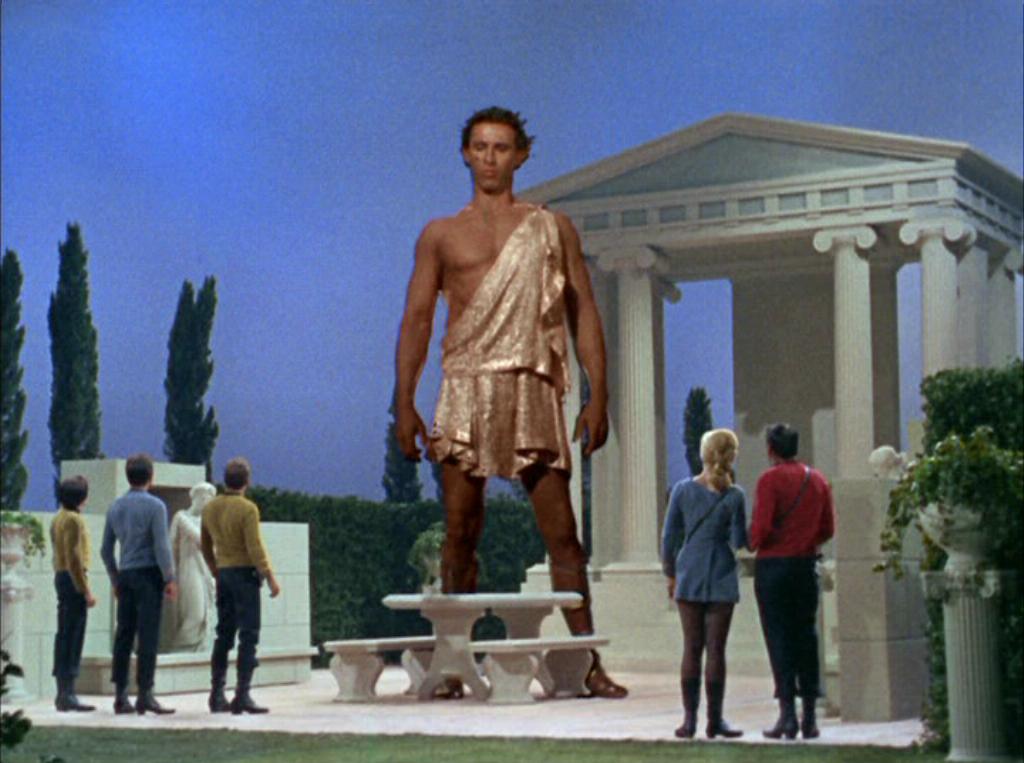
    • Meddlers in mortal affairs. Ultrapowerful being seeking to interfere with the lives and development of lesser entities - Star Trek's Apollo, Q, (and others), or Star Gate's Ra.
    • Alien, unknowable entities. Incomprehensible beings whose motives are unclear. They act without explanation - Lovecraft's Cthulhu et al, 2001's monolith builders.


What is truth?

What constitutes proof of the gods in the game? You need to consider what absolute evidence is available, and what is questionable - so that you can decide how people outside the faithful circles react to that evidence.

Do you have priests who gain their magic from divine energy (and how is that demonstrably different from wizardly magic)?
Would it matter if Apollo turned out to be some errant super-being, rather than a "real" god? What is the difference?
I'll consider these questions along with Function, below.

Function

So - what is the point of gods in your setting? What story purpose do they serve? How important are religion and / or deities to your setting?

I can break this down into three functions:
  • Background flavour
  • Political groups
  • Active characters

Background flavour

The gods and their religions are simply a background flavour - something to increase verisimilitude. Throughout real human history there have been cults and churches, and it would seem unreasonable for these to be absent from a fantasy setting.

These gods and religions are not especially important, except as role-playing and story-telling props.

Political groups

Massive congregations, infalible heirarchies and divine power can make a church an absolute ruler of its culture, even above secular leaders. Historically this has been the case for real world faiths for certain periods.
On the other hand, a religion can rule along side the secular throne. Wise advisers to the emperor hold enormous political influence.
In polytheistic socieities, the various deities' priests might jocky for supremacy with the mortal rulers - who may in turn elevate the status of the deity.

These gods and religions are important because they are the motivators of political groups - orthodox or revolutionary - but it is the people who act, rather than the gods themselves.

Active characters

The gods are present in the real world in some way, like the Greek Olympian gods, living on a holy mountain top, or like the Norse gods, living in some otherworld. In either case, they are real entities who will act on the game setting in some way.

Perhaps the gods manifest themselves through influencings nature - through storms, lightning, earthquakes, sickness and other events. Rather than manifesting in some physical form, the gods manipulate the world to do their will.
This sort of god is subtle and doesn't seem to directly influence the world, moving in mysterious ways. You can use this in games to set up divine coincidences to move the story - random fate becomes divine favour.

Maybe the gods do take on physical form, as perfect immortals, or divine animals - and perhaps these forms influence their bahviours, so that they are as petty and capricious as mortal culture. Just look at the Greek gods - stealing sexy women, starting wars out of jealousy, fighting amongst themselves, cursing mortals on a whim.

Such interfering gods can be the driving force behind adventures.

Divine magic

A common trope in fantasy games is that worship of gods gains the followers magical power.

If priests gain magic from the gods, is this the only form of magic? Are there also wizards? Is there a functional difference between wizardly and priestly magic? Or is the difference only political?

You might have priestly magic concentrate on life and death, fear and morale, and so on - whereas wizardly magic might be concerned with manipulating the elements.

Or if only politics separates divine from arcane, perhaps there would be jealousy between the two styles, so that wizards are outlawed, and the church investigates any magical practice by the layity.

The presence of divine magic in a fantasy game allows for magical differences between followers of different religions - followers of the Death god gain different sapells to the followers of the Creator god, and so on.

False gods

What is the functional difference between an ultrapowerful entity claiming to be a god, and a "true" god?
Leaving aside real-world current religious answers, let's think about why Zeus (who is a god, acording to the Greek mythos) is more qualified as a god than say, Manwe (who is not a god, according to JRR Tolkien's legendarium).
Neither are all-powerful. Neither is the creator of the world. Neither is infallible.

Functionally, then, there is no difference between "true" and "false" gods, except the political implications of the claims.

Enlightenment

There are lots of ways gods can appear in fantasy fiction. Depending on the preferences of your player group, you can use any god or gods you like - but it's usually a good idea to think about whether you'll offend anyone before you use real-world religions, or churches with similar traits to real-world organisations. If in doubt, ask.

Me, I like to have multiple religions in multiple cultures in my game settings, and I tend to have deities fit into the "Powerful outsiders" and "Unproven" categories - I'm interested in the political interaction of faiths.

Whatever sort of deities you want to have in your game, understanding their role and being consistent in their portrayal is key to making the world seem real.