There's an interesting article on the BBC News site about the circuit ultra-run this weekend in Gloucester.
Circuit ultra-running is daunting - rather than running a long course, it's just laps of a standard 400m track.
The changing scenery and sense of achievement I get from running long distances? Nope, none of that for circuit ultra-runners, just endless laps.
There's much bigger mental challenge in circuits. When I get tired 10 miles from home, I know that the only way to finish is to keep going.
On a circuit, rest is never more than 100m away. The grit to keep going is far more abstract, far more about personal discipline than about necessity.
2014-06-14

2014-05-31
Wildlife woes
When I go running, I particularly like to run in the countryside, either on country lanes, or footpaths and bridleways.
I get to see the picturesque landscape, the rabbits, butterflies, sometimes a fox. I hear the birds singing, and sheep in the fields.
All very pleasant.
But there are some creatures out there that seem to have other ideas...
Near where I work, some of the local farmers keep bees. Almost any footpath I care to run along has a nearby beehive, with the resultant traffic of bees to and from the hive and plants around about it.
So I've been stung three times now by bees.
Each time it has been on the top of my head, when a bee has been caught in my hair. I have fine fluffy hair, easy for an insect to get tangled in. The second time it happened, I cut my hair really short to try to stop it happening again - it didn't help.
When I get stung on the head, there's nowhere for the venom to go (scalps are thin), so the swelling looks worse. I end up looking sort of like this:
Or like this:

Now, I wear a bandana when I run, to keep the bees from getting trapped.
As well as bees, I've been stung a few times by a wasp. Just the one, over and over again, on my top lip. That was nasty, but not nearly as bad as the bee stings.
Moving on to vertebrates - but not exactly a wild animal: farm dogs.
There's a good 10 mile route through the countryside around my home, but it goes through a farm. This is a public road, which passes through a farm - its building are on either side of the road.
The farm appears to be run by a trio of dogs: I've never seen any people there. The first time I ran through there was with some mates - the dogs looked at us, but paid little attention.
Just before I ran through on my own, some weeks later, I met some cyclist going the other way, who warned me "There are some excited dogs up ahead."

For "excited", read "angry". These three farm dogs were pissed off with their territory being invaded once by whizzing sweaty men, and weren't going to let another sweaty man jog through. They herded me along - and the border collie bit me on the ankle.
(I'm told this is normal - if over-enthusiastic - herding behaviour for sheep dogs: to nip sheep on the ankles.)
Suffice to say, my personal best kilometer pace was set after passing through that farm.
Since then, I've learned that apparently dogs wag their tails differently when they're stressed and when they're happy - to the left when stressed, and to the right when happy.
Dogs know this, and they react with dominant / aggressive behaviour to dogs who appear stressed.
I theorise that being left-handed, when I instinctively wave left-handed to greet dogs - and being naturally nervous of them since I was bitten quite badly on the face by a dog as a child - I am encouraging dogs to be aggressive to me.
These days, I wave right-handed.
I also don't run through that farm.
On to avians - while running round a pond, I saw a lovely sight: some goslings being led along by their parents on the path ahead.
Of course, although I tried to give them plenty of room and go around, the parents had decided I was going to eat their offspring, and gave chase. Geese are quite big and scary when they're angry.

Worse than an angry goose waddling after me, was the buzzard attack this week.
Running along a normal stretch of road through a woodland, there was whoosh of something passing fast just above my head - a buzzard. As I ran on, I watched it fly over the road and into the trees on the other side, assuming I'd just been on its flight path by coincidence.
A few seconds later - BAM! I felt like someone had smacked me round the top of the head - a good cuffing blow that knocked my head forward and made me stagger. As I looked up and around to what had hit me, I saw my bandana flying to the ground on the verge in front of me, and the damn buzzard swooping up into the branches over my head.
It perched there, and keened at me: "Peeaw! Peeaw!" - I grabbed my hat and ran on, covering my head with my arms and muttering "All right, I'm going, I'm going!"
When I got back to work, one of my colleagues told me I was bleeding. Not too badly, on examination - as though I'd been badly scratched by a cat. The cuts didn't hurt so much as the impact. Still, I washed the cuts with alcohol from the solvents cupboard, to avoid bird flu or whatever nasties were on the hawk's talons.
As the attack had happened during my lunch break, I had to fill in the accident book and report it to the health and safety manager. "Wear a hat," he suggested.
I suspect the buzzard is nesting, or otherwise considers that patch of woods to its territory, and really just wanted me gone.
Suffice to say, that route is struck off my list of runs, too.
Incidently, when I was looking online for a picture of a British buzzard, it appears that my attack isn't especially uncommon:
Running is a great way to get out and about and see the countryside and wildlife. I just worry that the wildlife doesn't want to see me.
It'll be badger attacks, next...

I get to see the picturesque landscape, the rabbits, butterflies, sometimes a fox. I hear the birds singing, and sheep in the fields.
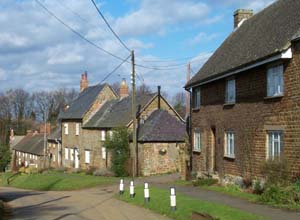 |
| Preston Capes |
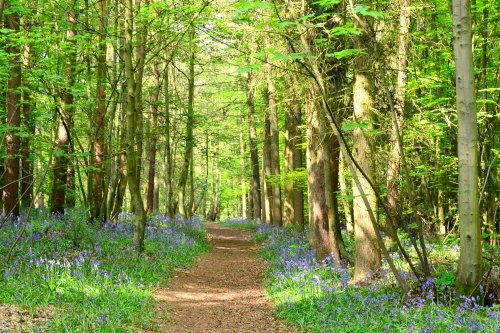 |
| Badby Woods |
All very pleasant.
But there are some creatures out there that seem to have other ideas...
Near where I work, some of the local farmers keep bees. Almost any footpath I care to run along has a nearby beehive, with the resultant traffic of bees to and from the hive and plants around about it.
So I've been stung three times now by bees.
Each time it has been on the top of my head, when a bee has been caught in my hair. I have fine fluffy hair, easy for an insect to get tangled in. The second time it happened, I cut my hair really short to try to stop it happening again - it didn't help.
When I get stung on the head, there's nowhere for the venom to go (scalps are thin), so the swelling looks worse. I end up looking sort of like this:
 |
Now, I wear a bandana when I run, to keep the bees from getting trapped.
As well as bees, I've been stung a few times by a wasp. Just the one, over and over again, on my top lip. That was nasty, but not nearly as bad as the bee stings.
Moving on to vertebrates - but not exactly a wild animal: farm dogs.
There's a good 10 mile route through the countryside around my home, but it goes through a farm. This is a public road, which passes through a farm - its building are on either side of the road.
The farm appears to be run by a trio of dogs: I've never seen any people there. The first time I ran through there was with some mates - the dogs looked at us, but paid little attention.
Just before I ran through on my own, some weeks later, I met some cyclist going the other way, who warned me "There are some excited dogs up ahead."
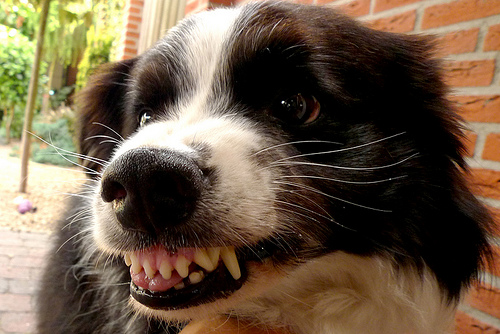
For "excited", read "angry". These three farm dogs were pissed off with their territory being invaded once by whizzing sweaty men, and weren't going to let another sweaty man jog through. They herded me along - and the border collie bit me on the ankle.
(I'm told this is normal - if over-enthusiastic - herding behaviour for sheep dogs: to nip sheep on the ankles.)
Suffice to say, my personal best kilometer pace was set after passing through that farm.
Since then, I've learned that apparently dogs wag their tails differently when they're stressed and when they're happy - to the left when stressed, and to the right when happy.
Dogs know this, and they react with dominant / aggressive behaviour to dogs who appear stressed.
I theorise that being left-handed, when I instinctively wave left-handed to greet dogs - and being naturally nervous of them since I was bitten quite badly on the face by a dog as a child - I am encouraging dogs to be aggressive to me.
These days, I wave right-handed.
I also don't run through that farm.
On to avians - while running round a pond, I saw a lovely sight: some goslings being led along by their parents on the path ahead.
Of course, although I tried to give them plenty of room and go around, the parents had decided I was going to eat their offspring, and gave chase. Geese are quite big and scary when they're angry.
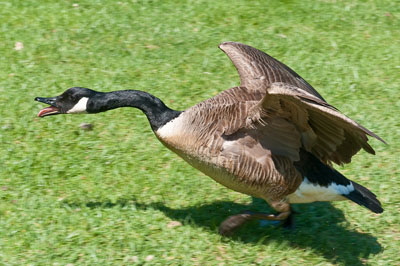
Worse than an angry goose waddling after me, was the buzzard attack this week.
Running along a normal stretch of road through a woodland, there was whoosh of something passing fast just above my head - a buzzard. As I ran on, I watched it fly over the road and into the trees on the other side, assuming I'd just been on its flight path by coincidence.
A few seconds later - BAM! I felt like someone had smacked me round the top of the head - a good cuffing blow that knocked my head forward and made me stagger. As I looked up and around to what had hit me, I saw my bandana flying to the ground on the verge in front of me, and the damn buzzard swooping up into the branches over my head.
 |
| A buzzard yesterday |
When I got back to work, one of my colleagues told me I was bleeding. Not too badly, on examination - as though I'd been badly scratched by a cat. The cuts didn't hurt so much as the impact. Still, I washed the cuts with alcohol from the solvents cupboard, to avoid bird flu or whatever nasties were on the hawk's talons.
As the attack had happened during my lunch break, I had to fill in the accident book and report it to the health and safety manager. "Wear a hat," he suggested.
I suspect the buzzard is nesting, or otherwise considers that patch of woods to its territory, and really just wanted me gone.
Suffice to say, that route is struck off my list of runs, too.
Incidently, when I was looking online for a picture of a British buzzard, it appears that my attack isn't especially uncommon:
 |
| Notice the first picture, top left... |
Running is a great way to get out and about and see the countryside and wildlife. I just worry that the wildlife doesn't want to see me.
It'll be badger attacks, next...
2014-05-24
Fantasy settlements - part 2.5: Location, location, location!
People don't just throw a stick in the air and build a town where it lands - at least, those who do don't meet with enough long term success for your player party to encounter such a shambolic shanty.
Here's a page where the topic is summarised nicely for high school level studies.
What can I add to that? Not a lot really - except some fantasy specific examples and possibilities.
Bridge point
The Twins - A Song of Ice and Fire
Osgiliath - The Lord of the Rings
Thandol Span / Dun Modr - Wetlands / Arathi Highlands, World of Warcraft
Nodal point
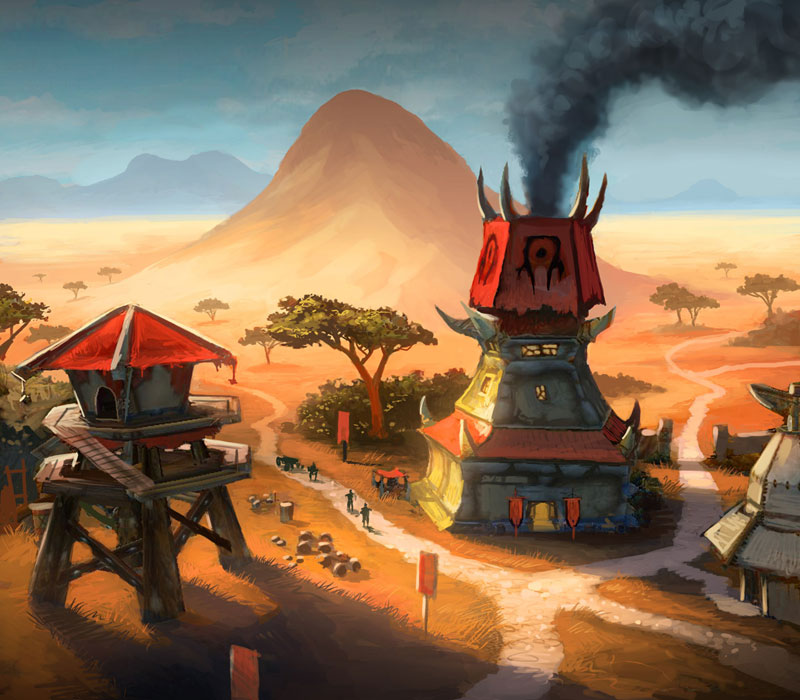
The Crossroads - Northern Barrens, World of Warcraft
 Inter-dimensional and inter-planar portals - a town around the entrance to the Underworld
Dry point
Swamp Castle - Monty Python and the Holy Grail
Thousand Needles (post-Cataclysm) - mesas as islands in a now flooded valley, World of Warcraft
Atlantis (post sinking) - often depicted as an air bubble under the sea
Wet point
Ramkahen - Uldum, World of Warcraft
Defensive
Stormwind - fortified prominence, World of Warcraft
Minas Tirith - The Lord of the Rings
Aspect
Winterfell - hotsprings protect against the worst of winter, A Song of Ice and Fire
Shelter
Blackrock Mountain - a safe solid haven in a land of fire, Burning Steppes, World of Warcraft
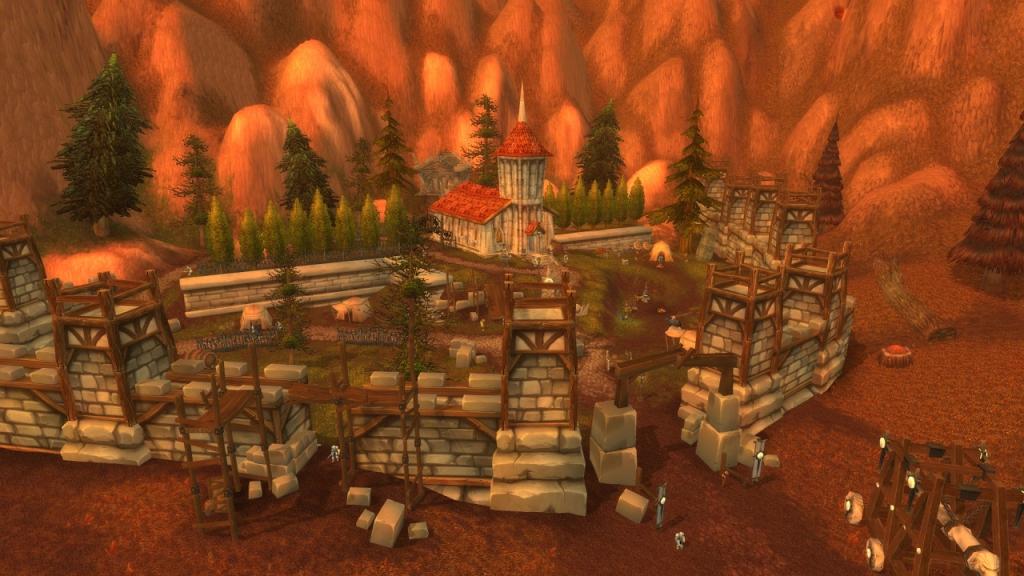
Light's Hope - a holy haven in a diseased land, Eastern Plaguelands, World of Warcraft

Resources
Nordrassil - magical resource - The World Tree of Mount Hyjal, World of Warcraft
Keep on the Borderlands, OD&D - a town supporting adventurers flocking to newly discovered dungeons or crypts
The growth point of a settlement will tend to set the form of that settlement: Aspect and Resource based settlements will often have dispersed buildings; Bridge and Nodal point settlements are frequently linear (clustered along one of the strips), and other settlement types tend toward the nuclear (closely gathered around the central point).
As successful small settlements expand, their original purpose may be lost - they'll begin to attract people for the protection that comes from large numbers and the opportunities of towns and cities. These larger settlements become nuclear around the original centre.
EDIT - some additional examples:
From the various forums where I trawled for comments, a wealth of additional suggestions have popped up.
What makes a good location?
A good location is one where the settlement can thrive. At its base level, the location provides something that other locations do not. That may be some physical resource, like water, or it might be a geographic resource, like a meeting of transport routes, or a social resource, like a holy site.Here's a page where the topic is summarised nicely for high school level studies.
What can I add to that? Not a lot really - except some fantasy specific examples and possibilities.
Bridge point
The Twins - A Song of Ice and Fire
Osgiliath - The Lord of the Rings
 |
| Osgiliath by AbePapakhian (Deviantart) |
Thandol Span / Dun Modr - Wetlands / Arathi Highlands, World of Warcraft

Nodal point
The Crossroads - Northern Barrens, World of Warcraft
Dry point
Swamp Castle - Monty Python and the Holy Grail
Thousand Needles (post-Cataclysm) - mesas as islands in a now flooded valley, World of Warcraft
Atlantis (post sinking) - often depicted as an air bubble under the sea
Wet point
Ramkahen - Uldum, World of Warcraft
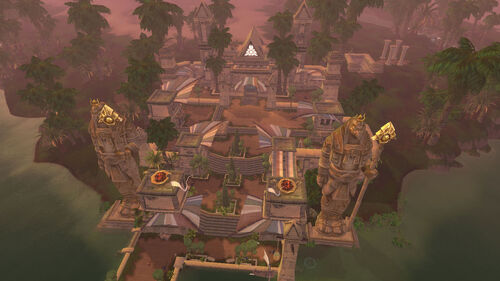 |
| Ramkahen - Surrounded by desert |
Defensive
Stormwind - fortified prominence, World of Warcraft
Minas Tirith - The Lord of the Rings
 |
| Minas Tirith guarding the narrow point between the mountains - Encyclopdeia of Arda |
Aspect
Winterfell - hotsprings protect against the worst of winter, A Song of Ice and Fire
Shelter
Blackrock Mountain - a safe solid haven in a land of fire, Burning Steppes, World of Warcraft
Light's Hope - a holy haven in a diseased land, Eastern Plaguelands, World of Warcraft
Resources
Nordrassil - magical resource - The World Tree of Mount Hyjal, World of Warcraft
Keep on the Borderlands, OD&D - a town supporting adventurers flocking to newly discovered dungeons or crypts
The growth point of a settlement will tend to set the form of that settlement: Aspect and Resource based settlements will often have dispersed buildings; Bridge and Nodal point settlements are frequently linear (clustered along one of the strips), and other settlement types tend toward the nuclear (closely gathered around the central point).
As successful small settlements expand, their original purpose may be lost - they'll begin to attract people for the protection that comes from large numbers and the opportunities of towns and cities. These larger settlements become nuclear around the original centre.
EDIT - some additional examples:
From the various forums where I trawled for comments, a wealth of additional suggestions have popped up.
- To launch an offense - campaign headquarters may become permanent given a long enough conflict
- Military base - town supporting a military base, perhaps a training ground rather than a strategic point. This becomes significant with standing armies, rather than the predominant medieval muster of knights and militia.
- Religious - loads of examples. Probably fits the resource categor, under tourism. Pilgrims making devotional journeys to religiously significant sites were common in medieval times.
- Accidental / catastrophe survivors - refugee camps become permanent over time
- Victory / battle site - in the Excalibur movie, Camelot is founded on the site of a great victory
- Slave city for massive monument - the pyramids' construction was supported by a massive city of workers
- temples around the site of fissures that give off psychoactive fumes
- mage schools around areas where the boundaries between the planes grow thin
- mountaintop laboratories to catch the lighting
- village of vassals to a nearby dragon
- small settlements of people trying their luck at removing the sword from the stone
- summer/wintering grounds in the path of prey migratory paths
- boom towns/ghost towns - some enormously valuable resource has been discovered, and people are flocking to exploit it (boom), and the aftermath of the drying up of that resource (ghost town)
- outcast/leper colonies
- campsites for academic expeditions
2014-04-16
We run
A suppodedly inspirational facebook post about how a "fatty" runner is inspirational has been rebuffed by the runner in question.
It makes good reading - both of the posts. Here they are with some commentary.
When I see another runner, all I think is "Go on!" - maybe a little "Can I catch them up?"
Both these posts talk about the journey - like self improvement is the only possible motivation to run.
Me, I run because it's fun - but when I think back, I remember it didn't start as fun. It started as self-improvement, to work on my asthma, and shift some weight.
It's taken me three years to get to be a mediocre runner - the London Marathon elite come in with times faster than my half-marathon times - but I was even worse when I started. I was half walking, half running for the whole 2.5 miles of the flat track near where I work.
You have to start to get better, and then you have to stick at it.
No-one looks their best when they run: your clothes are sweaty, your face is red, bits of you wobble, you're probably pulling a strained face.
Some people find being in public view hard enough without all that.
The thing is, no-one is really going to be paying much attention to a runner who jogs or lumbers or glides past. Even if you're in some way especially remarkable, you'll only be noticed for a second.
Runners are just part of the landscape. No-one expects you to stick around - you are moving past by default.
And anyway, the more you run, the more natural you'll look - less sweat, less red in the face, less wobbly.
It makes good reading - both of the posts. Here they are with some commentary.
When I see another runner, all I think is "Go on!" - maybe a little "Can I catch them up?"
Both these posts talk about the journey - like self improvement is the only possible motivation to run.
Me, I run because it's fun - but when I think back, I remember it didn't start as fun. It started as self-improvement, to work on my asthma, and shift some weight.
It's taken me three years to get to be a mediocre runner - the London Marathon elite come in with times faster than my half-marathon times - but I was even worse when I started. I was half walking, half running for the whole 2.5 miles of the flat track near where I work.
You have to start to get better, and then you have to stick at it.
UPDATE: The Self-consciousness Barrier
Talking about this post with some friendly people, I was reminded of the need to overcome self-consciousness.No-one looks their best when they run: your clothes are sweaty, your face is red, bits of you wobble, you're probably pulling a strained face.
Some people find being in public view hard enough without all that.
The thing is, no-one is really going to be paying much attention to a runner who jogs or lumbers or glides past. Even if you're in some way especially remarkable, you'll only be noticed for a second.
Runners are just part of the landscape. No-one expects you to stick around - you are moving past by default.
And anyway, the more you run, the more natural you'll look - less sweat, less red in the face, less wobbly.
2014-04-05
d02: Unlimited Power
Here's a fast and slightly silly role-playing game system I cobbled together this afternoon, for use in beer and pizza gaming sessions - or maybe even more serious, but less simulationist gaming than my usual d20 stuff.
It's based loosely on d02: Know No Limit, and its derived game REAL Ultimate Power d02.
I may expand on it sometime...
These are just three amazing examples of the amazing episodes of d02: Unlimited Power that you can play. There are no limits - only your imagination! Anything can happen.
An episode of d02: Unlimited Power is played out by a group of one or more players, and a Games Master (GM).
During each episode, your character (we'll just call the character "you", most of the time) will take on bad guys and their mook hench-folk to win.
Your character's focus can be anything - from debating to wrestling, from kung-fu to wizardry. This will be the focus of your winning.
When you create a character, you have 20 points to spread around these skills.
A skill of zero means you can't use the skill at all. Zero brains means you can't have ideas. Zero chasing means you can't move. Zero Hotness means nobody fancies you in the slightest. Zero Winning means you lose every contest. Zero luck means bad things will always happen to you.
Winning focus
You must state what sort of winning your character is best at - for example: shooting, fighting, gadgets, magic. This is your Winning focus.
Winning tools
A Winning tool is some sort of thing that you use to be better at winning. It must be something to do with your Winning focus - so if you have a Winning focus of Magic, it might be "Spells", or if you have a Winning focus of "kung-fu" it might be "Kung-fu weapons".
For every point of Awesomeness you have, when you use your Winning tools to win at your Winning focus, you add that number of successes to your Winning roll.
When your Awesomeness is more than 1, your benefit for using Winning tools increases. This may be because you're better at using it, or because you get to use more Winning tools at once - you decide.
You add your Awesomeness to all rolls. No matter how many penalties you get, you will always have at least as many dice as your Awesomeness.
Other equipment you have is determined by your skills. When you want something, tell the GM you have it. The GM will either agree, or ask you to make a skill check to have brought it along.
You should also keep track of things you pick up during an episode.
Roll as many dice as you have skill points, plus your Awesomeness, plus any bonus or penalty your GM gave you. This fistful of dice is called a "dice pool". Sometimes you add dice to it, sometimes you take dice away.
For every die that comes up high (that is, more than half the biggest number on that die), you score one success.
Sometimes you only need one success - like when you want to break a door down.
Sometimes you'll need more than one - like when you want to defuse a bomb, and there are booby traps on it: you'll need one success per booby trap, and one for the bomb fuse itself.
Luck
The Luck skill is a bit different.
You use Luck in two ways: to avoid bad things (explosions, poisons, stay conscious, resist spells, and so on); and to add to other rolls.
When your GM asks you to "Test your Luck", you roll your current Luck skill. Each success you get reduces the bad thing that you're trying to avoid.
When you use Luck to add to other rolls, you reduce your Luck skill by one, and get one extra die for that skill roll only.
Roll your winning skill, just like described in Using skill above. Remember, describing cool moves will get you bonuses, being dull will get you penalties.
Winning against mooks
When your in a contest with mooks (that is, anyone who doesn't have proper skills), you defeat as many mooks as you have successes. You can decide whether they are killed, unconscious, running away, or whatever you like.
If you get less successes than the number of mooks fighting you, that means that while you were taking out their mates, one of them got a hit in! Your Winning skill is damaged by one - you lose one die from that dice pool.
Winning against Bad guys
When in a contest with a Bad guy (that is, anyone who has proper skills, like you), you make your Winning rolls against each other - whoever got the most successes wins that round.
you check who has the highest Winning skill. If yours is equal or higher, then each success you get counts as damage to the Bad guy's Winning skill. If theirs is higher, then you only damage their Winning skill by 1 point, no matter how many successes you got.
Running out of Win
When you have no more points left in Winning, you must Test your Luck.
If you succeed, you can carry on fighting, using your Awesomeness, or you can use this chance to escape.
If you fail, then you have lost the contest! You are knocked out, captured, or paralysed - or whatever else is right for the scene.
Using your Winning focus
If the contest is the kind of thing you've written down as your Winning focus, then you use the whole dice pool. If it's anything else, you use one less die.
Example: Brad Sex's Winning focus is Wrestling. A Bad guy is shooting at him. Brad has to use his Winning skill at -1 if he tries to shoot back, so Brad decides it'd be better to climb up on the ropes and double-drop kick the Bad guy instead - he gets all his Winning skill dice (and probably a bonus for being cool).
Winning together
You can help your allies out by acting together. One of you gets to be the main contestant, and the others make Winning skill checks. The main contestant gets to add one die for each success that the other get.
So after a big fight, it might be a good idea to have a scene or two of planning and training, or something, to get everyone back up to strength.
You can also use the Brains skill to do first aid, and revive a knocked out ally.
Every success you get that is more than the Bad guy you're chasing means you are gaining on him. Each success above yours that the bad guy gets means that he is getting away.
To improve a skill by one point, it costs the same IP as the current skill. To improve it by more than one, add up all the steps.
Example: Brad Sex has 4 points in Hotness. If he wants to improve his Hotness, he has to spend 4 IP - this will get him to 5 Hotness. If he wants to improve it to 6 Hotness, it'll cost him 4 + 5: 9 IP.
Bad guy Skills & Awesomeness
Bad guys have skills and awesomeness just like the players' characters.
The skills given here are typical - as GM, you can change them.
Set the Bad guy's Awesomeness to whatever level seems challenging to the players for the episode you're planning.
Winning tools and bad guys
A Bad guy's winning tool should nearly always be an actual thing, so that the players can take it away - or try.
Zombie wizard
Bra 7; Cha 1; Hot 0; Win (magic) 7; Luck 5
Awesomeness ??
Winning tool - Skull staff
Terrorist boss
Bra 4; Cha 4; Hot 4; Win (bombs) 6; Luck 2
Awesomeness ??
Winning tool - Detonator
Mega monster
Bra 2; Cha 6; Hot 0; Win (biting) 10; Luck 2
Awesomeness ?? (at least 5)
Winning tool - Hugeness
Alien queen
Bra 3; Cha 6; Hot 0; Win (fighting) 8; Luck 3
Awesomeness ??
Winning tool - Laser claws
It's based loosely on d02: Know No Limit, and its derived game REAL Ultimate Power d02.
I may expand on it sometime...
d02: Unlimited Power
- Bad guys have captured the Queen! Are you badass enough to defeat them and rescue Her Majesty?
- A zombie wizard has turned your brother into a monster! Are you brainy enough to save him and stop the wizard?
- Evil terrorists have kidnapped your family and are trying to make you kill the President! You get the picture.
These are just three amazing examples of the amazing episodes of d02: Unlimited Power that you can play. There are no limits - only your imagination! Anything can happen.
An episode of d02: Unlimited Power is played out by a group of one or more players, and a Games Master (GM).
During each episode, your character (we'll just call the character "you", most of the time) will take on bad guys and their mook hench-folk to win.
Character creation
What sort of hero do you want to play? Make up your character's focus, select skills, and play!Your character's focus can be anything - from debating to wrestling, from kung-fu to wizardry. This will be the focus of your winning.
Skills
There are 5 skills, which range from 1 to 10.- Brains (Bra)
- Chasing (Cha)
- Hotness (Hot)
- Winning (Win)
- Luck (Luk)
When you create a character, you have 20 points to spread around these skills.
A skill of zero means you can't use the skill at all. Zero brains means you can't have ideas. Zero chasing means you can't move. Zero Hotness means nobody fancies you in the slightest. Zero Winning means you lose every contest. Zero luck means bad things will always happen to you.
Winning focus
You must state what sort of winning your character is best at - for example: shooting, fighting, gadgets, magic. This is your Winning focus.
Winning tools
A Winning tool is some sort of thing that you use to be better at winning. It must be something to do with your Winning focus - so if you have a Winning focus of Magic, it might be "Spells", or if you have a Winning focus of "kung-fu" it might be "Kung-fu weapons".
For every point of Awesomeness you have, when you use your Winning tools to win at your Winning focus, you add that number of successes to your Winning roll.
When your Awesomeness is more than 1, your benefit for using Winning tools increases. This may be because you're better at using it, or because you get to use more Winning tools at once - you decide.
Awesomeness
As well as skills, you have Awesomeness. Your Awesomeness starts at 1, and may be increased as you get better.You add your Awesomeness to all rolls. No matter how many penalties you get, you will always have at least as many dice as your Awesomeness.
Equipment
You start out with your Winning tool (unless the episode is all about getting it for the first time - your origin story!). You may have your Winning tool taken away if you are captured - be careful! But don't worry, getting it back will be awesome.Other equipment you have is determined by your skills. When you want something, tell the GM you have it. The GM will either agree, or ask you to make a skill check to have brought it along.
You should also keep track of things you pick up during an episode.
Using skills
Describe your action. The GM will give you a bonus for how interesting, cool and amazing your action is - and a penalty for any dull actions. Remember, no matter how many penalties you get, you will always have at least as many dice as your Awesomeness.Roll as many dice as you have skill points, plus your Awesomeness, plus any bonus or penalty your GM gave you. This fistful of dice is called a "dice pool". Sometimes you add dice to it, sometimes you take dice away.
For every die that comes up high (that is, more than half the biggest number on that die), you score one success.
Sometimes you only need one success - like when you want to break a door down.
Sometimes you'll need more than one - like when you want to defuse a bomb, and there are booby traps on it: you'll need one success per booby trap, and one for the bomb fuse itself.
Luck
The Luck skill is a bit different.
You use Luck in two ways: to avoid bad things (explosions, poisons, stay conscious, resist spells, and so on); and to add to other rolls.
When your GM asks you to "Test your Luck", you roll your current Luck skill. Each success you get reduces the bad thing that you're trying to avoid.
When you use Luck to add to other rolls, you reduce your Luck skill by one, and get one extra die for that skill roll only.
Winning
Each time you get into a fight, argument, dance-off or rap-battle, or any other kind of contest, you need to win. No matter what kind of battle your trying to win, we call it a contest.Roll your winning skill, just like described in Using skill above. Remember, describing cool moves will get you bonuses, being dull will get you penalties.
Winning against mooks
When your in a contest with mooks (that is, anyone who doesn't have proper skills), you defeat as many mooks as you have successes. You can decide whether they are killed, unconscious, running away, or whatever you like.
If you get less successes than the number of mooks fighting you, that means that while you were taking out their mates, one of them got a hit in! Your Winning skill is damaged by one - you lose one die from that dice pool.
Winning against Bad guys
When in a contest with a Bad guy (that is, anyone who has proper skills, like you), you make your Winning rolls against each other - whoever got the most successes wins that round.
you check who has the highest Winning skill. If yours is equal or higher, then each success you get counts as damage to the Bad guy's Winning skill. If theirs is higher, then you only damage their Winning skill by 1 point, no matter how many successes you got.
Running out of Win
When you have no more points left in Winning, you must Test your Luck.
If you succeed, you can carry on fighting, using your Awesomeness, or you can use this chance to escape.
If you fail, then you have lost the contest! You are knocked out, captured, or paralysed - or whatever else is right for the scene.
Using your Winning focus
If the contest is the kind of thing you've written down as your Winning focus, then you use the whole dice pool. If it's anything else, you use one less die.
Example: Brad Sex's Winning focus is Wrestling. A Bad guy is shooting at him. Brad has to use his Winning skill at -1 if he tries to shoot back, so Brad decides it'd be better to climb up on the ropes and double-drop kick the Bad guy instead - he gets all his Winning skill dice (and probably a bonus for being cool).
Winning together
You can help your allies out by acting together. One of you gets to be the main contestant, and the others make Winning skill checks. The main contestant gets to add one die for each success that the other get.
Recovering
All skills recover one point per your level of Awesomeness, each scene.So after a big fight, it might be a good idea to have a scene or two of planning and training, or something, to get everyone back up to strength.
You can also use the Brains skill to do first aid, and revive a knocked out ally.
Chasing
When a Chase happens, the GM decides how many successes you need to catch up. The GM may give you bonuses or penalties depending on what kind of transport you want to use: a push bike is not as fast a rocket plane.Every success you get that is more than the Bad guy you're chasing means you are gaining on him. Each success above yours that the bad guy gets means that he is getting away.
Getting better
Improving skills
Your skills increase as you defeat bad guys and mooks. Defeating bad guys give you Improvement Points (IP), which you use to get better - but it gets harder to improve skills as you get better.To improve a skill by one point, it costs the same IP as the current skill. To improve it by more than one, add up all the steps.
Example: Brad Sex has 4 points in Hotness. If he wants to improve his Hotness, he has to spend 4 IP - this will get him to 5 Hotness. If he wants to improve it to 6 Hotness, it'll cost him 4 + 5: 9 IP.
Improving Awesomeness
Like Skills, it gets harder to improve Awesomeness as you get more awesome. To improve Awesomeness by one point, it cost 10 times your current Awesomeness level.Bad guy gallery
Bad guy Skills & Awesomeness
Bad guys have skills and awesomeness just like the players' characters.
The skills given here are typical - as GM, you can change them.
Set the Bad guy's Awesomeness to whatever level seems challenging to the players for the episode you're planning.
Winning tools and bad guys
A Bad guy's winning tool should nearly always be an actual thing, so that the players can take it away - or try.
Zombie wizard
Bra 7; Cha 1; Hot 0; Win (magic) 7; Luck 5
Awesomeness ??
Winning tool - Skull staff
Terrorist boss
Bra 4; Cha 4; Hot 4; Win (bombs) 6; Luck 2
Awesomeness ??
Winning tool - Detonator
Mega monster
Bra 2; Cha 6; Hot 0; Win (biting) 10; Luck 2
Awesomeness ?? (at least 5)
Winning tool - Hugeness
Alien queen
Bra 3; Cha 6; Hot 0; Win (fighting) 8; Luck 3
Awesomeness ??
Winning tool - Laser claws
2014-03-24
Ankle weights
There aren't many big hills round here in the Midlands - at least, there are few long steep hills, like I'll have to cope with in Wales in May - so I do repetitions of the tallest steep hill round here, and makes sure I include a few steep gradients in my runs in general.
But I've been looking at those Welsh hills, and realising that no matter how many reps I do, I just don't have access to the gradients that Wales has.
So I've been running with ankle weights on. The ones I've been using at just under half a kilo each and have been getting lighter as they leak the iron sand that gives them their weight - they're old, see.
Now I've decided that the combination of those weights being light, and shedding their load gradually, means that I should use some new, heavier ones - and today was my first run with the new 2 kilo weights.
Bloody hell, that was hard going!
For the first time in ages, I came home exhausted - both out of breath and with tired legs. It was just a 7 km run, over the local big hill and back. Usually, that gets me a little out of breath, but it hardly fatigues me.
But when I started out, that hill used to be the most daunting thing on my routine. It's taken a lot of running to make it a relatively casual event.
By adding an extra kilo to each leg, and dragging that up and down and up and down that hill, I'm forcing myself to recondition my legs.
In time, it'll be easy.
But I've been looking at those Welsh hills, and realising that no matter how many reps I do, I just don't have access to the gradients that Wales has.
So I've been running with ankle weights on. The ones I've been using at just under half a kilo each and have been getting lighter as they leak the iron sand that gives them their weight - they're old, see.
Now I've decided that the combination of those weights being light, and shedding their load gradually, means that I should use some new, heavier ones - and today was my first run with the new 2 kilo weights.
Bloody hell, that was hard going!
For the first time in ages, I came home exhausted - both out of breath and with tired legs. It was just a 7 km run, over the local big hill and back. Usually, that gets me a little out of breath, but it hardly fatigues me.
But when I started out, that hill used to be the most daunting thing on my routine. It's taken a lot of running to make it a relatively casual event.
By adding an extra kilo to each leg, and dragging that up and down and up and down that hill, I'm forcing myself to recondition my legs.
In time, it'll be easy.
2014-03-21
In praise of one-off sessions
Throwing together a one-off game for an evening is something that the group I used play with used to do a lot.
Or rather, Tim used to do it a lot. I used to do it a bit. Other players used to do it sometimes. Tim was our hero GM, really. Hail Tim!
But I digress - making up a one-off game, that would last just one night, is what I want to blog about here.
I've got an ulterior motive here - I've become Tim. I'd like to get to play now and then, but I seem to be the only person in my gaming group who runs games.
Just like with Tim, I suspect that's because I volunteer to do so, and other GMs don't feel the need to step up.
You only have one evening, so the game needs to be quite simple, too. Don't try to have a complex plot, cause it'll be harder to show it in just a few hours of play. Keep the number of encounters to a minimum. Have just one villain, and a few minions. Don't have too many puzzles.
Maybe start in media res
Don't get bogged down in details - move on quickly, jump to the end of the journey
Don't use challenging encounters as a warm up
Also, my desire to start with the action has led me to a way of doing things that works quite well if you have a day or so of notice: tell the players up front what the adventure set up is going to be, and ask them why their character is going to be there.
For example: The adventure will be taking place in the castle of Baron Vileness, who is hated by the locals for his harsh taxes and bad behaviour. He often abducts pretty young folk and abuses them. He is said to have vast reserves of treasure and magical artefacts.
Why does your character want to break into the castle, and what are they planning to do there?
This lets the players think up their own characters' motives, which may only overlap with the other characters' motives in that they're both trying to get into Castle Vileness and get something from it.
Armed with the players input, I then tweak the adventure to give them what they want.
You get to steer the players into your adventure, but they control their characters' motivations.
Why is this good for one-session games? Because we start the session at Castle Vileness, with everyone already knowing why they want to be there and what they have to do.
A short story is far easier to write than a novel - and a novel is easier to write than a whole game multiverse.
The setting that I use for my games is actually the result of a couple of decades idle thought, and collaberation from the other GMs.
What I actually have written down is tiny compared to the time it's taken. I'm actually very lazy - it just looks like I've done loads of work.
I've been watching Star Trek's original series - and it's really clear that each episode is adding to a galaxy that was rather sketchy to start off with. Ideas change and mutate over the course of the first season - but it doesn't matter! Each episode is self-contained.
So if you feel the urge to make up a whole complex multiverse, then don't try to do that before you start playing - the short games will build that game world as you go along.
Or rather, Tim used to do it a lot. I used to do it a bit. Other players used to do it sometimes. Tim was our hero GM, really. Hail Tim!
But I digress - making up a one-off game, that would last just one night, is what I want to blog about here.
I've got an ulterior motive here - I've become Tim. I'd like to get to play now and then, but I seem to be the only person in my gaming group who runs games.
Just like with Tim, I suspect that's because I volunteer to do so, and other GMs don't feel the need to step up.
Low investment
If your one-off game goes a bit wrong, who cares? You only spent an evening on it, and you still got to muck about with your mates.You only have one evening, so the game needs to be quite simple, too. Don't try to have a complex plot, cause it'll be harder to show it in just a few hours of play. Keep the number of encounters to a minimum. Have just one villain, and a few minions. Don't have too many puzzles.
Cut to the chase
Get the game into the action as soon as you can. I've already blogged on where I got it wrong with one of my own one-off sessions. Here's what I learnedAlso, my desire to start with the action has led me to a way of doing things that works quite well if you have a day or so of notice: tell the players up front what the adventure set up is going to be, and ask them why their character is going to be there.
For example: The adventure will be taking place in the castle of Baron Vileness, who is hated by the locals for his harsh taxes and bad behaviour. He often abducts pretty young folk and abuses them. He is said to have vast reserves of treasure and magical artefacts.
Why does your character want to break into the castle, and what are they planning to do there?
This lets the players think up their own characters' motives, which may only overlap with the other characters' motives in that they're both trying to get into Castle Vileness and get something from it.
Armed with the players input, I then tweak the adventure to give them what they want.
You get to steer the players into your adventure, but they control their characters' motivations.
Why is this good for one-session games? Because we start the session at Castle Vileness, with everyone already knowing why they want to be there and what they have to do.
Building on short games
One-off adventures are the best start. When you've never GMed before, or if you don't GM very often (hint, hint), it's far less daunting to run a game for a few hours, than it is to think about how a game will last weeks of multiple sessions and need an interlocking story and game-world and so on.A short story is far easier to write than a novel - and a novel is easier to write than a whole game multiverse.
The setting that I use for my games is actually the result of a couple of decades idle thought, and collaberation from the other GMs.
What I actually have written down is tiny compared to the time it's taken. I'm actually very lazy - it just looks like I've done loads of work.
I've been watching Star Trek's original series - and it's really clear that each episode is adding to a galaxy that was rather sketchy to start off with. Ideas change and mutate over the course of the first season - but it doesn't matter! Each episode is self-contained.
So if you feel the urge to make up a whole complex multiverse, then don't try to do that before you start playing - the short games will build that game world as you go along.
Subscribe to:
Posts (Atom)