2018-10-07

Learn from your mistakes - Houserule for d20

I learned a lot by messing up in the past - I used to smoke, obsess over crushes, goof off work... and it taught me plenty.

Why should we just learn from our good experiences? We can learn from mistakes!

So here's my (incomplete) list of RPG situations that should grant XP to anyone who survives. Treat it as a suggestion list: sometimes it won't be right to give out a reward, even though the failure is on the list - and other times, something that's not on the list will totally deserve some compensatory XP.

Some of these listed failures are conditional on the situation being deadly. This means that you should actually be fighting for your life, rather than sparring with your allies.
Some of these are for first times only - the first time a bad thing happens to you, you get to learn something from it, but when it happens over and over again, not so much. There's two reasons for that: it's simpler, and it'll stop players from doing it deliberately.

That's a very important point - if you find yourself with players demanding XP for deliberately stupid actions, then you'll need to revise your decision on using this houserule.

How much XP should be gained from these failures and mishaps? I propose that it should be 10% of the XP you gain in a session. Not much - but it all adds up...

  • Any time a party member dies (unless you killed them - then you just get the usual XP for defeating them)
  • First time you get hit in deadly combat
  • First time you fall victim to a Combat Manoeuvre in deadly combat 
  • First time you get knocked out in deadly combat
  • First time you fail a saving throw of each type in a deadly situation
  • First time you get poisoned
  • First time you trigger a trap
  • First time you get charmed or dominated by a monster
  • First time your method of attack proves to be useless (due to immunity, damage reduction, etc)
  • First time you encounter a creature of each type (i.e. aberration, construct, dragon, etc - but NOT animals)
  • First time you take damage from falling
  • First time you fail a skill check that you would have made if you took 10

2017-10-02

Keeping It Simple - Training & skills

In my earlier post about setting target numbers in RPGs, I said that the method I'd come up with might break down when skills are assumed to include some specialist training:


Fixed difficulties can make it hard to model tasks that require advanced training.
For example, if someone wants to open a lock, the GM might think "This is just an ordinary door in a house - the lock is nothing special. I'll make it an average task, 'cause the lock is just an average object." However, this would mean that an untrained person with a decent Dexterity could open the lock with a few tries - not very realistic. 
D&D and many other d20 games deal with this by saying that some skills cannot be used untrained - if you've not invested your skill points in the skill, you just can't do it.
Me, I don't like that so much, as it adds another level of look-up: which skills are prohibited to untrained characters? It's not always intuitive.
... and I promised I'd provide my solution. Well, it's a been a little while (ahem), but here it is.

Do we think this task requires special knowledge?

Usually, this is a yes / no question, and the answer is clear. 

For example, climbing is an innate skill of  human (and other humanoids, depending on your game setting) - yes, skill makes us better at it, but anyone with sufficient mobility can climb. 
Similarly jumping, running, and other raw motor skills. 
Also fighting - we can all fight to some extent, even if that just means flailing the limbs wildly and hoping. 

On the other hand, can you try electronic engineering without knowledge? Not so much.

When there is doubt about whether a skill needs knowledge and training, make a decision for the particular skill check, and move on. After the game, think the decision over - was it right? Don't get stuck on little things during the game itself.

Not knowing the topic imposes a penalty

Once we've decided that special knowledge is required for a given skill check, then we think about whether you know that stuff.


That's easy - make a Knowledge check to know the topic. And because we've already set target numbers for skill checks, we only have to decide if the Knowledge is Easy, Average, Hard, Heroic, or Epic.

For complex systems and tasks (like retro-fitting a turbo to an engine, or deciphering a dead language), we can require multiple Knowledge checks, or higher success. 
For example,  "What are all these symbols?" is an Average task, "Knowing these symbols, what happens when they're arranged like this?" is an Average task, or a Hard task if it's your first roll (so you skip a stage of the process); and it's a Heroic task to establish that "I recognise this arrangement of symbols on sight."

Outside knowledge can be influential, too - in a modern game ,there's loads of information available almost all the time. Does the PC have a manual or some sort of instructions for the task, for example? Then we can allow this to take the place of a Knowledge check success, but probably at a slower pace.

But what does success mean? We're buying off penalties here. If you know little about mechanics, it'll be hard to fix an engine, but it's not impossible - a heroically intelligent PC might be able to figure it out with hard work and perseverance. So we're not changing the DC of the task - the task is the task, it will always have the same DC. What's changing is the PC's understanding of the task.

Setting the penalty

How hampered by a lack of Knowledge will you be in this task? Again, because we've already set a bunch of standard adjustment levels using natural language, this should be easy to decide. Is it a Minor, Major, or Extreme problem? You can decide this from your own experience, or use the Difficulty level to give you a clue to what's appropriate - lack of Easy or Average Knowledge will generally be a Minor penalty, Hard would be Major, and Heroic or Epic would be Extreme.

So if the Knowledge check is failed, it may not be the end of your task attempt - you might only be faced with a Minor penalty. Or it could be Extreme. 

For extended complicated systems, you might be able to work out things as you go along examining the problem. That'll let you make new Knowledge checks after starting. So you can start trying to buy down that penalty to something more manageable - all of which will take in-game time.

That's it

Decide: does this skill check require special knowledge?
Set the Knowledge DC, or DCs for complex tasks.
Set the penalty for lack of knowledge.
Decide: do we allow new Knowledge checks as the task progresses.

2017-10-01

Fantastic Toponymy: Inventing Place Names

When we invent a place for a game, we need to name it. We can just mash together some syllables until they sound cool, or we can try to make a name that seems to have history, that sound natural and hints at the culture of the place by using real elements from real cultures. Or if we're really adventurous, we can invent sounds that have invented meaning, and use those to build our place names - like Tolkien famously did.

"Toponymy" is the naming of places, from the Greek "topos" place and "onoma", name. The places all around the Old World have names that have developed over centuries or millennia- names usually derived from a simple description of the place.

The New World, by contrast, is named far more recently, with names that are usually simple, current language terms that are easily understood, or native names perhaps spelled poorly by the settlers. Both follow similar conventions once you look into the language.

Reflecting culture

Where is this place you're naming? What are the people there like? Are this a place of familiar, homely folk, or do you want to invoke a feeling of "otherness" about your invented place?

The names of the British Isles are familiar sounding to we English speakers (even those outside the UK). They can seem homely, even rustic and Olde Worlde (especially to those outside the UK!).

Similarly, the names of other nations' places, made up as they are by different language elements, can seem foreign, but familiar - "Porto Nova" reflects that it's inhabitants speak some Mediterranean, Romance language, so we have a handle on the sort of culture we might find there, just from the name.

A place called "Klak'amtuu" or "Shissiissii" tells us that this is a culture we are not familiar with.

Be careful not to just borrow real world names directly for your fantasy locations, though. Those have cultural baggage that you probably don't want in your game.
Of course, if you deliberately want to bring in the implications of a real-world name to your game, that's up to you - just be sure you're aware of them!
Calling your pseudo-Britain "Albion" (as in the popular CRPG Fable) is fine if you include all the people of Great Britain - the Cornish, English, Scottish and Welsh), but not so good if you just treat them all as English. We have whole political parties here in the UK dedicated to independence for those nations.

Settlements and other places 

Since you're reading this in English, I'll start by looking at English place names.

Nottingham is a worn-down version of "Snotta-ingas-ham", meaning the settlement ("-ham") of the people ("-ingas") of Snotta (a Danish chieftan). That "-ingham" ending is all over England.
Canterbury is from "Cantware-burgh", meaning the Kentish ("Cantware-") Stronghold ("-burgh"). Again, that "-bury" ending, and the related "-burg", "-borough", and "-burgh" ending are all over the British Isles.

So armed with this knowledge, your invented place could be called Notesbury ("Snotta's Stronghold"), or Cantingham ("Settlement of the people of Kent") - some other combination from the name elements appropriate to the culture.

There are plenty of resources for such elements of British place names on the web, so I won't just reproduce a list here.

Similarly, you can find that sort of list for other cultures: Here's a list for Japanese place names, and a short list for Maghreb toponyms.

From these examples, you can see that place names tend to be derived from a few common parts:
  • geographical feature (river, hill, valley, forest, etc)
  • type of settlement (farm, fort, village, town, etc)
  • direction or position (north, south, upper, middle, etc)
  • person of note (founder or clan leader, saint, etc)
  • description (dark, cold, red, windy, etc)
It can be helpful to make up a plain English name with such elements, and then translate it into whatever language is appropriate - for example: Hill Fort Town might be "Lawtonbury" in pseudo-Britian, or "Okajo Machi" in pseudo-Japan.

Country and regional names 

Nations and regions are often named for who lives (or lived) there (usually this is the name given to the place by its inhabitants), or a descriptor of the region (usually this is a name given by outsiders to the region).

Thus we get Scotland, the land of the Scots; France, named for the Franks; and Afghanistan the place of ("-istan") the Afghans, and so on.
While on the other hand we get Cameroon, the land of shrimp (Portuguese "Camaroes", via French "Cameroun"), from the abundance of shrimp found by European explorers in the Wouri River; and Wales, named by the Saxons for the foreigners ("Welisc") who lived there.

This can be useful - dual names for a place can help show historical enmity between the natives and the outsiders who imposed the other name.

Here's a list of country names and etymologies - and a list of regional names for places within countries that aren't on the former list.

You can see from those lists that national names - in the Old World - tend to be derived from a few common elements:
  • people's or tribal name (Franks, Angles, Danes, Sicels, etc)
  • description of people (foreigners, bearded ones, etc)
  • geographical description (green, forest, mountainous, etc)
  • place indicator (place, land, home, etc)
So again using your language of choice to reflect the culture you want to imply, you can name your region in a similar manner to settlements and places, but using these elements.

Geographical feature names

The great geographic features of the land were often named long long ago, in languages far removed from everyday. The new folk invading or colonising a place would just use the local name, not knowing or soon forgetting what it meant.
The River Avon in England means the "River River" - "avon" is derived from an ancient British word for river.

Alternately, the name may be clear and descriptive in the current common language - the Misty Mountains in Tolkien's Middle Earth, for example.

Features like mountains, rivers, lakes, marshes, and headlands will usually include some element that means just that - "mountain", "river", "lake", etc. Together with that element, there will usually be another part that simply describes the feature - "misty", "dark", "wide", or similar - or perhaps the name of a person or tribe.

Once again, we end up with the same sort of naming method, choosing from a this set of word elements.

Alien and bizarre places

To suggest a strange an exotic place, you can use language elements the players will not be familiar with, or invented languages like Klingon, or Quenya - or even your own invented gibberish sounds.

So in Middle Earth, we have Imladris, meaning "Cloven Valley" for Rivendell, and and Hithaeglir meaning literally "Towers of Mist" for Misty Mountains.

One could with relative ease invent a range of place name word element and use them consistently for a new culture. This could work particularly well in contrast with a region of familiar sounding names - for example, Crick Hollow, Buckland, Chetwood, and Weathertop giving way to Khazad-dum, Lothlorien, Gondor and Cirith Gorgul as we progress further away from the homely Shire with Frodo and Company.

Similarly, this technique works even with names that while relatively familiar, don't have that homely feeling created by names like your local region's names - so English name elements giving way to Germanic and Scandinavian names, or Latin names will create an atmosphere that evokes those lands, and all the assumptions that go with them.

Conclusion

Because place names can be evocative, and can be laden with culture, we should be careful not to just use them at random. Names and style choices in game settings will create an atmosphere. With only a little research and work, you can bring life into a place just by speaking its name.

2017-04-12

A Coventry Way Challenge

A Coventry Way is a full circumnavigation of the city of Coventry in Warwickshire. It was started in the 70s, and thrashed out over decades of path finding (they literally thrashed it out in some places) by some local runners who were training for mountain marathons by running in the country- side around the city. Here's a link to the association's homepage history:

The Challenge then is to do the whole route in one go. Some walk, some run, some form relay teams. All start when they feel like it on the day - so there's a stretched out circle of tired folk round Coventry from before dawn to after dusk.

Getting ready

In my head, whenever I have an event run to do I always set out my excuses first - it's not part of any planned psychology, it just tends to happen. I think I'm a positive pessimist: by planning for the worst, I'm well prepared - but often pleasantly surprised.
Maps - upside down, too
So this event's excuses are: I had a chest infection that developed into a minor bout of pneumonia over the New Year and into February, so my training has been shortened; I've never run this distance before; it's a self-navigated course, so I might get lost along the way; it's going to be the hottest day of the year so far at a maximum of about 20°C in the shade.
With all those problems to overcome, I decided that I would be pleased if I just finished the course!
Standard rations
Naturally, some part of me also optimistically predicted a finishing time based on my closest similar distances - I tend to complete the 33 miles of the Marlborough Downs Challenge in 6.5 hours - so I guessed between 8 and 9 hours would be pretty good going.
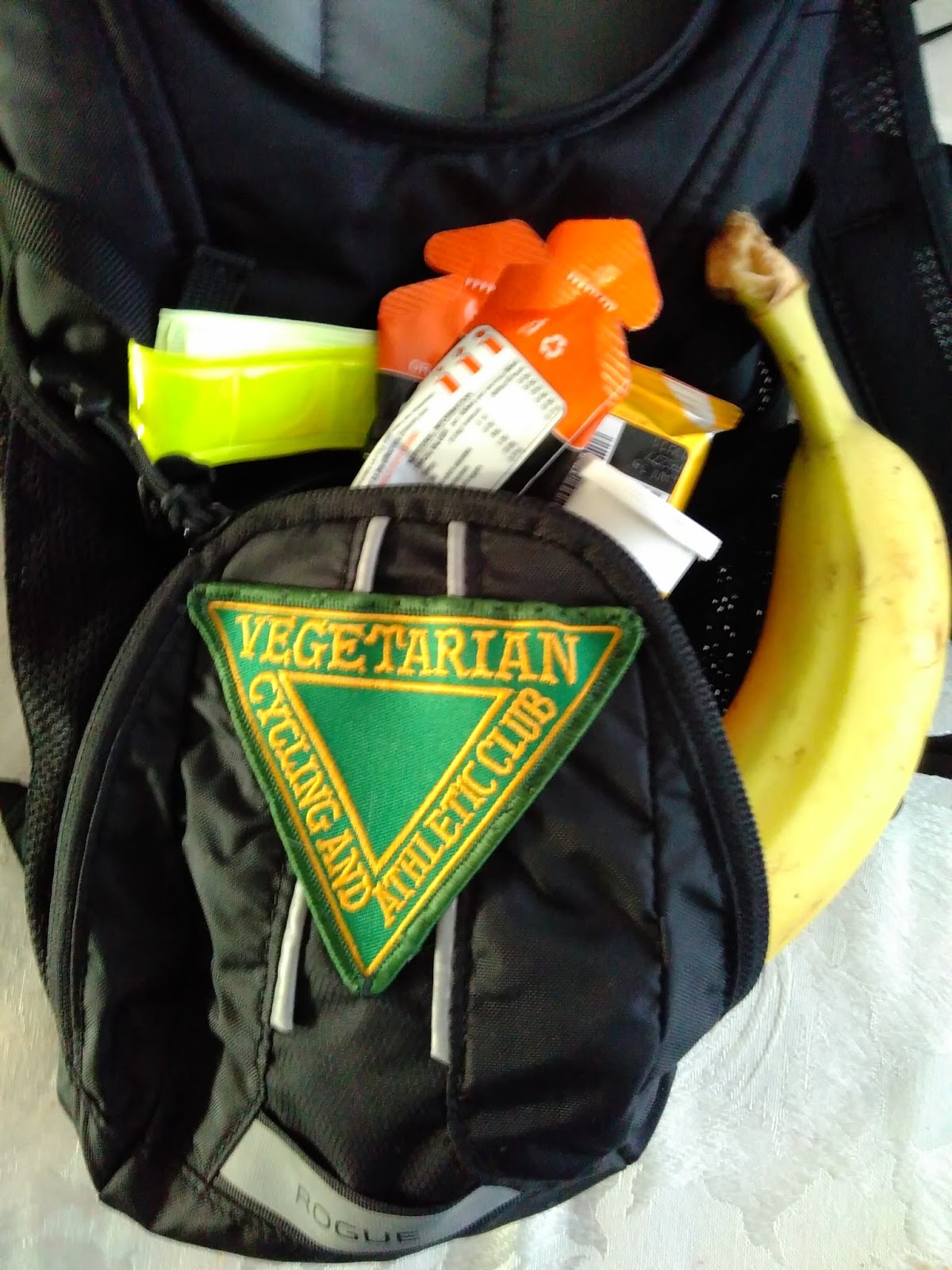
There are checkpoints along the way, with food provided, but I have learned that you can't rely on the world to provide veggie friendly options - I carried my own. It barely fit in my pack! I also took extra isotonic tablets to let me replenish my drink, as I reckoned I'd need to refill my two litres Camelbak once or twice along the way.


Setting out

This year over 200 took part. It was a breezy, very sunny day, and warming up even at 8 am when I arrived. The car park at the Queens Head in Meriden (west of Coventry, just off the A45) was filling up with cars, and people in hiking and / or running gear. I gave in my number, got my start time logged, started my tracking app, and set out.
Straight away, I felt my calves tighten up - I get this sometimes when I'm not properly hydrated. I slowed my pace and drank, and shook it off. The opening section was up hill, in rolling middle-England country side - with an unfortunate stink of cattle (one of the local farms near Meriden is rather intensive in its housing of the cows). Breathing through the nose, I found myself falling in with an ultra-runner called Glyn - he was a Grand Union Canal veteran. We chatted for a long stretch up til check point 1, where I met up with a work colleague Jon and his kids who cheered me on before going off to rugby practice. It's good to get support! This event doesn't draw crowds, so peer support from chatting with fellow runners along the way is key. Lots of gelatin-based snacks, sadly - it's amazing how many running events want to hand out jelly babies and Haribo! - but some Jaffa Cakes were on offer.

Horses - I didn't steal any
Between CP1 and check point 2, we had a diversion because of a golf tournament as we headed out of Kenilworth. Glyn lingered longer than I wanted to at CP2, so I made off on my own.
Through Bubbenhall and on to Ryton-on-Dunsmore, where we ran through some narrow paths among industrial sheds - a bit grim after the open country - and then crossing under the Eastern side of the A45, to head north. I spotted some leisurely horses paddocked by the path - I doubt they'd have made better progress than us runners! As I came up on CP3 I was really grateful for a rest. I'd only done 19 miles by that point!


Halfway and harder going

Motte or Bailey?
From Wolston, I headed off through open fields toward the Fosse Way, over the Avon and along a straight and deeply hoof-pitted bridleway (the mud was like concrete with the dry weather), up to Brinklow. There are the remains of a motte-and-bailey castle at Brinklow - thankfully we didn't have to climb it! Out of Brinklow, at CP4, I refilled my Camelbak - over half way.


The route joins the Oxford Canal path for a few miles, and passes under the M6 (concrete and noisy traffic) and the Nettle Hill Bridge (iron aquaduct, much quieter).

M6 - going under it
Coming off the towpath, headed toward Ansty - and then across what I have come to think of as the Plains of Gorgoroth! Like something out of Mordor - a ploughed field of crumbled earth so dry, it was like staggering across rocks. I swear I could hear Sam Gamgee trying to encourage me onwards.


Once again the course came back to the Oxford Canal, before turning north to Barnacle and into Bedworth.
Urban(e) art
Here, I got lost. Making it to CP5 in a pleasant housing estate, I paused, chatted with other walkers and runners, had a Jaffa cake or two, water, etc. - and then set off in completely the wrong direction. If it hadn't been for a helpful driver at a set of lights about a kilometre away sending me back the way I'd come, I'd have been properly lost!
Back to CP4, and off in the right direction, then. This urban section was the trickiest - the signs were harder to spot, and fellow challengers were harder to see among the usual normal townsfolk. I tagged along for a bit with a challenger who knew his way, going at a brisk walk rather than a jog, and I was grateful not only for the guidance, but for the rest. To be honest, I'd been walking longer sections between jogging by this point - about 30 miles.


M6 again - over it this time
Back over the M6, and down into Corley Moor. I'd been warned this would be a quagmire, but it was hardly even muddy that day! On to Corley Moor village - the Red Lion looking very inviting in the sunshine - but onwards to CP7. I should have refilled my Camelbak again - I ran out of water as I went through Birchley Hays Wood, as I discovered trying to wash down an energy gel to pep me up for the last stretch - but a fellow challenger let me have some of his. Very thankful! The course runs mainly downhill from there, gently enough to ease the legs - and I finally came in sight of the Queens Head again 8 hours and 53 minutes after I'd set off.

Food was being served - mainly carnivorous at a glance, but to be honest, I didn't feel hungry so much as thirsty and tired. I collected my certificate, changed into soft shoes and headed home for a decent thirst quencher.
Reward (unofficial)
Reward (official)


Observations

There were lots and lots of kissing gates along the way, which broke one's stride (I tended to walk up to and away from them, rather than run). The course was generally well signed, as the Coventry Way logos were well-placed at turns and gates and so on. The few places that caused confusion were when we passed through built-up areas (just a couple in the whole 40 miles), where it was easier to miss what signs there were.

This is a challenge I will definitely do again! I hope to make better time in future (less wrong turns!) - but the biggest challenge for me is just finishing!

RESULTS

2016-01-28

Keeping it Simple - Bonuses and Penalties

Specific lists restrict creativity


Lots of games seem to fall into the trap of giving you lists and lists of specific adjustments to apply to die rolls in your game.
I'm calling this a "trap", because if you specify a set of adjustments, then you are strongly suggesting and promoting the idea that only those adjustments are correct.
Yes, you may state that the GM can invent their own adjustments, but unless you put that text alongside every instance of specified adjustment, players will end up treating it like a mandatory list of unassailable law.
 
Games also have a habit of having lots of levels of adjustment, from lots of sources. The d20 OGL games have a myriad of +1s, +2s, -1s, -4s, +5s and so on. There's a lot of maths to juggle, and in the excitement of an action scene, who wants to be fiddling with mental arithmetic?*


OGL d20 games also have rules on which adjustments are allowed to "stack" - that is, what can and can't add together. Usually (but not always), the same type of bonus cannot stack - but there are lots of types of bonus (circumstance bonus, equipment bonus, morale bonus, etc., etc.), and they don't always follow the rule you might expect - so you have to go look them up.
 
D&D Next, or 5th Ed, call it what you like, has a neat way of overcoming this maths issue, with the "Advantage / Disadvantage" rule: when circumstances give you better or worse conditions, roll 2 dice, and take the best (advantage) or worst (disadvantage) result.
Unfortunately, as neat as this rue is, it applies in a list of specified case again, resulting in a perceived lack of freedom to wing it.
 

Broader guidelines promote freedom

Broader guidelines on adjustments allow freedom and creativity. If you give the players and GM a list of a few adjustments that can be made, then they can apply them how they see fit.
If the players are trying to get an advantage, they'll tell the GM how they want to do it, instead of looking up a rule that tells them how they must do it.
Instead of checking through the combat rules to see if there's a bonus for higher ground or charging or whatever, you'll feel free enough to declare that your character's swinging in the rigging and jumping on her enemy like a proper swashbuckling hero!
 

My "fix"

Let's have just three levels of adjustment: Minor, Major and Extreme. This lets us have bonuses or penalties of just three types, positive or negative. Giving them simple descriptive names lets you make value judgements about them, too.
  • Minor = 2, Major = 4, Extreme = 8
Can we stack the adjustments?
Yes - but to avoid run-away adjustments, here's the only bit of complexity I'm going to add: you need 2 of the lower adjustment to add up to make one of the higher adjustment.
That is, 2 Minor = Major, and 2 Major = Extreme.
In this way, adding a Minor adjustment has no effect on a Major adjustment (unless you add 2 Minors, which add together to make a Major).
And to keep our adjustments from getting too high, I'll say that Extreme is as high as they ever go. If you've ever lucky enough to have 2 Extreme bonuses, then the GM should just rule that you succeed, rather than making you roll.
 

Will it work?

For games with a gritty or heroic scale of characters (Conan, Buck Rogers, Star Wars, Pulp Fiction and the like), this sort of thing will work fine. If you need more extreme adjustments (such as in a superhero game, modelling both Superman and Lois Lane), then you'll need to allow them - maybe add an Impossible adjustment level beyond Extreme?
I'll see how we get on with this ruling, and post my findings!
 

* Yes, some people like maths. Not everyone does.


2016-01-09

Keeping It Simple - DCs

Lots of games, especially D&D (all editions - some worst than others), suffer from target numbers or difficulty classes ("DC"s) that are opaque, presented once as a special case, with no explanation as to where the number comes from.

On the other hand, there are plenty of games that give you a set of numbers up front as a basis to let you (the GM or the players) eye-ball the numbers and set your own DCs accordingly - R. Talsorian's Cyberpunk 2020, for one (I think it was the first game I played that used the idea).

How do we set these difficulty-based target numbers?
Decide what difficulty types you want - they should be clear and memorable, and not too many. There should be no doubt which is harder and which is easier.
I'm going with:

  • Easy (little chance of failure), 
  • Average (trained people usually succeed, but may fail), 
  • Hard (trained people need a few attempts to succeed), 
  • Heroic (little chance of success), and ...
  • Epic (even elite trained people usually fail).

Now we need to look at the numbers we should assign to these.
"Easy" should be at least a 50% chance of success even to untrained and untalented characters - so in the d20 system, that's a 10 (you can beat a 10 on an unmodified 1d20 roll 50% of the time).
"Average" should be about a 50% chance for someone with innate talent, or training. In d20 games, a starting character can have a maximum skill bonus of +4, plus their ability score bonus (again, a maximum of +4, but those sort of scores are relatively rare).  So we can set the Average task number at 15, because you need to roll an 11 if you have a bonus of +4, which is what we expect an unexceptional starting character to have.
"Hard" should require talent and skill, and maybe a little more experience. The starting character's maximum ability + skill bonus of +8 can be boosted by Feats like Skill Focus, or by proper tools - so we can set this target number as 20.
However, so far, each of these difficulties can all be beaten by someone with no training, if they're lucky - i.e., they get a high roll. Even an average unskilled person can achieve a hard task sometimes - it'll just take more tries.

"Heroic" and "Epic" tasks are out of the reach of the untalented and untrained.
Let's set "Heroic" at 25 - to beat this, you'll need to roll high, and have a big bonus. That maximum starting character bonus of +8 we looked at a moment ago will need to be boosted with experience or other bonuses to get to the point where Heroic tasks are routine. To have a 50% chance of beating a 25, you'll need a +15 bonus - requiring Feats, experience levels or special tools to reach.
"Epic" needs to be harder, but not out of reach of higher level characters. Let's set it at 30 - that way, Epic tasks won't become routine until you've acquired a +20 bonus.

I've picked increments of 5 for each of the difficulties. Nice and easy to remember, and supported by the game's mechanics: a +5 bonus is normal for a starting character's speciality, and it can be expected to increase by an average of 2 points per level.


  • Easy 10
  • Average 15
  • Hard 20
  • Heroic 25
  • Epic 30


With these numbers set, instead of having to look up the skill, you just have to agree the class of difficulty.

Problems

Of course, it isn't perfect - it needs some tweaks to make it work universally. I'll look at solutions to these in future posts, but first, I'll state what the problems are.

Fixed difficulties can make it hard to model tasks that require advanced training.
For example, if someone wants to open a lock, the GM might think "This is just an ordinary door in a house - the lock is nothing special. I'll make it an average task, 'cause the lock is just an average object." However, this would mean that an untrained person with a decent Dexterity could open the lock with a few tries - not very realistic.
D&D and many other d20 games deal with this by saying that some skills cannot be used untrained - if you've not invested your skill points in the skill, you just can't do it. Me, I don't like that so much, as it adds another level of look-up: which skills are prohibited to untrained characters? It's not always intuitive.

Fixed difficulties don't account for circumstances.
If you're trying to break that lock by torchlight, with a kitchen knife and a bent nail, while the rest of your team are fighting a rear-guard action at your back, it's harder than if your were doing it on your table at home under a bright lamp.
This is simple enough to fix - we can make a system of bonuses and penalties to apply. But again, we need to keep it simple!

2016-01-01

Keep It Simple, Stupid!

I like my games to be simple, so I can concentrate on the play. I don't like having tables and table of things to look up.
I like games that have a neat core mechanic, and stick with it so that everything runs off one easy to learn rule. I don't like special exemptions.
I want to be able to run or play a game with only my notes or the character sheet in front of me, never needing to dig through the rule book.

I've been playing around with my own d20 hack system for a while now. I'd become very familiar with the Open Game Licence d20 systems through playing D&D 3.x, Pathfinder, d20 Modern, and all the rest - so a d20 hack seemed like the way to go. It's been great, very enjoyable ... but I've been weighed down by a lot of legacy issues from the original system.
OGL d20 comes close to having one core mechanic, but then it produces lots of special cases. The character class system, the feats, the skills - there are far too many special abilities, specified DCs, and so on: too much stuff to look up.

So - I've been thinking about how to get rid of look ups. Using d20 as a base to work from (partly because it's where I'm starting from with my own hack, but also because it's OGL and we can all look at it for reference), I'm going to present alternative methods and examine them to see how they stand up.
At the end of this process - or at least after several iterations of the process - I may have a plan of cuts and adjustments to make that'll turn my d20 hack into a system that really stands up by itself. Or I may just have a set of house rules to bolt onto the rules as written. Either way, I'll be happy.


2015-05-03

Marlborough, Physio and Stretching

I've been laid low with sciatica. Some months ago I decided I was going to have to bail out of the Marlborough Downs 33 mile challenge.
Very disappointing, especially as I'd persuaded / challenged my brother to run it this year. We're looking to raise money for the Kenya Community Education Project - a small non-profit school funding project that my brother's been involved with.

I'd seen the doctor about my sciatica, and been told to rest and take ibuprofen. The NHS website has a few stretches to combat sciatica, which I was trying to remember to do regularly. Nothing was getting better - in fact, with work requiring me to drive assorted hire cars with badly adjusted seats on long hauls, and my lab stool being badly set for typing up reports, I was getting worse.

One day I was in such agony that I just made a private appointment for a physiotherpay session, then went home, calling in sick for the rest of the day.
That was my best move of this saga!

Physio at Daventry's  Heartlands Physiotherapy (not a sponsored plug, just a genuinely grateful nod) discovered a bunch of things wrong with me that were causing the sciatica - but which all boil down to one overall issue: I'm not supple, and running was tightening everything up.

When I first satarted running, I used to stretch a bit afterwards. I seem to have stopped bothering at some point. Part of the reason I was doing it was to strengthen my knees - but the knee troubles of my novice days seemed to have disappeared, so I suppose that's why I stopped.

I've never been able to touch my toes with my knees straight - but I'd been gradually getting worse. Toughening up my legs with long distances was also shortening my muscles and ligaments. I was less and less flexible.
When the sciatica hit, I could hardly even touch my knees! (Exaggeration, but not much.) And putting on socks was a real struggle.
I'm not actually this skinny


So I was prescribed a bunch of stretches - hamstring, piriformis, side core, knee - and some strengthening exercises - squats. Twice a day. The pain started to go away. I need less ibuprofen.
I have a couple of pages of diagrams like this

After a couple of appointments to check progress, I got back to running short distances, and have built up the miles gently. I've got back into a routine, but added to it, too - now I'm running shorter distances at the weekend, but more often. Instead of running 30km in one go, I'm doing two lots of 15km - one in the morning, and one in the evening, and then again the next day.

So now, after 3 months, I'm ready for the biggest run of the year.

Click here to sponsor me (or my brother - the choice of charity was his).

I'll never neglect my stretching again!

2015-04-27

Buying Shoes

Shoes are hard to buy for long distance running, because you don't really know what they'll be like until you've run a serious few in them - and then it's too late to take them back.

Here, then, are some problems I've found over the last 4 years:

  • Stripes - dynamic stylish stripes on shoes can cut into the instep. Maybe they're added for arch support? But for me, they are usually a sign of bleeding soles to come.
  • Width fitting - I've got skinny ankles but wide toes, and my spread starts back at the arch. If I don't get medium width or wider shoes, I get compression across the bones of the middle of my foot.
  • Differences in sizing - a 9 is not a 9 from all the shoe makers. At least this one is easy to spot in the shoe shop, or before I go running, but sometimes I've been caught out by shoes that are only slightly too small, and thinking I'll get away with it. Black toenails from repetitive briuising are the result - not good.

Moat of these issues take about 6km (3-4 miles) to manifest. The shoes by then are muddy and the soles are clearly scuffed. It's cost me an average of about £100 each year in hardly used shoes - I wear out shoes every 500 miles or so.

This outburst today was brought to you by the shoe sale at our local sports store, from which two pairs of low priced lemons have recently made their way, via a 6 mile detour round my running routes, into the charity shops.

So for the 33 mile ultramarathon next month, I'll be running in my old, nearly worn out shoes - cause I'm not risking wrong shoes on the race day!

2015-03-19

"Following!" - apprentices and goon squads


Re-watching Game of Thrones the other night, I was struck by how several characters wield power by commanding various others, rather than directly - in particular, one character snaps an order to their guards to seize another name character and cut his throat, just to demonstrate their power.

A goon squad in action

This got me thinking about how to introduce that sort of thing into an RPG - and whether it's a good idea at all.
There's a long history of games, from D&D onwards, adding lots of hirelings and men-at-arms to the player party, but as time has worn on, these features seem to have fallen away. Lately it seems games focus on individual player characters - you get one PC, and maybe an animal companion or hireling.

In my experience as a player and GM, there are issues with player characters having followers - the followers can overshadow the players' characters, they can add to the complexity of scenes (especially combat), they can boost one character's power far beyond the rest of the player-base...

So here's my list of pros and cons:
    PROS:
  • Physically weak but charismatic characters become more viable, even in a violent setting
  • Politically powerful or important characters would tend to be surrounded by guards
  • Apprentices, squires and batmen are trope-tastic
  • More role-playing opportunities
    CONS:
  • Many more characters means more work for the GM
  • More combatants means longer combat
  • Players who don't want henchmen might lose out
With that in mind, I'm going to look at how to harness the pros, while avoiding the cons. Let's see how it might work...

Avoiding GM overload

A follower, yesterday
My first need is to avoid overloading myself!

To that end, henchfolk are an extension of the player's prime character - the player looks after them and directs them, rather then adding to the GM's load.

(I was going to say that "I've not had much experience of this", but actually in the main group I play with, any absent player's character has been run as a sort of collective character by the players and me as Ref.)

Giving the playing of the apprentice or guards to the player of the leader character keeps the GM's load down, but we have to make sure the player doesn't abuse this extra power.
Let's give the GM the right to question any apprentice actions that the player declares - perhaps with some mechanical back up, like a loyalty check.

Avoiding longer combat & extra actions

Goon squads and apprentices defend their master as a default - taking no active action, but granting defensive bonuses.
Directing the henchfolk to do something else requires the master to use an action. The follower(s) do  that action till complete, then return to default. And to avoid shenanigans, these directions can't be contingent - like "Attack those guys there, then those guys over there."

That ought to make sure that we don't have a proliferation of  dice rolls to worry about, and that getting henchfolk to do anything complex or scene-stealing will use up the master character's actions, too.

However,  we've still got the possibility of a squad of guards all needing dice rolls to resolve their actions. That's not what we want!
Some games treat small groups of soldiers as a sort of gestalt larger creature - Star Wars Saga Edition used Squads, for example. By using these sorts of rules we can just roll once for the squad of guards.

Types of followers

I've mentioned "apprentices" and "guards" so far, but we can extend those terms to cover any squire, butler, caddy or similar individual, and any gang, mob, or small force of combatants.

Followers need not be the same character type as the leader they follow -  in the Game of Thrones example that started me out thinking about this, those guards are very definitely differently skilled (tough fighters) to their leader (a scheming court socialite).

So I'd be quite happy for a scholarly wizard character to have a gang of dumb thugs protecting him, or for a barbarian warrior to have a loyal minstrel sidekick. Some combinations can be quite amusing, especially when they stray from what's expected.

Advancing followers

D&D 3rd edition and later editions allow player characters to gather followers - and then advances those followers as a function of the leader character's advancement. As your PC levels up, so do your followers.
So rather than letting any of your fellow PCs who've elected not to have followers catch up with your increased power, that system means that you will always be better than others due to your horde of followers and cohorts.
I reject that - it's exactly what I'm trying to avoid. Under that system, taking followers grants you an immediate advantage over any player who doesn't want to do so, and at very little cost. Once one player takes followers, anyone else who wants to play a loner character is put at a disadvantage - their character concept becomes sub-optimal within the player group. That's no fun.

Improving your followers should require that you spend effort training them, equipping them and so on. In terms of game mechanics, perhaps you should have to give up some of your lead character's experience points to improve followers, and spend your hard-gotten gains on kitting them out with decent weapons.

This method means that your fellow adventurers will advance faster than you if you spend effort keeping your followers trained. You could always neglect their training instead - but it will be part of the game to decide how much investment you want to make in your band of goons.


Conclusions

With a few easy tweaks, we've created some basic rules to gain the pros of using followers, and avoid the cons.

We've given control of the follower to the lead character's player, to avoid overloading the GM.
To keep the use of followers in games balanced, we've limited the additional actions - the leader needs to use some of their turn to command the follower - and we've made the player choose how much investment in the advancement of the followers she wants to make.

In practice, using followers has worked reasonably well with my gaming groups. At least, the cons have all been avoided - to gain all the pros, it may take time for us to get used to having multiple characters to play with.

2015-02-15

Morality & Reality - meta-ethics in your game

What is good? What is evil? Are they real physical forces, purely mortal moral judgements, or what?

What started me thinking about this again - after I've already laid out my opinions and tool box for both gods and morality in games - was a rather heated discussion about a particular real-world religion and its morality or lack of it. I'm naming no names. The discussion got rather entrenched, but it made me think of a few things that I found helpful.

Now there are plenty of discussion threads out there on alignment, and some very serious heavy debate about religion. I'm not going to try to replicate those here - I want to look at how the different points of view can be used when creating your game world.

Like my article on gods, I think that one's attitude toward Good and Evil in the game setting can have profound consequences which may be more wide reaching than you'd expect. As in that article, I'm going to present some stances that  you might consider for your game setting, and look at how these influence the setting.

I'm going to talk about Good and Evil with capitals, in that I want to distinguish these grand concepts from the less important good (meaning beneficial, competent, fitting, etc.) and evil (meaning nasty, ill, etc.).
I'm also going to talk about gods, angels and demons, and mortals as creatures that have different moral scopes within a fantasy game setting - but I'm using these terms generally: I don't mean to refer to D&D 3.5's demons, WoD's angels, or Zoroastrianism's gods, or any other specifics.

Debating ethics


Good & Evil are Actual Forces?

In this stance, Good and Evil are real, measurable forces, like temperature or mass.

As well as conscious beings having morality, Good and Evil can inhabit objects and places. A book may be inherently Good, its presence harmful to Evil creatures - or dreadfully Evil, driving its readers insane. An Evil ring may corrupt the wearer. A Good, sacred place may heal the sick.

If Good and Evil are tangible forces, then are sapient creatures left with a fixed morality? Can Good be driven out of a person? Can an Evil being become Good?

Of course, it's a common complaint about alignment systems that characters' mortality becomes fixed, and this stance seems to reinforce that idea - but it needn't be like that...

A flexible alignment system in action?

Only Actions are Good and Evil?

Only the actions of sapient creatures are Good or Evil in this stance.

Things cannot have morality, only people - and then only as the result of their acts. By doing Good, Bobby the Barbarian is Good. By doing Evil, Winifred the Wizard is Evil.The Book of Nasty Tales, however, is just a book, the Sword of Demonslaying is just a magic sword, and the Chapel of Holy Rest is just a building.

Perhaps the build up of moral actions can be detected in a person - their Evil becomes tangible through their repeated acts, and we can sense it, through divination magic, or as a creepy feeling.

This stance inherently allows the moral standing of a person to change as they choose to act differently. Over time, a Good person can be corrupted by Evil acts, and vice versa. We can have redemption and damnation as story arcs - a rich vein of role-playing to mine!

While this stance is flexible and arguably more realistic, it lacks the supernatural element of Good and Evil that we enjoy from  fantasy literature.

The Middle Way

The above stances can be somewhat restrictive - especially for a fantastic setting, which is of course where we most commonly want to play with Good and Evil ideas.

Perhaps there are beings who are inherently Good and Evil, who are exemplars of those morals - Angels and Demons - but the common folk, the mortals of the setting, are free to choose their moral acts, and in choosing, to determine whether they are Good or Evil.

Perhaps objects can be imbued with Good and Evil by exemplars like Angels and Demons, or particularly pious or profane mortal magic users.

In such a setting, mortals retain free will, and can change their moral codes over time, but the existence of creatures of absolute morality is permitted. We can have our inherently Evil monsters, our literally holy ground, AND our ambiguous and mutable protagonists, struggling to do the right thing.

2015-02-11

Sciatic nerve pinch!

It feels like I've somehow pinched my sciatic nerve - the leg nerve that runs from the back of the pelvis to the calf. It's a sharp pain in the back of my right hip, that gets worst when I raise my right leg, especially if I keep the leg straight.

No, it's not some Vulcan incapacitating technique, it's an injury.
Apparently this is common in runners, though I've only just experienced it after years of happy running.
Weight lifters also get it, so maybe the leg lunges with weights I was trying out to strengthen my knees started it off.
Lower back mobility is another issue - and I've always had difficulty touching my toes with straight legs, ever since I was a kid.

There are a bunch of exercises to strengthen the core muscles, which should prevent it from re-occurring, and there are a load of stretches to ease it off in the mean time.

But the horrifying crux of the matter is - I should stop running till the pain goes, then build back up gently.

Yuk! Horrible idea!

I've got three and a half months till the Marlborough 33 miler - so I've got to rest if I'm going to get better.

In the meantime, I'll be back at the boxing and static bike - and I'm looking to get a rowing machine maybe - to keep the cardio up and help with the core flexing and strength.

2015-01-26

Selling a load of mixed minis

Just so I can store the pics somewhere easy to point to, here's a list and pics of the minis I have for sale.

  • Big GW case of assorted humanoids, hero figs and a few larger monsters. All painted to reasonable standard. 30 quid. SOLD


  • Small GW case of assorted humanoids and heroes - painted reasonably. 20 quid. SOLD


  • Assorted modern and sci-fi minis. Includes 2 helicopters in 1/72 scale & a bunch of matchbox cars. Mixed level of painting. In carry case with packing. 15 quid.
 
  • Assorted dungeon scenery in a carry case. Includes floor tiles, walls, door, columns, crates and barrels etc. 30 quid.
  •  
     

2015-01-08

Self-censorship in RPGs?

There are times when I wonder about my sense of good fun.

Last weekend, I ran a game where the players had fun battling through storm conditions on the high seas, getting excited by running the risk sinking and drowning - when that very night, in the North Sea, dozens of real sailors lost their lives in a shipping disaster.

Regularly, I run games where religious intolerance, inter-faith war, assassination, fanaticism and the like are sources of entertainment - while the so-called Islamic State and al-Qeda are organising and inspiring the murder of journalists and aid workers
.
Is it okay to use these horrible events, vile actions and situations as part of a game?

Yes - of course!

We can examine the world through RPGs. By playing roles, we can understand people better, empathise better. By imagining what brings a person to behave in a certain way, we aren't condoning it.

Would you say that Sean Bean is evil because he played the corrupt agent 006? That Alan Rickman is a bad person because of his portrayal of the Sherrif of Nottingham?
Would you say that Peter Jackson is promoting black magic because he made films about Sauron and the Witch King of Angmar and all those evil beings?

Story telling is one of our ways of coping with the nasty and horrible parts of the world - and roleplaying games especially so.

So let's not self-censor ourselves. You only have to answer to your player group. If it's cool to you, then it's cool.

2014-12-12

Stealing settings for fun (and possibly profit)

Rather than trying to invent some wholly original game setting (and then trying to explain it to the players), often it's easier and more immediately fun to take an existing adventurous setting and modify it to your needs.

Love Star Wars and Spaghetti Westerns? Do both at once! Just watched Jason and the Argonauts and Pirates of the Carribean? Merge them!

How do you do that? Break it down into essential parts of the setting you want to emulate, and think about how to translate those into your planned setting.

So - what are the essential parts of the setting? Let's look at a couple of examples.

---

Cowboys in Space
(or wherever)

- making a Wild West themed setting in any genre

You will need:
  • The Old World
    • The planet (or planets) from which our Colonial settlers' ancestors hailed - representing Europe (and Asia and Africa) in our real world history.
    • The Old World has its problems, which may still influence what happens in the New World, but usually only at arms' reach: a war in the Old World might send more emigrants to the New World
    • Example: Earth-that-Was in Firefly. We assume this was our Earth, and Firefly is set in our future. Earth-that-Was is gone, and has no further influence over the setting.
    • Example: Mundia in the Helios system is the Old World. It is home to the human race, and is thought to be the orignal planet on which humans evolved and developed all civilisation. Its continental superpowers fluctuate between cold and hot war.
  • The New World 
    • The region that has been settled by the colonials.
    • The New World is largely virgin and unspoiled; rich in resources, but hard and wild.
    • Including:
      • The Established Colonies
        • The early colonies which have had a hundred years or more to settle down and expand - the equivalent of the 13 colonies of the US.
        • Example: The Sapiens Cluster. The initial colonisation of the Cluster was acheived through the creation of an artificial wormhole, allowing vast insterstellar distances to be travelled in a single short hop. The Cluster's several adjacent star systems were swiftly colonised by sub-light expeditions, and are now teeming hubs of industry and commerce.
      • The Wild Frontier
        • The regions of expansion, where the established colonies are pushing into the hinterland - the Wild West of the mid-19th Century.
        • Example: Since the colonisation of the Cluster, the invention of the FTL jump drive has allowed for interstellar expansion beyond the Old Colonies. The dozens of new frontier systems see explorers pushing back the edges of the known systems, prospectors following mineral rushes seeking fast riches, terraformers trying to create new farm lands, emigrants looking for a new chance - and the inevitable opportunists who support and prey on those waves of migrants: gamblers, grocers, doxies, doctors, engineers, bandits and marshalls.

Optional content: 
Some of the elements that go to make up the Wild West genre may be contentious and delicate, touching on real-world issues that are distasteful and perhaps out of place in an adventurous game setting - treat these with care.
  • The Recent Civil War
    • The Established Colonies and certain of the New Frontier regions have engaged in a bloody and devastating war over slavery or some similarly divisive ethical issue. The slump experienced by the losing faction causes resentment and division for decades to come. 
  • Various Natives - oppressed, belligerent, friendly, etc
    • Attempts to civilise the natives
    • Annexation of native land and resources
---

Pirates of the Mediterranean
(other seas are available)

- a Greco-Roman themed take on swashbuckling piratical adventures

You will need:
  • Civilised trading nations
    • The sophisticated empire and other regions between which expensive and exclusive goods are traded - so that the pirates can steal them
    • These will be your stand-ins for England, Spain and the "exotic" regions they traded spice with.
    • Example: Greece and Carthage trade around the Mediterranean and beyond, clashing with each other, but more usually coexisting as rivals - up to a point.
  • Naval authority
    •  The civilised nations have their navies who protect their trade ships.
  • Unexplored regions full of native riches
    • Standing in for the Meso-American civilisaitons plundered by the European colonials
    • Example: The African and European hinterlands are largely unknown lands to the Mediterraneans - so we can have hot and cold lands to explore and exploit, and all the alien cultures to go with them. With our mythic theme in mind, we can add legendary monsters and dangerous wizards into the mix.
  • Lots of uncharted islands and coasts
    •  Standing in for the islands of the Carribean, the Mexican Gulf, etc.
    • Example: The Greek Islands themselves, as well as invented myriad islands for adventures among hidden coves, smugglers' stashes, pirate havens and isolated cultures. In this mythic setting, these islands can be plucked straight from the Odyssey, with cyclopes, harpies and all.

2014-11-23

Playing roles - revisited

In my first "Playing Roles" post, I talked about the different forms of role playing that I've noticed people tend to do. Here, I'll talk about overcoming embarrassment - the idea that by acting up a role, you're making a fool of yourself.
 
Recently, I was chatting online with a mate who has trouble getting into character at the game table.
At the end of it all, he suggested it'd make a good topic for a blog - so here's an editted transcript of our chat, and a few comments to expand on it.


Via messenger


Me: As far as RPing goes, you seem to me to be a bit embarrassed about actually playing "in character".

Jack:Yeah. I get too shy doing it.
I always try to make a character based on someone from TV so I have a rough idea.

Me: Nicking other people's characters is fine - we all do it a bit. The point is to put yourself in their shoes.

Jack: I know we are all nerds together but I hated drama and stuff at school.
I can do the whole loud, blunt Jack act quite well, but that's it.

Me: Sure - make characters who are easy for you to play before you try hard stuff. You know - play Jesse from Breaking Bad. He'd be right up your street.

Jack: See, Vin [Jack's rogue character] was always Mike from Breaking Bad in my head. Sutrin [Jack's warrior character] was always going to be the Hound [from Game of Thrones] - but I never really got the ball rolling with him.

Me: Okay  - but you aren't a grim tough guy, yourself. You're more of a gobby youth, innit blood! That's what made me think of Jesse.
Me, I like to play clever, slightly posh chaps who want to do the right thing, but get out of their depth and have to bluff and blag their way through.

Jack: Is that why you are always a mental wizard? ;)
I was thinking gruff type dude would be easy as I can just be blunt.

Me: You may be blunt, but you're not gruff.

Jack: Sure. Right then - that's my plan. I will make a Rogue for [the next] game, and he can be a street urchin type - BITCH! Totally works, yo!


---


Play yourself


The short version is this: play yourself - or a version of yourself. 
It's usually within your comfort zone, you don't have to stop to think about character motivations so much - it reduces the strain and lets you enjoy the game.

Acting like yourself is far less out there than acting like a large ham, booming all your statements and trying to sound like Brian Blessed or Laurence Olivier.

I've seen the same sort of embarrasssment in LARPing - it's far easier to get people to come and play contemporary or near future LARP where they get to wear their own clothes than it is to get them to dress up like Robin Hood.

Once you've got the hang of playing a version of yourself, you might want to try assembling a character out of part of yourself, rather than just slotting your whole personality into the setting. 
Maybe you're a bit of a science nut, who finds social niceties difficult - then you might find it easiest to play a bookish wizard with little time for social skills.

Myself, my day job is working in product safety compliance, applying laws and safety standards rigidly: so aside from clever-but-naive idealists, sometimes I like to play strong enforcers of some code of ethics - cops or paladins or whatever the setting has - who have to learn to moderate their black-and-white morality.

Great actors talk about finding a connection with their character from their own experience, so that they can channel their own real emotions into the performance. 

You'll need to know yourself to play like this - but I've found that playing various versions of myself over the years has given me a better understanding of those parts of my own personality, which in turn makes me better at playing other roles.

If you start by making an alter-ego of yourself who shares much of your own personality, then their behaviour in the face of the game's scenarios starts out as easy - and in time, that behaviour and expeience will change the person that the character is, as their life moves away from your own. 
Then you'll find you're playing a well-rounded character, with just a hint of you buried under the wealth of experience they've gone through.